
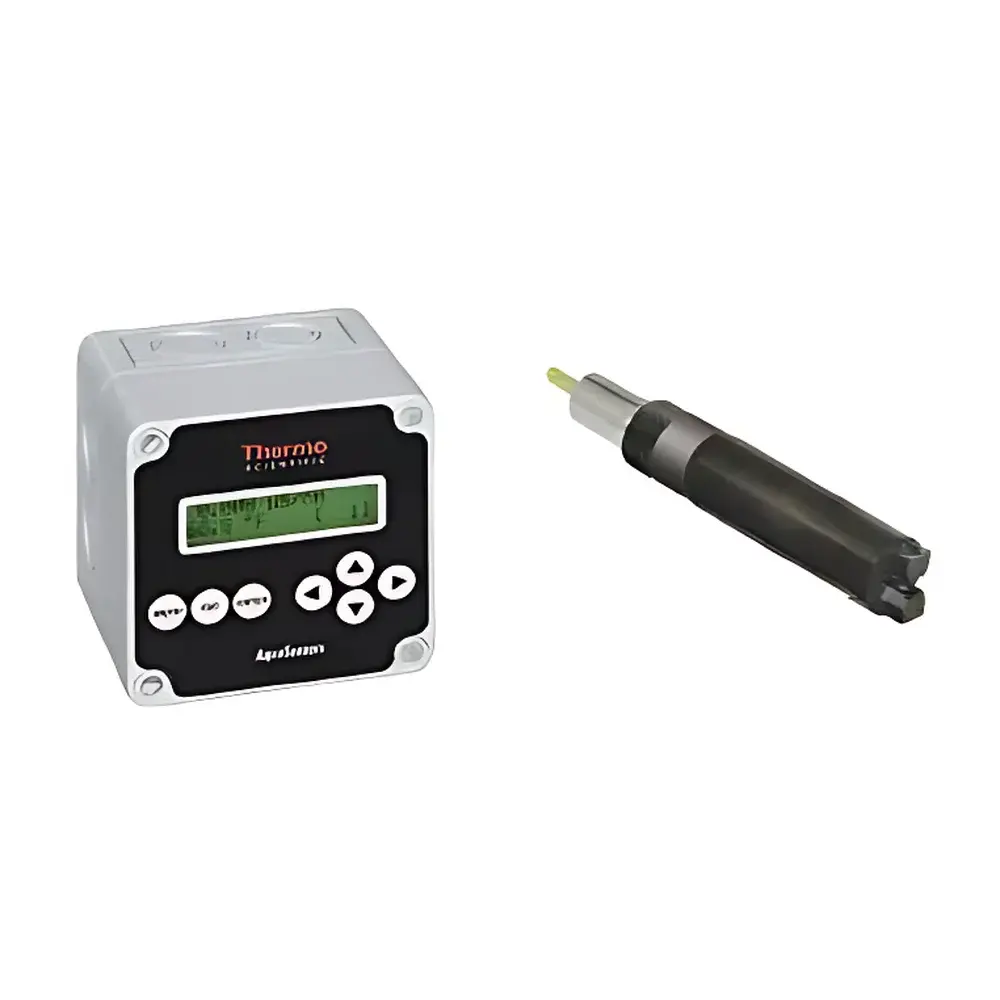
Thermo Scientific AquaTurb High-Range Turbidity Analyzer / AquaSol Suspended Solids (Sludge) Analyzer
| Brand | Thermo Fisher |
|---|---|
| Origin | USA |
| Manufacturer Type | Original Equipment Manufacturer (OEM) |
| Origin Category | Imported |
| Model | AquaTurb / AquaSol |
| Instrument Type | Online Water Quality Analyzer |
| Measured Parameters | Turbidity, Suspended Solids (SS) Concentration |
| Optical Method | ISO 7027-compliant Nephelometric & Backscatter Detection |
| Light Source | Infrared LED (850 nm) |
| Detection Angles | 90° and 180° |
| Output | Digital (RS-485, Modbus RTU), Optional 4–20 mA Analog |
| Temperature Compensation | Integrated Pt1000 sensor |
| Enclosure Rating | IP68 |
| Cleaning Option | Optional Automatic Wiper or Air-Pulse Self-Cleaning Module |
Overview
The Thermo Scientific AquaTurb High-Range Turbidity Analyzer and AquaSol Suspended Solids (Sludge) Analyzer are engineered for continuous, reliable measurement of turbidity and suspended solids concentration in demanding water and wastewater applications. Based on dual-angle optical detection—nephelometric (90°) and backscatter (180°)—the instruments comply fully with ISO 7027 for turbidity measurement, ensuring traceable, standardized performance across global regulatory frameworks. The use of an 850 nm infrared light source eliminates spectral interference from colored dissolved organic matter (CDOM), humic substances, or dye contaminants commonly present in industrial effluents and municipal wastewater streams. Unlike single-angle systems, the simultaneous dual-angle acquisition enables real-time compensation for particle size distribution and morphology effects—critical when monitoring heterogeneous sludge suspensions in activated sludge basins, thickened waste activated sludge (WAS), or high-solids digester feed streams.
Key Features
- Dual-angle optical detection (90° + 180°) per ISO 7027, delivering enhanced accuracy across broad particle size ranges (0.1 µm to >100 µm)
- Infrared LED illumination at 850 nm minimizes color interference and improves long-term signal stability in colored or UV-absorbing matrices
- Integrated Pt1000 temperature sensor provides automatic temperature compensation for both turbidity and SS readings
- Digital sensor architecture supports full remote configuration, diagnostics, and calibration via Modbus RTU over RS-485—no field laptop required
- True plug-and-play design: zero initialization or system-level setup; sensor auto-identifies and synchronizes with transmitter firmware
- Robust, fouling-resistant optical window geometry with optional self-cleaning modules (mechanical wiper or pulsed air-jet)
- IP68-rated housing suitable for submersible or wet-well installations in primary clarifiers, aeration tanks, and final effluent channels
Sample Compatibility & Compliance
The AquaTurb/AquaSol platform is validated for use in raw water intakes, drinking water filtration backwash streams, wastewater treatment plant influent/effluent points, and industrial process streams—including pulp & paper white water, dairy processing lagoons, mining tailings ponds, and chemical reactor overflow lines. It meets ISO 7027 for turbidity and supports correlation-based suspended solids quantification aligned with ASTM D3921 (Standard Practice for Determining Suspended Solids in Water by Gravimetric Methods) and ISO 11923 (Water quality — Determination of suspended solids — Gravimetric method). Data integrity complies with GLP/GMP principles through audit-trail-enabled calibration logs and time-stamped event records. While not inherently 21 CFR Part 11 compliant, the system supports integration into validated SCADA or LIMS environments where electronic signatures and change control are managed at the supervisory layer.
Software & Data Management
Configuration and diagnostics are performed using Thermo Scientific’s AquaLink™ PC software or via web-enabled HMI interfaces compatible with common industrial protocols (Modbus TCP, OPC UA). All calibration events—including zero, span, and multi-point verification—are stored with user ID, timestamp, and deviation metrics. Raw sensor data (scattered/backscattered intensity, temperature, signal-to-noise ratio) is accessible for trend analysis or third-party modeling. Firmware updates are delivered via secure USB or network push, with rollback capability and version-locking for regulated deployments. Historical data export supports CSV and XML formats, enabling direct ingestion into statistical process control (SPC) platforms or digital twin models.
Applications
- Municipal wastewater: Real-time monitoring of return activated sludge (RAS) concentration, mixed liquor suspended solids (MLSS) in aeration basins, and final effluent turbidity prior to discharge
- Drinking water treatment: High-range turbidity control in sedimentation basin effluent and filter backwash recovery streams (up to 4000 NTU)
- Industrial pretreatment: Sludge blanket level estimation in clarifiers serving food & beverage, pharmaceutical, or textile facilities
- Resource recovery: Optimization of centrifuge feed consistency and dewatering polymer dosing based on sludge concentration feedback
- Environmental compliance: Continuous reporting for NPDES permits requiring turbidity limits (e.g., <5 NTU for stormwater outfalls)
FAQ
What is the maximum measurable turbidity range?
The AquaTurb sensor supports up to 4000 NTU in standard configuration, extendable to 10,000 NTU with optional high-dynamic-range optics.
Can the same sensor measure both turbidity and suspended solids?
Yes—the AquaTurb/AquaSol platform outputs both ISO-compliant turbidity (NTU) and correlated suspended solids concentration (mg/L or g/L), derived from factory-established calibration curves validated against gravimetric reference methods.
Is the instrument suitable for seawater or brackish water applications?
Yes—its corrosion-resistant 316L stainless steel body and sapphire optical window ensure long-term stability in saline environments; however, biofouling mitigation (e.g., wiper or chlorination) is recommended for extended submersion.
Does it support automatic calibration?
No—calibration requires traceable standards (e.g., Formazin or AMCO AEPA polymer suspensions); however, the digital interface streamlines manual calibration with guided workflows and pass/fail validation criteria.
How often does the optical surface require cleaning?
With optional self-cleaning, maintenance intervals extend to 3–6 months depending on solids loading; without cleaning, weekly inspection is advised in high-fouling environments such as primary sedimentation tanks.
Related Products







