
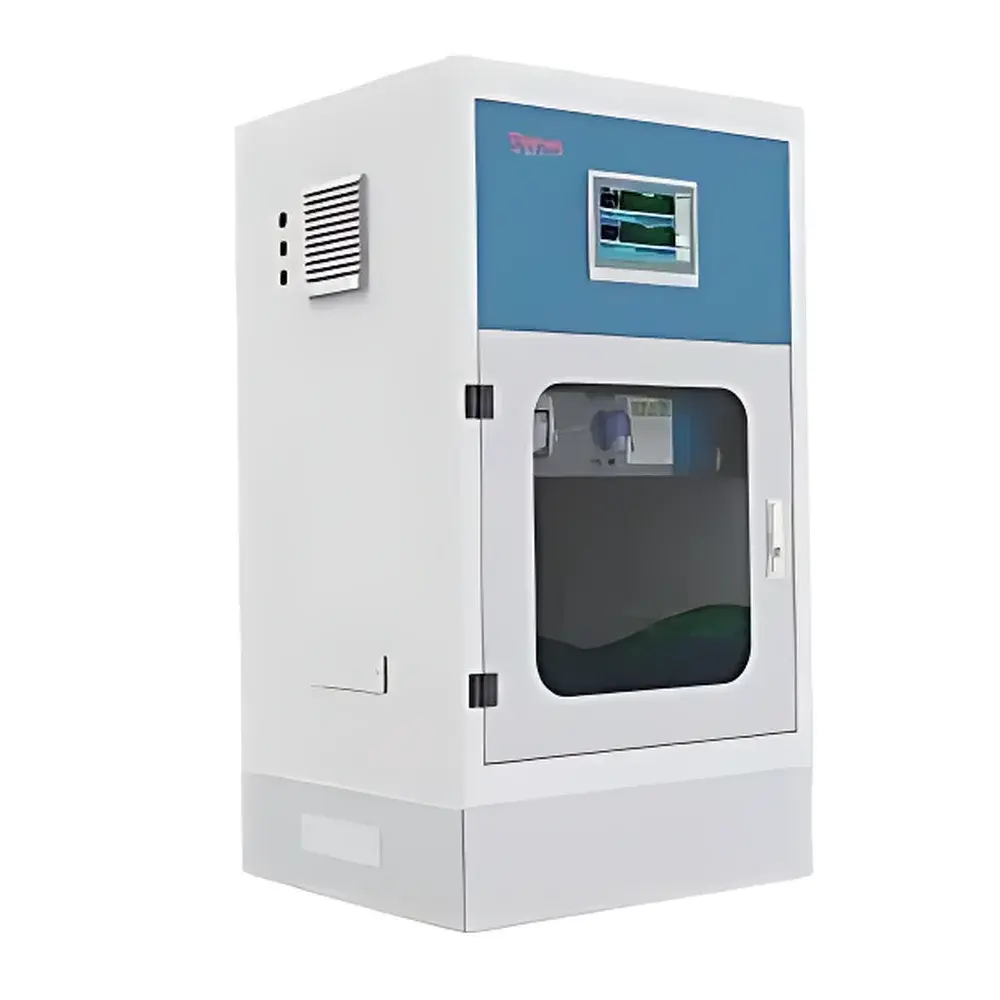
Thermo Scientific 3510VA Bromate Online Analyzer
| Brand | Thermo Fisher |
|---|---|
| Origin | USA |
| Manufacturer Type | Original Equipment Manufacturer (OEM) |
| Product Origin | Imported |
| Model | Thermo Scientific 3510VA |
| Instrument Type | Online Water Quality Analyzer |
| Analyte | Bromate |
| Detection Principle | Chronopotentiometric Anodic Stripping Voltammetry (ASV) |
| Electrode System | Mercury-free, non-plated solid working electrode |
| Sample Throughput | Up to 6 analyses per hour |
| Detection Limit | Sub-µg/L range (typical for bromate in drinking water matrices) |
| Compliance | Designed for EPA Method 300.1 and ISO 10304-3 compatibility |
| Software Interface | Embedded web-based UI with bilingual (English/Chinese) support |
| Power Requirement | 100–240 VAC, 50/60 Hz |
| Enclosure Rating | IP54 |
Overview
The Thermo Scientific 3510VA Bromate Online Analyzer is an automated, laboratory-grade electrochemical instrument engineered for continuous or scheduled monitoring of bromate (BrO₃⁻) in drinking water, treated effluent, and source waters. It employs chronopotentiometric anodic stripping voltammetry (ASV), a highly selective and sensitive electroanalytical technique that quantifies trace-level bromate through controlled electrodeposition and subsequent oxidative dissolution. Unlike conventional colorimetric or ion chromatographic methods, the 3510VA eliminates reliance on mercury-based electrodes or hazardous reagents—leveraging a proprietary solid-state, mercury-free working electrode housed in a patented flow-through electrochemical cell. This architecture ensures long-term stability, minimal drift, and compliance with evolving global regulatory restrictions on mercury use (e.g., Minamata Convention). The system operates fully autonomously: integrated sample conditioning removes matrix interferences (e.g., chloride, nitrate, organic matter), while dual-step electrochemical measurement—comprising potential-controlled deposition followed by current-controlled stripping—enables high-fidelity signal resolution. Background subtraction is performed in real time for each analysis cycle, ensuring robust accuracy even in variable water quality conditions.
Key Features
- Mercury-free, non-plated solid working electrode—eliminates toxicity risks, simplifies disposal, and meets OSHA and REACH requirements
- Patented flow-through electrochemical detection cell optimized for low-volume sample consumption (<2 mL per analysis) and rapid response (analysis cycle ≤10 min)
- Integrated pre-treatment module with programmable dilution, pH adjustment, and interferent masking—enhances selectivity across diverse water matrices (e.g., chlorinated tap water, desalinated seawater, wastewater effluent)
- Self-diagnostic firmware with real-time fault logging, sensor health monitoring, and configurable alarm thresholds (e.g., low flow, electrode passivation, calibration drift)
- Uninterruptible operation: automatic recovery after power loss; resumes scheduled analysis without manual intervention
- Low operational cost: no consumable membranes, zero mercury replenishment, and non-toxic reagents compatible with standard municipal wastewater discharge protocols
- Bilingual embedded interface (English/Chinese) with intuitive touchscreen navigation and role-based access control
Sample Compatibility & Compliance
The 3510VA is validated for direct analysis of raw and treated drinking water per U.S. EPA Method 300.1 (Ion Chromatography – UV Detection) performance benchmarks, though it delivers equivalent sensitivity without chromatographic separation. It accommodates turbidities up to 5 NTU and total dissolved solids (TDS) ≤1,000 mg/L without filtration—enabled by adaptive baseline correction and dynamic range scaling. Regulatory alignment includes support for ISO 10304-3 (determination of anions in water by liquid chromatography), WHO Guideline Limits for bromate (10 µg/L), and EU Drinking Water Directive (2020/2184) compliance reporting. Data integrity conforms to ALCOA+ principles, with audit-trail-enabled event logging and electronic signature capability for GLP/GMP environments.
Software & Data Management
The analyzer runs Thermo Scientific AquaLink™ Embedded Software v4.2, providing secure web-based configuration via HTTPS. All measurement data—including raw chronopotentiograms, calibration curves, QC check results, and maintenance logs—are timestamped, digitally signed, and exportable in CSV or XML formats compliant with LIMS integration standards. Remote diagnostics and firmware updates are supported over Ethernet or optional 4G LTE. Data retention is configurable (default: 90 days on-device, extendable via external NAS or cloud sync). Audit trails meet FDA 21 CFR Part 11 requirements for electronic records and signatures when deployed with network authentication and role-based permissions.
Applications
- Real-time bromate surveillance at ozone disinfection contact chambers in municipal water treatment plants
- Compliance monitoring for bottled water manufacturers subject to FDA 21 CFR §165.110 and NSF/ANSI Standard 53
- Research applications investigating bromate formation kinetics during advanced oxidation processes (AOPs)
- Environmental monitoring of bromate migration in groundwater impacted by industrial discharge or desalination plant brine leakage
- Validation of bromate removal efficiency in granular activated carbon (GAC) or biological filtration systems
FAQ
What detection principle does the 3510VA use, and why is it suitable for bromate?
It uses chronopotentiometric anodic stripping voltammetry (ASV), which offers superior selectivity for bromate in complex aqueous matrices due to its redox-specific electrode reaction and built-in background compensation.
Is mercury required for operation?
No—the system employs a proprietary mercury-free solid electrode, eliminating regulatory, safety, and disposal concerns associated with mercury-based ASV methods.
Can the 3510VA be integrated into existing SCADA or DCS platforms?
Yes—via Modbus TCP or OPC UA protocol support, enabling seamless telemetry of concentration values, status flags, and alarm events.
What maintenance intervals are recommended?
Electrode cleaning every 7–14 days (depending on sample fouling potential); full system calibration every 30 days; pump tubing replacement every 6 months under continuous operation.
Does the instrument comply with drinking water regulatory reporting requirements?
Yes—it generates auditable, timestamped reports aligned with EPA, WHO, and EU regulatory frameworks, including QC pass/fail indicators and method-defined uncertainty estimates.







