
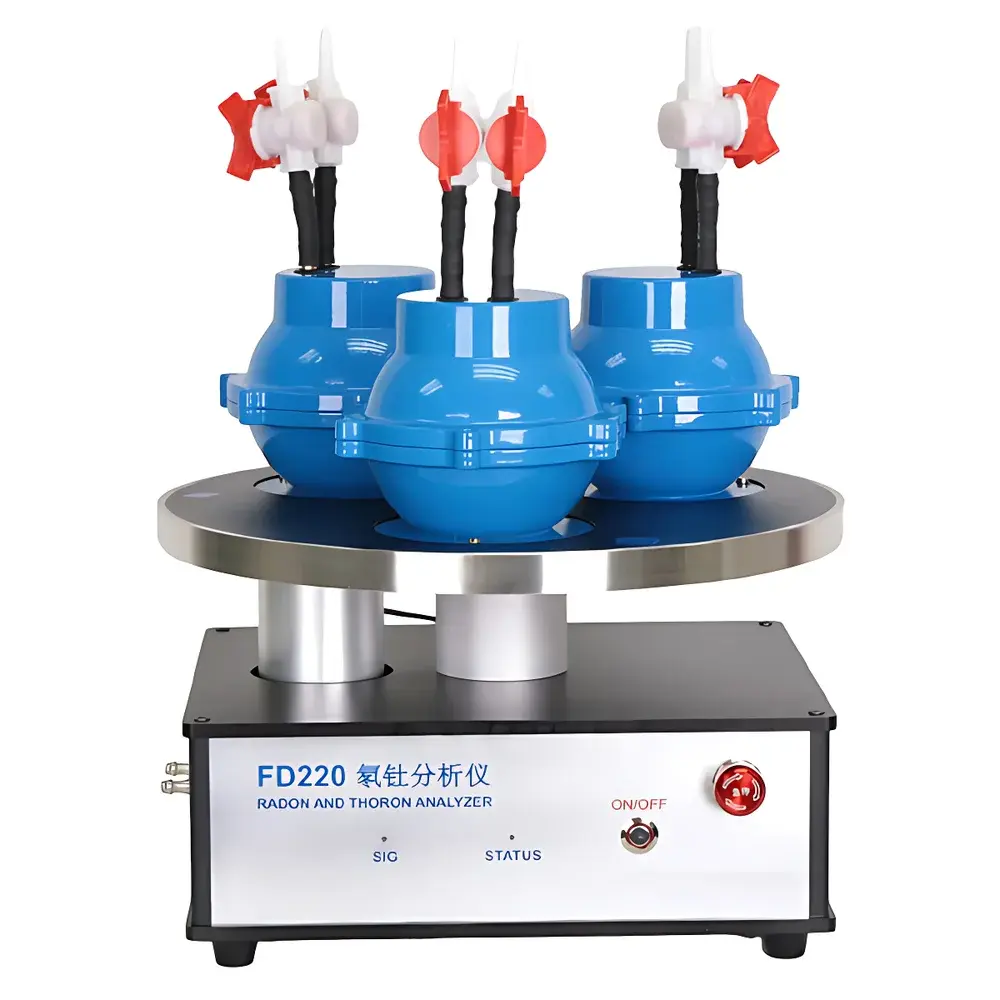
Beifen Sanpu FD220 Radon and Thoron Analyzer
| Brand | Beifen Sanpu |
|---|---|
| Origin | Beijing, China |
| Manufacturer Type | Manufacturer |
| Origin Category | Domestic (China) |
| Model | FD220 |
| Price | USD 9,400 (FOB Beijing) |
| Sensitivity (Radon) | ≥110 cpm/Bq |
| Sensitivity (Thoron) | ≥22 cpm/Bq |
| Background Count Rate | ≤2.5 cpm |
| Counting Capacity | 1–2³² pulses |
| Repeatability (RSD) | ≤2.7% (using ²⁴¹Am source, 8000 particles/2π·min) |
| Accuracy (Radon) | ±5% MPE at ≥37 Bq/g |
| Accuracy (Thoron) | ±8% MPE at ≥40.58 Bq/g |
| Detection Limit (Radon) | 0.01 Bq (5 min) |
| (Thoron) | 0.05 Bq (5 min) |
| Stability (RE) | ≤2.7% over 8 h |
| Operating Modes | Radon — single-point or continuous |
| Power Supply | 12 V DC / optional Li-ion rechargeable battery (≥48 h runtime) |
| Operating Temperature | –10 to +50 °C |
| Relative Humidity | ≤90% at +40 °C |
| Dimensions (W×D×H) | 310 × 250 × 213 mm |
| Weight | 11.0 kg |
| Certification | Verified and calibrated by National Institute of Metrology, P.R. China (NIM) |
Overview
The Beifen Sanpu FD220 Radon and Thoron Analyzer is a dedicated alpha-particle spectrometric instrument engineered for quantitative measurement of 222Rn (radon) and 220Rn (thoron) concentrations in air and soil gas samples. It operates on the principle of alpha scintillation detection using a spherical ZnS(Ag) scintillation chamber—optimized for high light yield and low background interference. The analyzer employs pulse-height discrimination to distinguish radon- and thoron-derived alpha emissions based on their characteristic energy spectra (5.49 MeV for 222Rn decay chain; 6.29 MeV for 220Rn decay chain), enabling simultaneous yet independent quantification without cross-interference. Designed for field-deployable environmental monitoring, the FD220 supports both laboratory-based calibration workflows and unattended long-term site surveillance—meeting technical requirements for national radiation protection programs, geological survey applications, and indoor air quality assessments per GB/T 14582–2022 and ISO 11665 series standards.
Key Features
- Integrated constant-flow sampling system for thoron with real-time mass flow control and pressure-compensated volumetric accuracy (±2% full scale)
- Spherical ZnS(Ag) scintillation chamber with optimized geometry for uniform photon collection efficiency (>85%) and minimal wall effect
- Embedded microcontroller-based acquisition electronics featuring 24-bit ADC resolution and dead-time correction algorithms
- Auto-calibration routine using internal reference sources and configurable background subtraction protocols
- Real-time graphical display of counting rate (cpm), spectral histogram, and time-resolved activity curves
- Low-power architecture supporting dual-mode operation: mains-powered (12 V DC input) or battery-operated (optional 22,000 mAh Li-ion pack)
- IP54-rated enclosure with thermal management for stable performance across ambient temperature gradients (–10 to +50 °C)
Sample Compatibility & Compliance
The FD220 accepts gaseous samples drawn directly from ambient air, soil gas probes (via stainless-steel tubing), or sealed accumulation chambers (e.g., 0.5–2 L passive diffusion vessels). It complies with metrological traceability requirements established by the National Institute of Metrology, P.R. China (NIM), and supports calibration verification against NIM-certified 226Ra and 232Th reference sources. Instrument design aligns with IEC 61540:2020 (radiation protection instrumentation – radon monitors) and incorporates hardware-level safeguards for GLP-compliant data integrity—including non-volatile memory write-locking, timestamped event logging, and tamper-evident firmware signatures. All measurement records include metadata fields for operator ID, sampling location coordinates (optional GPS integration), atmospheric pressure, and relative humidity—facilitating audit-ready reporting under ISO/IEC 17025 and CNAS accreditation frameworks.
Software & Data Management
The FD220 Control Suite is a Windows-native application providing full instrument control, live visualization, and post-acquisition analysis. It implements ASTM D6932–22 compliant reporting templates and exports raw pulse data, corrected activity values, and uncertainty budgets in CSV and Excel (.xlsx) formats. Each exported dataset includes embedded digital signatures verifying measurement sequence integrity and software version traceability. Audit trail functionality logs all user actions—including parameter changes, calibration events, and data export operations—with timestamps and operator credentials. Optional network-enabled mode supports remote monitoring via TCP/IP interface and integration into centralized environmental data platforms using Modbus RTU or MQTT protocols.
Applications
- Indoor radon risk assessment in residential, educational, and healthcare facilities per WHO Handbook on Indoor Radon (2009) and national building codes
- Soil gas radon/thoron mapping for uranium exploration, fault-line characterization, and geothermal prospecting
- Validation of radon mitigation system efficacy before and after installation (e.g., sub-slab depressurization)
- Long-term trend analysis in underground workplaces (mines, tunnels, basements) under ICRP Publication 126 exposure guidelines
- Research-grade studies on radon progeny equilibrium ratios, aerosol attachment kinetics, and ventilation rate modeling
- Field calibration support for passive detectors (CR-39, LR-115) and continuous monitor intercomparison campaigns
FAQ
What is the minimum detectable activity for radon and thoron using the FD220?
The instrument achieves a detection limit of 0.01 Bq for radon and 0.05 Bq for thoron under standard 5-minute counting conditions, assuming optimal chamber fill and background stability.
Can the FD220 differentiate between radon and thoron in mixed gas samples?
Yes—through pulse-shape and energy discrimination enabled by the ZnS(Ag) scintillator’s response profile and embedded digital signal processing firmware.
Is the device suitable for unattended outdoor deployment?
It is rated IP54 and supports battery operation for up to 48 hours; however, extended outdoor use requires environmental shielding (e.g., solar radiation shield, desiccant-equipped inlet filter) to maintain humidity and temperature stability.
Does the software comply with FDA 21 CFR Part 11 requirements?
While not certified for pharmaceutical GxP environments, the FD220 Control Suite provides electronic signature capability, audit trail export, and role-based access control—enabling customization to meet Part 11 implementation criteria when deployed within validated IT infrastructure.
How often does the instrument require recalibration?
Annual recalibration against NIM-traceable standards is recommended; field verification using check sources should be performed prior to each measurement campaign per ISO/IEC 17025 Clause 7.7.







