
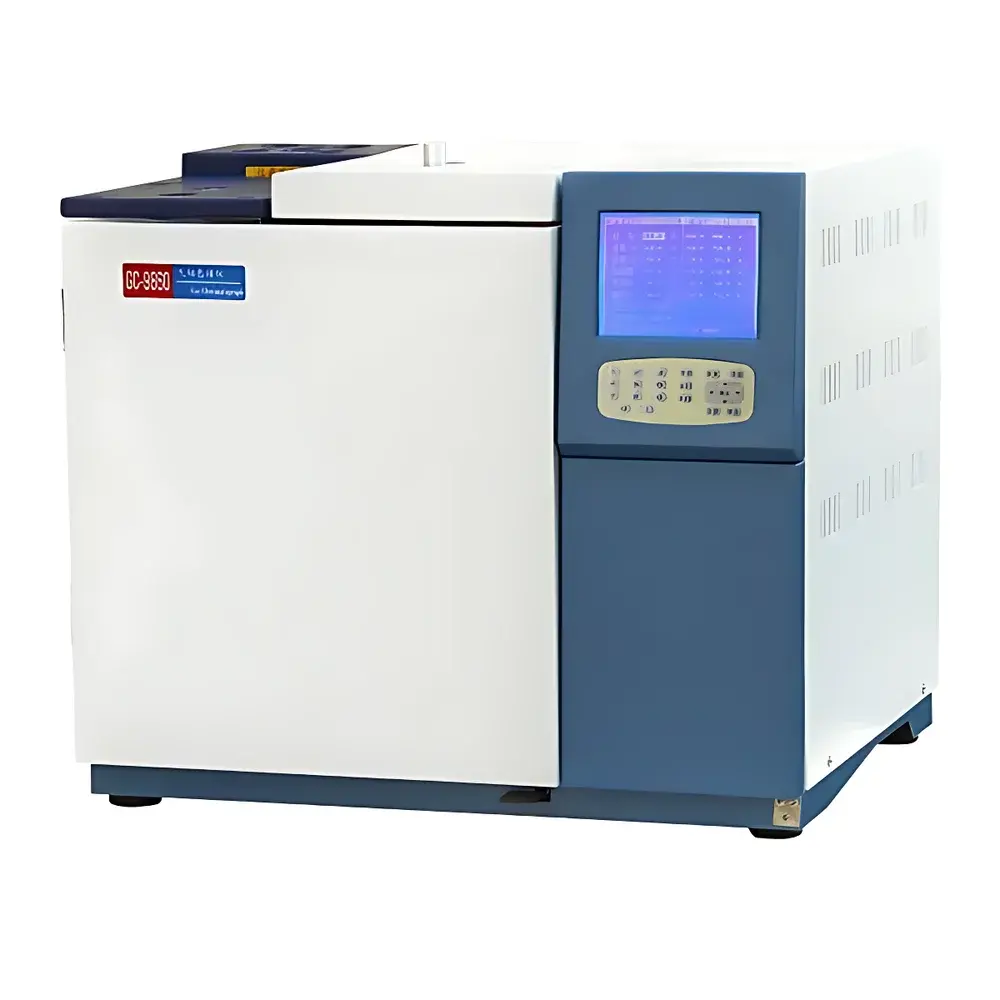
Beifen Sanpu G11C-9860 Laboratory Gas Chromatograph for Baijiu Flavor Profiling
| Brand | Beifen Sanpu |
|---|---|
| Origin | Beijing, China |
| Manufacturer Type | OEM Manufacturer |
| Instrument Type | Laboratory Gas Chromatograph |
| Model | G11C-9860 |
| Temperature Control Range | 100–350 °C |
| Heating Rate | 0.1–40 °C/min |
| Cooling Time | ~6 min (from 350 °C to 100 °C) |
| Carrier Gas Flow Range | 0–1200 mL/min |
| Carrier Gas Pressure Range | 0–970 kPa |
| Injector Maximum Temperature | 100–350 °C |
| Injector Pressure Setting Range | 0–970 kPa |
| Injector Total Flow Setting Range | 0–1000 mL/min |
Overview
The Beifen Sanpu G11C-9860 is a purpose-engineered laboratory gas chromatograph designed specifically for quantitative and qualitative profiling of volatile organic compounds (VOCs) in baijiu — China’s traditional distilled spirit. Baijiu’s sensory identity arises from a complex matrix of alcohols, esters, aldehydes, fatty acids, and trace congeners at sub-ppm concentrations. This instrument leverages flame ionization detection (FID) coupled with high-resolution separation on either packed or wide-bore capillary columns to deliver reproducible, trace-level quantification in compliance with industry-standard analytical workflows. Its architecture adheres to fundamental gas chromatographic principles: sample volatilization in a precisely controlled injector, selective partitioning across a thermally stable stationary phase within the column oven, and sensitive, linear detection via hydrocarbon-specific ionization in the FID. The system supports both isothermal and multi-step programmed temperature ramping — enabling method flexibility for legacy DNP-packed column protocols (e.g., 10+ component alcohol/ester analysis in ≤40 min) as well as modern wide-bore capillary methods resolving >20 components including C₂–C₆ fatty acids in under 15 min.
Key Features
- Eight-stage linear programmable temperature control with ±0.1 °C accuracy across 100–350 °C operating range, supporting both rapid screening and high-resolution profiling
- Dual independent oven door design with intelligent post-column cooling, achieving thermal recovery from 350 °C to 100 °C in approximately 6 minutes
- FID detector with detection limit ≤2 × 10⁻¹² g/s (n-hexadecane), linear dynamic range ≥10⁷, and auto-ignition capability via microprocessor-controlled hydrogen/air flow sequencing
- Integrated electronic pressure and flow control (EPC) for carrier gas (0–1200 mL/min), make-up gas, and detector gases — ensuring retention time stability and method transferability
- Modular detector configuration: accommodates up to four detectors simultaneously (e.g., dual FID, FID/TCD, or FID/ECD), with independent column routing and gas supply management
- Industrial-grade 5.7-inch LCD interface with bilingual (English/Chinese) display, 20 customizable data screens, and flash-based non-volatile memory for 20 method/data sets
- Comprehensive hardware diagnostics with real-time fault localization and Chinese-language error prompts for rapid troubleshooting
- Robust column compartment accommodating 6-inch standard mounts; compatible with 3–5 mm OD packed columns and 0.53 mm ID wide-bore capillaries
Sample Compatibility & Compliance
The G11C-9860 is validated for direct liquid injection, split/splitless mode, and optional integration with headspace samplers or thermal desorbers — essential for minimizing matrix interference in high-alcohol, high-viscosity baijiu samples. It meets baseline requirements for GLP-compliant laboratories through hardware-level safeguards: automatic carrier gas shutoff upon pressure loss, platinum RTD-based overtemperature protection, and open-circuit/short-circuit monitoring for all temperature sensors. While not pre-certified to FDA 21 CFR Part 11, its N2000 chromatography workstation supports audit-trail-enabled data acquisition when configured with timestamped user authentication and electronic signature modules — aligning with ISO/IEC 17025 and CNAS accreditation frameworks common among Chinese provincial CDCs and distillery QC labs. Column selection follows established baijiu standards: DNP-packed columns (for routine ethanol/ethyl acetate/methanol quantification), and proprietary wide-bore fused-silica capillaries (e.g., FFAP or equivalent polar phases) optimized for simultaneous resolution of ethyl hexanoate, ethyl octanoate, and γ-butyrolactone.
Software & Data Management
The system operates with N2000 Chromatography Workstation — a Windows-based platform compliant with IEEE 1278.1 data format conventions. It provides peak integration using tangent skim and valley-to-valley algorithms, internal standard calibration (e.g., n-butyl acetate for ester quantification), and customizable report templates meeting GB/T 10345–2007 (National Standard for Baijiu Analysis) reporting requirements. Raw data (.dat) and processed results (.xls) are stored with embedded metadata (operator ID, injection time, method version, column lot number). Optional upgrades include networked deployment with centralized method library management and LIMS interfacing via ASTM E1384-compliant XML export. All firmware updates are delivered via secure USB key with SHA-256 hash verification to ensure integrity.
Applications
- Quantitative determination of 12+ key flavor congeners in baijiu: acetaldehyde, methanol, ethyl acetate, n-propanol, sec-butanol, acetal, isobutanol, n-butanol, ethyl butyrate, isoamyl alcohol, ethyl valerate, ethyl lactate, ethyl caproate
- Extended profiling of C₂–C₆ short-chain fatty acids and their ethyl esters using wide-bore capillary columns under gradient temperature programs
- Batch consistency monitoring across production lines via retention time locking (RTL) and relative response factor (RRF) normalization
- Raw material screening (fermentation mash, sorghum, wheat) for off-flavor precursors such as diacetyl or furfural
- Stability testing of aged baijiu during storage, tracking ester hydrolysis and aldehyde oxidation kinetics
- Regulatory compliance testing for plasticizer residues (e.g., DEHP, DBP) per GB 5009.271–2016 using optional ECD configuration
FAQ
What column types are supported for baijiu analysis?
The G11C-9860 accepts both stainless-steel/glass packed columns (3–5 mm OD) and wide-bore fused-silica capillaries (up to 0.53 mm ID). Standard configurations include DNP-packed columns for legacy methods and polar FFAP-type capillaries for enhanced acid/ester resolution.
Does the instrument support automated headspace sampling?
Yes — the GC chassis includes standardized electrical and pneumatic interfaces for third-party or Beifen Sanpu HS-20 headspace autosamplers, enabling unattended analysis of volatile profiles without manual syringe injection.
Is method validation documentation provided?
A comprehensive Instrument Qualification Package (IQ/OQ) is supplied, including temperature uniformity mapping, FID linearity verification (5-point n-hexadecane curve), and retention time repeatability data (RSD < 0.15% over 10 injections).
Can the system be upgraded to full EPC control?
The base model features analog pressure regulators; however, an optional EPC retrofit kit (G11C-EPC-UPG) replaces all manual valves with solenoid-driven digital controllers, enabling method portability and remote parameter adjustment via Ethernet.
What regulatory standards does the G11C-9860 help satisfy?
It supports implementation of GB/T 10345–2007 (Baijiu Quality Standards), GB 5009.271–2016 (Plasticizers), and GB 5009.48–2016 (Methanol Limits), while its hardware architecture facilitates alignment with ISO/IEC 17025 clause 5.9 (Method Validation) and China’s CNAS-CL01:2018 requirements.






