
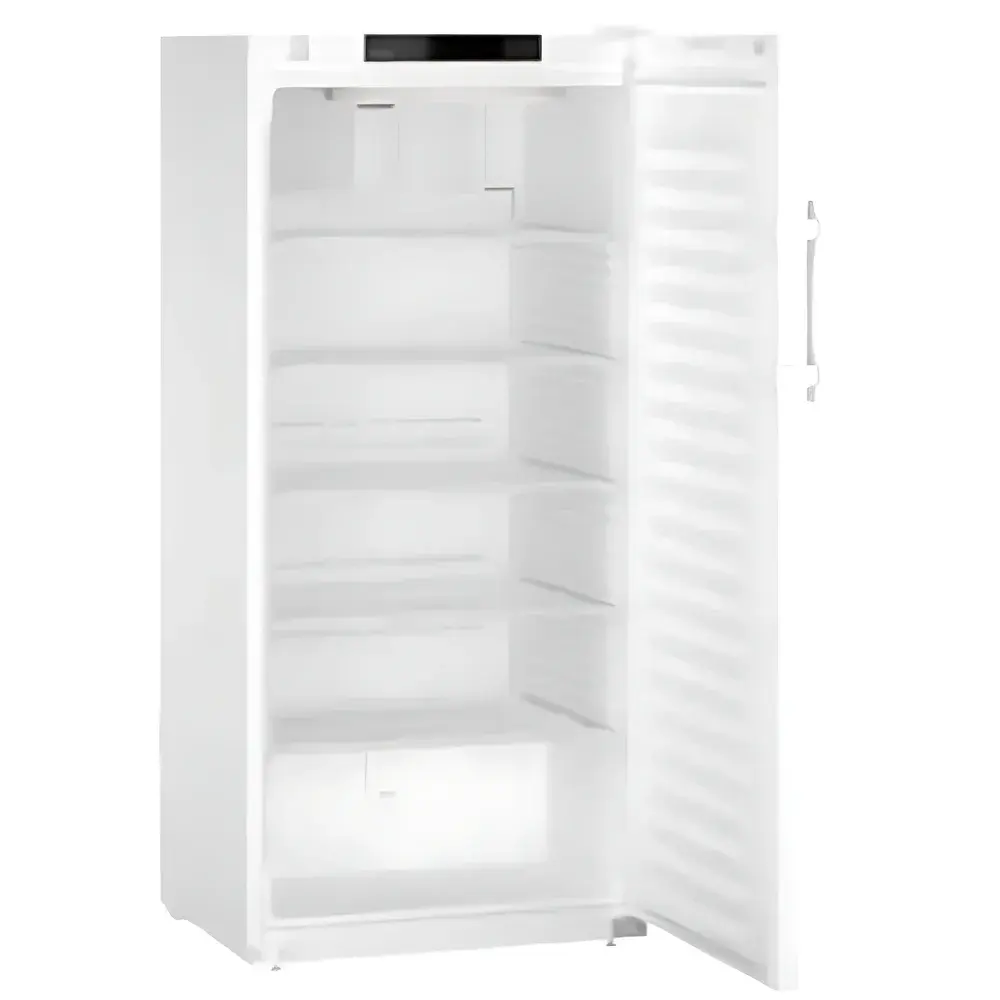
Liebherr SFFsg 5501 Laboratory Cryogenic Refrigerator
| Brand | Liebherr |
|---|---|
| Origin | Austria |
| Model | SFFsg 5501 |
| Storage Temperature Range | −9 °C to −30 °C |
| Annual Energy Consumption | 501 kWh/365 days |
| External Dimensions (W × D × H) | 769 mm × 747 mm × 1684 mm |
| Refrigeration Method | Direct Cooling / Manual Defrost |
| Net Capacity | 394 L |
| Gross Capacity | 499 L |
| Temperature Uniformity (Max Gradient) | 6.0 °C |
| Temperature Stability (Max Fluctuation) | ±2.9 °C |
| Refrigerant | R290 |
| Noise Level | 49 dB(A) |
| Power Supply | 220–240 V~, 50 Hz |
| Locking Mechanism | Mechanical Lock with Two Keys |
| Compliance | DIN 13277, IEC 61010-2-011, CE |
Overview
The Liebherr SFFsg 5501 is a purpose-engineered laboratory cryogenic refrigerator designed for reliable, stable, and compliant low-temperature storage of temperature-sensitive biological materials, pharmaceuticals, vaccines, clinical samples, and reference standards. Operating within a precisely controlled range of −9 °C to −30 °C, the unit employs direct-cooling refrigeration architecture with R290 (propane) — a natural, low-global-warming-potential (GWP = 3) refrigerant aligned with EU F-Gas Regulation (EU) No 517/2014 and global sustainability mandates. Its thermally optimized cabinet structure, high-density polyurethane insulation (≥70 mm), and dual-seal door system collectively ensure minimal thermal bridging and exceptional temperature homogeneity across the entire storage volume. Unlike general-purpose commercial freezers, the SFFsg 5501 meets the stringent performance and safety requirements defined in DIN 13277 for laboratory and biomedical cold storage equipment — including mandatory validation protocols for temperature mapping, alarm response time, recovery time after door opening, and power failure resilience.
Key Features
- Electronic microprocessor control with monochrome touchscreen interface for precise setpoint adjustment (0.1 °C resolution) and real-time monitoring of internal temperature, ambient conditions, and system status.
- Integrated mechanical lock with two physical keys — providing access control without dependency on electronic authentication or battery backup, essential for GLP/GMP environments where audit-trail integrity and fail-safe security are non-negotiable.
- Front-mounted LED illumination system with motion-activated or manual override, enabling rapid visual identification of stored items in low-light laboratory settings while minimizing door-open duration and thermal load disruption.
- Four adjustable, plastic-coated wire shelves (580 mm × 523 mm usable area; 60 kg max load per shelf); total shelf load capacity: 300 kg. Shelf height spacing is optimized for standard ISO/IEC 17025-compliant sample containers (e.g., 50 mL conical tubes, cryovials, and multi-well plates).
- Acoustic and visual power failure alarm with memory retention — triggers audible and flashing LED alerts upon mains interruption and retains fault log even during extended outages, supporting root-cause analysis per FDA 21 CFR Part 11 data integrity principles.
- Optional connectivity modules (Wi-Fi or LAN) enable integration into centralized environmental monitoring systems (EMS), supporting automated data logging, remote diagnostics, and alarm forwarding via SMTP/SNMP protocols — critical for ISO 13485-certified medical device manufacturers and clinical trial biobanks.
Sample Compatibility & Compliance
The SFFsg 5501 is validated for long-term storage of biospecimens requiring strict thermal constancy, including but not limited to: mRNA vaccine intermediates, monoclonal antibody formulations, primary cell isolates, plasma fractions, and nucleic acid extracts. Its temperature uniformity profile (≤6.0 °C gradient, ≤±2.9 °C fluctuation under steady-state operation at −25 °C) satisfies the stability criteria outlined in USP , ISO 20387:2018 (Biobanking), and Annex 15 of the EU GMP Guidelines. The unit conforms fully to DIN 13277:2021 — the definitive German standard specifying test methods for temperature deviation, recovery time (<30 min after 60 s door opening), and alarm activation thresholds (±3 °C deviation). Electrical safety compliance with IEC 61010-2-011 ensures protection against electric shock, fire hazard, and mechanical instability during continuous operation in Class II laboratory environments.
Software & Data Management
While the base configuration features embedded firmware with local event logging (power failures, door open duration >10 s, temperature excursions), optional data logger modules provide time-stamped, tamper-evident CSV export with UTC timestamping and digital signature capability. When deployed with Liebherr’s certified EMS gateway, the unit supports 21 CFR Part 11-compliant user access controls (role-based permissions), electronic signatures, and audit trail generation — including operator ID, timestamp, parameter change history, and alarm acknowledgment records. All logged data is retained for ≥36 months onboard and may be exported to LIMS or QMS platforms via secure FTP or HTTPS API endpoints.
Applications
- Stable short-to-medium term storage (up to 6 months) of lyophilized proteins and enzyme preparations at −25 °C.
- Controlled-temperature quarantine zones for incoming raw materials in pharmaceutical QC labs.
- Backup cold chain staging for ultra-low temperature (−80 °C) freezer workflows — reducing thermal cycling stress on sensitive biologics.
- Regulated storage of clinical trial specimens under ISO 20387-accredited biobank protocols.
- Compliance-driven archiving of calibration standards, reference materials, and proficiency testing samples in ISO/IEC 17025 testing laboratories.
FAQ
Does the SFFsg 5501 support automatic defrost?
No — it uses a manual defrost system, consistent with DIN 13277 requirements for laboratory-grade precision and avoidance of uncontrolled thermal transients during active sample storage.
Is R290 refrigerant safe for laboratory use?
Yes — R290 is classified as A3 (low toxicity, high flammability) under ASHRAE Standard 34; Liebherr implements hermetic compressor housing, leak detection interlocks, and ventilation clearance per EN 378-1 to mitigate risk in properly ventilated lab spaces.
Can temperature data be exported for regulatory audits?
Yes — optional data loggers generate CSV files with cryptographic hash verification and support TLS 1.2-encrypted transmission to validated enterprise systems.
What is the recommended ambient operating range?
+10 °C to +35 °C — performance validation is conducted across this full range per DIN 13277 Clause 6.3.
How many users can be assigned access rights via the optional network module?
Up to 32 unique user profiles with configurable privilege levels (Operator, Supervisor, Administrator), each requiring individual password and optional second-factor authentication.
Related Products



