
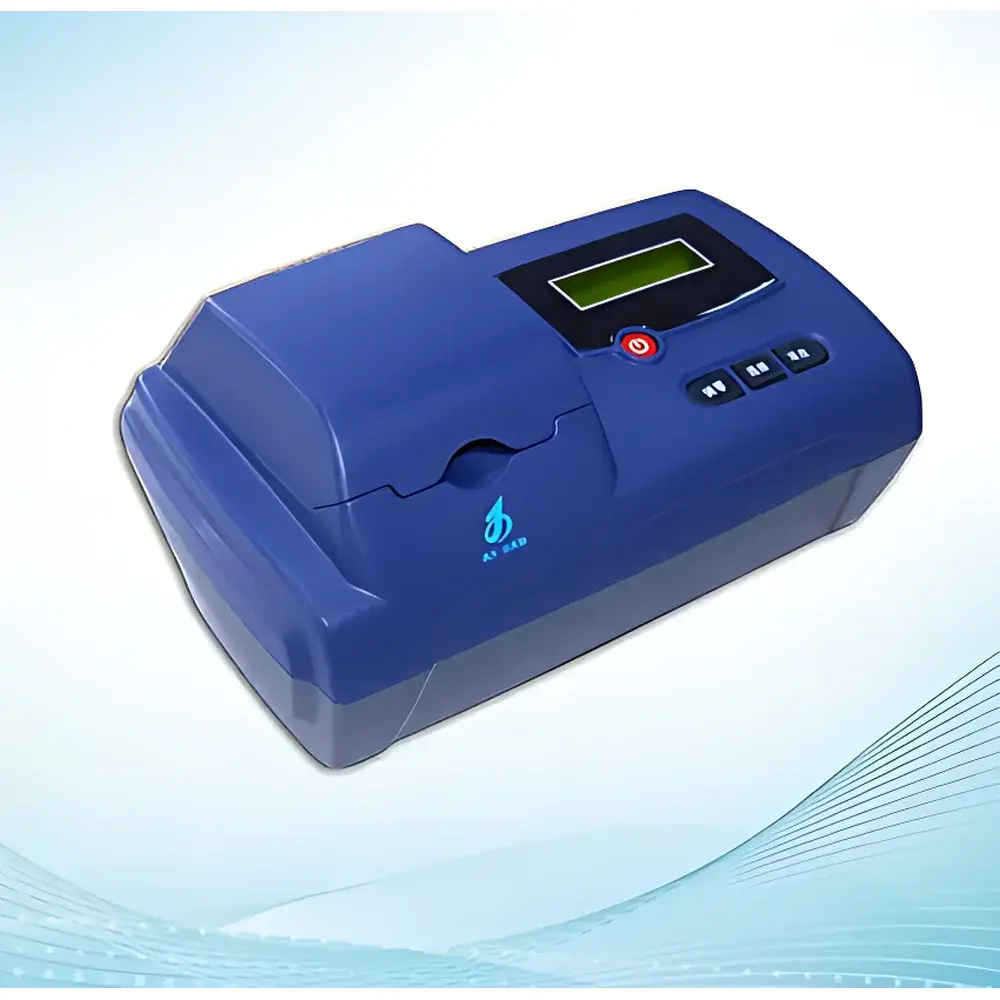
Beifen Sanpu GDYS-101SN2 Residual Chlorine Analyzer
| Brand | Beifen Sanpu |
|---|---|
| Origin | Beijing, China |
| Manufacturer Type | Direct Manufacturer |
| Product Origin | Domestic (China) |
| Model | GDYS-101SN2 |
| Application | Quantitative residual chlorine analysis in water samples |
| Detection Method | DPD colorimetric method per GB/T 5750.11–2006 |
| Detection Time | ≤3 minutes |
| Detection Range | 0.00–5.00 mg/L |
| Lower Detection Limit | 0.05 mg/L |
| Accuracy | ±5% of reading |
| Power Supply | 9 V alkaline battery (operating life: ≥40 hours) |
| Reagent Format | Single-use, pre-packaged DPD reagent kits (50 tests per kit) |
| Accessories Included | Complete set of calibrated colorimetric cuvettes and reagents (50 tests) |
Overview
The Beifen Sanpu GDYS-101SN2 Residual Chlorine Analyzer is a portable, field-deployable colorimetric instrument engineered for rapid, on-site quantification of free and total residual chlorine in aqueous matrices. It operates on the standardized N,N-diethyl-p-phenylenediamine (DPD) oxidation method, fully compliant with GB/T 5750.11–2006 — China’s national standard for drinking water quality testing. Unlike laboratory-based spectrophotometers requiring optical calibration and solvent handling, the GDYS-101SN2 integrates fixed-wavelength photometry (typically 515–525 nm), optimized optical path geometry, and temperature-compensated LED detection to deliver reproducible results under variable ambient conditions. Its design prioritizes operational robustness in non-laboratory environments: no external power source is required, and the pulse-driven circuitry minimizes current draw without compromising photometric stability. The analyzer targets routine monitoring workflows where regulatory compliance, operator training constraints, and logistical simplicity are critical — including municipal water distribution points, swimming pool facilities, wastewater effluent stations, and emergency response deployments.
Key Features
- Compliance with GB/T 5750.11–2006 for residual chlorine determination in potable and environmental waters
- Fixed-time assay protocol: quantitative result output within ≤3 minutes post-reagent addition
- Integrated pulse-power electronics enabling ≥40 hours of continuous operation on a single 9 V alkaline battery
- Dedicated single-use DPD reagent kits — pre-weighed, sealed, and moisture-protected to ensure lot-to-lot consistency and eliminate weighing errors
- Optimized optical system with stabilized LED light source and matched photodiode detector, minimizing drift across 10–35 °C ambient range
- Calibrated colorimetric cuvette set included; no user calibration or wavelength selection required
Sample Compatibility & Compliance
The GDYS-101SN2 is validated for use with clear, low-turbidity aqueous samples including distilled water, tap water, treated drinking water, domestic wastewater effluents, and surface water (e.g., rivers, reservoirs). Samples with turbidity >5 NTU or high levels of oxidant-interfering substances (e.g., monochloramine above 0.5 mg/L as Cl₂, manganese >0.1 mg/L, or strong oxidizers such as ozone or chlorine dioxide) require pretreatment per GB/T 5750.11–2006 guidelines. While not certified to ISO/IEC 17025 or accredited for regulatory reporting, the instrument supports GLP-aligned field documentation when used with traceable reagent lots and standardized SOPs. Its methodology aligns with foundational principles referenced in EPA Method 334.0 and APHA Standard Method 4500-Cl G, facilitating cross-method data interpretation in multi-instrument laboratories.
Software & Data Management
The GDYS-101SN2 is a standalone hardware analyzer with no embedded microprocessor, firmware, or digital data storage. Results are displayed as direct analog-scale readings (mg/L) on a high-contrast LCD panel. No software installation, USB interface, or cloud connectivity is provided. Users record measurements manually or integrate outputs into existing LIMS or QA/QC logbooks using standardized field data sheets. This architecture eliminates cybersecurity vulnerabilities, firmware update dependencies, and validation overhead associated with regulated digital systems — making it suitable for environments where 21 CFR Part 11 compliance is not mandated but method traceability remains essential.
Applications
- Routine verification of disinfectant residual at water treatment plant exit points and distribution system nodes
- Swimming pool and spa facility daily compliance checks per local health department requirements
- Field screening during disaster response or infrastructure failure events (e.g., post-flooding water safety assessment)
- Educational laboratories demonstrating fundamental colorimetric analytical principles and water quality parameter relationships
- Pre-screening prior to confirmatory analysis by HPLC or amperometric sensors in QA/QC workflows
FAQ
Does the GDYS-101SN2 measure both free and total chlorine?
Yes — free chlorine is measured directly using DPD reagent #1; total chlorine requires sequential addition of DPD reagent #1 followed by potassium iodide (included in total chlorine test kits), per GB/T 5750.11–2006 protocol.
Can the instrument be recalibrated by the user?
No — the optical path and electronics are factory-calibrated and sealed; no user-accessible calibration routine is provided. Verification is performed using certified reference standards (e.g., NIST-traceable chlorine solutions) at defined intervals.
Are reagent kits compatible with other Beifen Sanpu models?
Reagent kits are model-specific and designed exclusively for the GDYS-101SN2 platform; cross-model use is not supported due to formulation and dosing volume differences.
What maintenance is required?
Routine cleaning of the cuvette chamber and lens surface with lint-free tissue and deionized water; no scheduled servicing or consumable replacement beyond reagents and batteries.






