
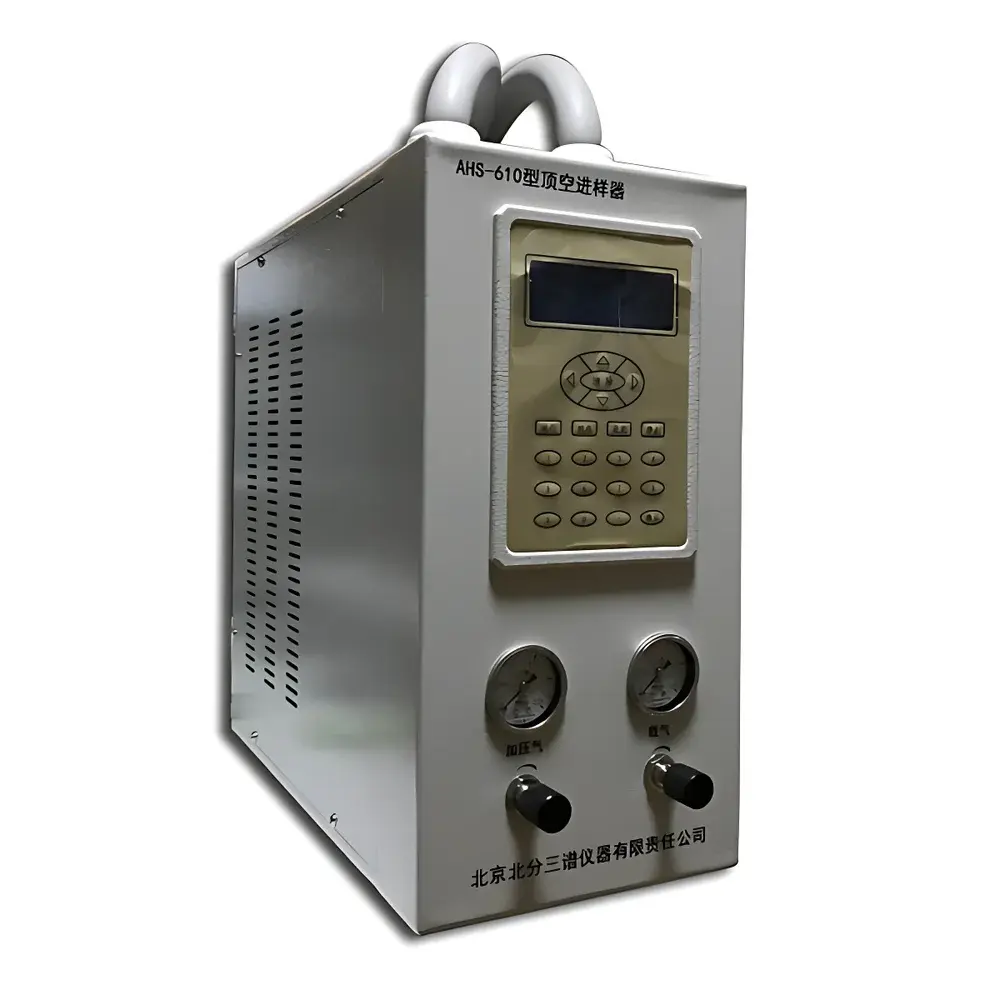
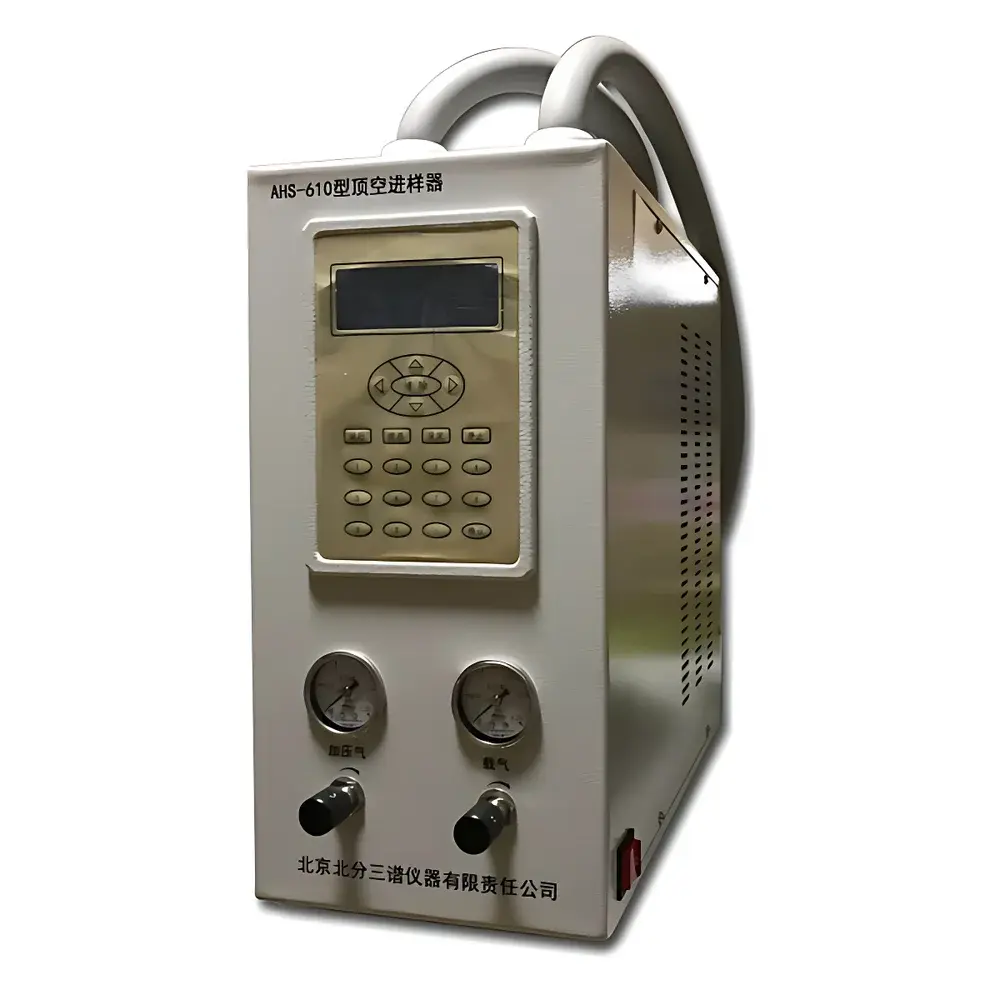
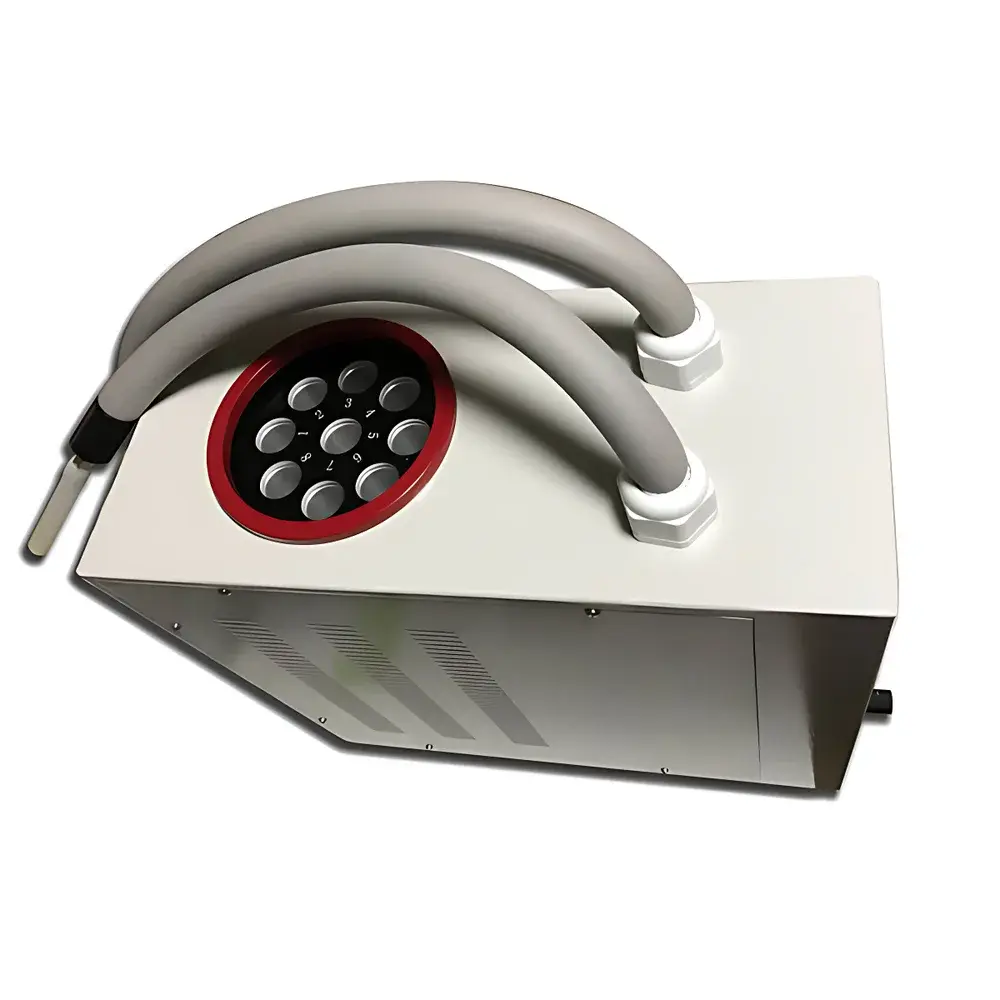
Beifen Sanpu AHS-610 Dynamic Headspace Sampler
| Brand | Beifen Sanpu |
|---|---|
| Origin | Beijing, China |
| Manufacturer Type | Direct Manufacturer |
| Instrument Type | Dynamic Headspace Sampler |
| Automation Level | Semi-Automatic |
| Sample Vial Heating Range | Ambient to 200 °C (1 °C increments) |
| Valve & Transfer Line Temperature Control Range | Ambient to 160 °C (1 °C increments) |
| Quantitative Loop Volume | 1 mL |
| Vial Capacity | 9 positions |
| Vial Standard Size | 20 mL |
Overview
The Beifen Sanpu AHS-610 Dynamic Headspace Sampler is a purpose-engineered sample introduction system designed for precise, reproducible volatile compound analysis in conjunction with gas chromatography (GC). It operates on the principle of pressurized dynamic headspace extraction—where a controlled volume of inert carrier gas sweeps volatiles from the equilibrated headspace above solid or liquid samples into the GC column. Unlike static headspace methods, the AHS-610 enables enhanced sensitivity and broader analyte coverage by actively transferring analytes under regulated pressure and flow, minimizing adsorption losses and improving transfer efficiency. Engineered for routine QC/QA laboratories and method development environments, the AHS-610 delivers robust thermal control architecture, modular integration capability, and deterministic time-programmed operation—making it suitable for compliance-critical applications in environmental testing, pharmaceutical residual solvent analysis (per USP , ICH Q2(R2)), food safety (AOAC, ISO 17025), and forensic toxicology.
Key Features
- Triple-zone independent temperature control: sample vial block (ambient–200 °C), injection valve assembly (ambient–160 °C), and heated transfer line (ambient–160 °C), all with ±0.5 °C stability and uniformity across all 9 vial positions
- Semi-automatic dynamic sampling workflow with programmable pressurization (0–0.4 MPa), sample draw, injection, and post-injection purge—all synchronized via user-defined time-based event sequences
- Integrated 1 mL quantitative loop with high-pressure injection pathway—eliminating reliance on rotary valves and reducing carryover risk associated with conventional six-port valve systems
- Heated stainless-steel transfer lines and syringe needles with automated backflush (0–20 mL/min adjustable), ensuring minimal cross-contamination between runs
- Microprocessor-controlled interface with Chinese-character LCD display, membrane keypad, and real-time monitoring of method parameters, elapsed time, and system status
- Eight-step, three-event external trigger programming supports seamless synchronization with GC oven start, data system acquisition, or external analytical events
- Dedicated vial seal integrity tester included for validation of crimp-cap sealing prior to analysis—critical for method robustness and GLP/GMP traceability
- Modular gas management: compatible with existing GC carrier gas supply; no instrument modification required; supports shared use across multiple GC systems
- Low-voltage (18 V DC) heating circuitry for sample transport lines—enhancing electrical safety and long-term reliability in continuous operation
Sample Compatibility & Compliance
The AHS-610 accommodates standard 20 mL headspace vials (with optional 10 mL and 50 mL configurations available upon request) and accepts both solid and liquid matrices without solvent addition. Its design aligns with widely adopted regulatory frameworks: it supports method validation per ASTM D7622 (determination of volatile organic compounds in water by dynamic headspace GC), EPA Method 502.2 (volatile halogenated hydrocarbons), and ISO 11843-2 (capability of detection). The absence of solvent-based extraction eliminates matrix interference common in liquid–liquid or solid-phase extraction workflows, thereby improving accuracy for trace-level VOC quantification. All temperature zones maintain audit-ready calibration stability, and system diagnostics—including self-check routines for control board and display modules—facilitate internal verification and documentation for ISO/IEC 17025 accreditation.
Software & Data Management
While the AHS-610 operates as a standalone hardware module with embedded firmware, it integrates natively with third-party GC data systems (e.g., Agilent OpenLab, Thermo Chromeleon, Shimadzu GCsolution) via TTL-level external start triggers and status signals. Time-programmed methods—including up to nine stored protocols—are editable directly on-device using numeric input and saved non-volatile memory. All operational logs (run timestamps, temperature setpoints, pressure values, and error codes) are retained locally and can be exported manually for inclusion in electronic lab notebooks (ELN) or LIMS. Though not equipped with native network connectivity or 21 CFR Part 11-compliant user authentication, its deterministic, event-driven architecture ensures full traceability when deployed within validated laboratory IT environments that enforce electronic signature and audit trail policies at the data system layer.
Applications
- Residual solvent analysis in active pharmaceutical ingredients (APIs) and excipients per USP Class 1–3 solvents
- Volatile organic compound (VOC) profiling in drinking water, wastewater, and soil extracts
- Flavor and fragrance compound quantification in beverages, dairy, and confectionery products
- Off-gas analysis of packaging materials and polymer leachables
- Forensic detection of accelerants in arson investigation samples
- Quality control of industrial solvents, adhesives, and coatings
- Method development for challenging matrices including viscous oils, suspensions, and thermally labile biological tissues
FAQ
Is the AHS-610 compatible with all major GC brands?
Yes—the device interfaces via standard TTL triggers and requires no hardware modification to GC instruments. It functions as an autonomous sample introduction module using the host GC’s existing carrier gas supply.
Can the AHS-610 perform multiple injections from the same vial?
Yes—its programmable sequence logic supports repeated sampling from a single vial, enabling replicate analysis, method optimization, and internal standard bracketing without manual intervention.
What maintenance is required for long-term reliability?
Routine maintenance includes periodic inspection of septa, vial crimp seals, and transfer line integrity; cleaning of the quantitative loop with appropriate solvents; and verification of pressure regulator calibration every 6 months under heavy-use conditions.
Does the system support unattended overnight operation?
Yes—its solid-state thermal control, fault-detection circuitry, and auto-shutdown after completed sequences allow safe unattended operation for extended batch runs.
Are custom vial sizes supported beyond 20 mL?
Yes—10 mL and 50 mL vial carriers are available as factory-installed options; contact technical support for mechanical compatibility verification and firmware configuration updates.




