
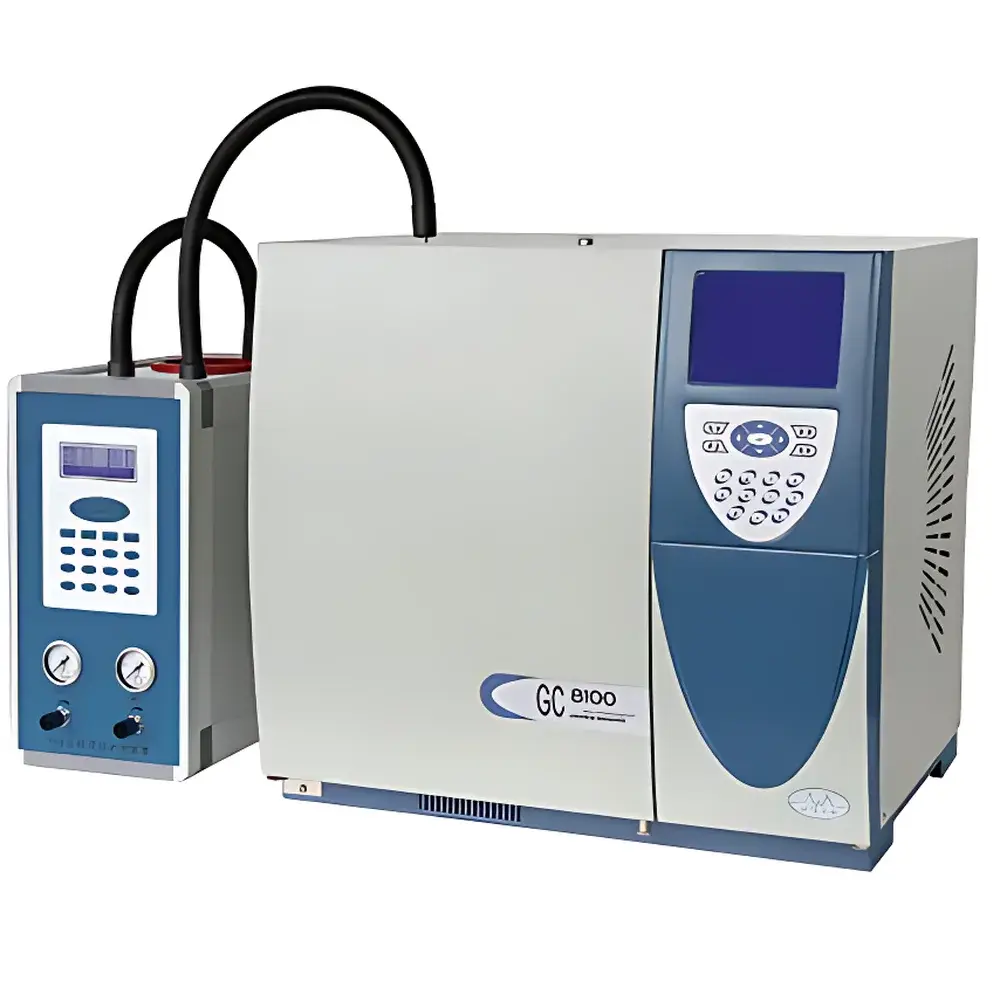
BFSP TVOC-Specific Gas Chromatograph
| Brand | BFSP |
|---|---|
| Origin | Beijing, China |
| Manufacturer Type | OEM Manufacturer |
| Regional Classification | Domestic (China) |
| Model | BFSP |
| Instrument Type | Laboratory Gas Chromatograph |
| Application Scope | General-Purpose |
| Oven Temperature Range | +4 °C to 450 °C |
| Ramp Rate | 0.1–40 °C/min |
| Cool-Down Time | ~6 min (450 °C → 50 °C) |
| Carrier Gas Flow Range & Control | 0–1200 mL/min |
| Carrier Gas Pressure Range & Control | 0–970 kPa |
| Injector Max Operating Temperature | 450 °C |
| Injector Pressure Setting Range | 0–970 kPa |
| Injector Total Flow Setting Range | 0–1200 mL/min |
| Column Oven Temp Accuracy | ±0.1 °C (5 °C above ambient to 400 °C) |
| Injector/Detector Temp Accuracy | ±0.1 °C (6 °C above ambient to 399 °C) |
| Programmable Temperature Ramping | 5-stage |
| FID Sensitivity | ≤1×10⁻¹¹ g/s (n-hexadecane) |
| FID Noise | ≤5×10⁻¹⁴ A |
| FID Linear Dynamic Range | ≥10⁶ |
| TCD Sensitivity | ≥4000 mV·mL/mg (n-hexadecane) |
| TCD Noise | ≤20 µV |
| TCD Linear Dynamic Range | ≥10⁴ |
| NPD (N) | ≤5×10⁻¹¹ g/s (azobenzene) |
| NPD (P) | ≤2×10⁻¹² g/s (malathion) |
| NPD Noise (N) | ≤2×10⁻¹³ A |
| ECD Sensitivity | ≤1×10⁻¹³ g/mL (γ-HCH) |
| ECD Noise | ≤15 µV |
| ECD Linear Dynamic Range | ≥5×10³ |
| ECD Radioisotope Source | ⁶³Ni |
| FPD (S) | 5×10⁻¹¹ g(S)/s (thiophene) |
| FPD (P) | 1.4×10⁻¹² g(P)/s (parathion-methyl) |
Overview
The BFSP TVOC-Specific Gas Chromatograph is a purpose-engineered laboratory gas chromatography system optimized for the quantitative analysis of Total Volatile Organic Compounds (TVOC) in indoor air and environmental samples. It operates on the principle of thermal desorption coupled with capillary gas chromatography and flame ionization detection (FID), fully aligned with the analytical methodology specified in GB 50325–2001 Appendix E—“Method for Determination of Total Volatile Organic Compounds (TVOC) in Indoor Air.” The instrument supports standardized sampling using Tenax GC or Tenax TA sorbent tubes, followed by thermal desorption at controlled temperatures, carrier-gas-assisted transfer of analytes into a fused-silica capillary column, and high-resolution separation under precisely regulated temperature gradients. Its architecture integrates robust thermal control, multi-detector flexibility, and modular gas-flow management—ensuring reproducible retention times, accurate peak integration, and compliance-ready data integrity for routine regulatory monitoring.
Key Features
- Five-stage programmable temperature ramping with precision of ±0.1 °C across column oven (5 °C above ambient to 400 °C), injector, and detector zones—enabling method-specific resolution of C6–C16 hydrocarbons and oxygenated VOCs.
- Modular detector configuration supporting simultaneous installation of up to three detectors: Flame Ionization Detector (FID), Thermal Conductivity Detector (TCD), Electron Capture Detector (ECD), Nitrogen Phosphorus Detector (NPD), and Flame Photometric Detector (FPD)—each with factory-calibrated sensitivity and linear dynamic range per ASTM D3612 and ISO 16000-6.
- Independent temperature-controlled zones for dual packed columns and capillary inlet systems—including dedicated split/splitless injector with septum purge, adjustable分流 ratio, and make-up gas control—ensuring optimal sample introduction for both Tenax-based desorbed extracts and direct liquid injections.
- High-speed cooling system achieving 450 °C → 50 °C in approximately six minutes via intelligent rear-door airflow modulation—reducing cycle time between analyses without compromising thermal stability.
- Integrated self-diagnostic firmware with over-temperature shutdown, baseline auto-zeroing, and real-time pressure/flow validation—supporting unattended operation and GLP-compliant audit trails when paired with compliant data acquisition software.
- Expandable platform accommodating optional accessories including six-port gas sampling valves, methanizer reactors for CO/CO₂ conversion, and cold-on-column injectors—facilitating method development beyond TVOC toward broader VOC profiling or speciated hydrocarbon analysis.
Sample Compatibility & Compliance
The BFSP GC is validated for use with standard EPA TO-17 and ISO 16017-1 compliant thermal desorption systems, accepting 6 mm OD stainless steel or quartz sorbent tubes loaded with Tenax TA or equivalent polymers. It meets the instrumental performance criteria outlined in GB 50325–2001, including minimum resolution of o-xylene/m-xylene, retention time repeatability (<0.05 min RSD), and calibration linearity (r² ≥ 0.999) across 0.5–500 µg/m³ concentration ranges. All temperature and flow parameters are traceable to NIST-certified references. The system architecture supports 21 CFR Part 11–compliant electronic signatures and audit logs when operated with validated chromatography data systems (CDS), fulfilling requirements for environmental laboratories accredited to ISO/IEC 17025:2017.
Software & Data Management
Data acquisition and processing are performed using vendor-supplied chromatography software compatible with Windows OS, featuring automated peak detection, retention time locking (RTL), and customizable reporting templates aligned with Chinese Ministry of Ecology and Environment (MEE) reporting formats. Raw data files (.cdf or .dx) are stored with embedded metadata—including instrument configuration, method parameters, operator ID, and timestamped calibration records—to support full traceability. Optional CDS upgrades provide electronic lab notebook (ELN) integration, multi-user role-based access control, and secure network deployment in centralized QC/QA environments. All software modules undergo periodic verification per ICH Q2(R2) guidelines to ensure continued analytical validity.
Applications
- Indoor air quality (IAQ) assessment in residential, commercial, and institutional buildings per GB 50325 and ISO 16000 series standards.
- Regulatory compliance testing for construction materials, furniture, adhesives, and coatings under China’s Green Building Evaluation Standard (GB/T 50378).
- VOC source identification and emission profiling in manufacturing facilities, printing plants, and automotive refinishing operations.
- Method validation and reference material analysis in provincial environmental monitoring stations and third-party testing laboratories.
- Research applications involving semi-volatile organic compound (SVOC) screening, odorant profiling, and solvent residue quantification in pharmaceutical excipients.
FAQ
Does this instrument comply with international TVOC standards such as ISO 16000-6?
Yes—the BFSP GC satisfies all instrumental requirements for ISO 16000-6:2011, including column selection (e.g., DB-5ms or equivalent 30 m × 0.32 mm × 1.0 µm), temperature programming, and detector sensitivity thresholds for target analytes (C6–C16).
Can the system be configured for unattended overnight analysis?
Yes—equipped with auto-shutdown, scheduled start-up, and event-triggered injection sequencing, it supports batch processing of up to 100 samples via optional autosampler integration.
Is FID the only required detector for TVOC analysis per GB 50325?
While FID is mandated for total quantification due to its universal hydrocarbon response and wide linear range, optional detectors (e.g., ECD for halogenated compounds or NPD for amine-containing VOCs) may be installed for expanded contaminant screening.
What maintenance intervals are recommended for long-term reliability?
Routine maintenance includes quarterly GC inlet liner replacement, biannual column trimming, and annual detector cleaning and gas filter replacement—documented in the included GLP-aligned maintenance log template.
Is remote diagnostics supported?
Yes—via secure SSH-enabled Ethernet interface, enabling firmware updates, parameter diagnostics, and real-time sensor status monitoring by authorized service engineers.
Related Products




