
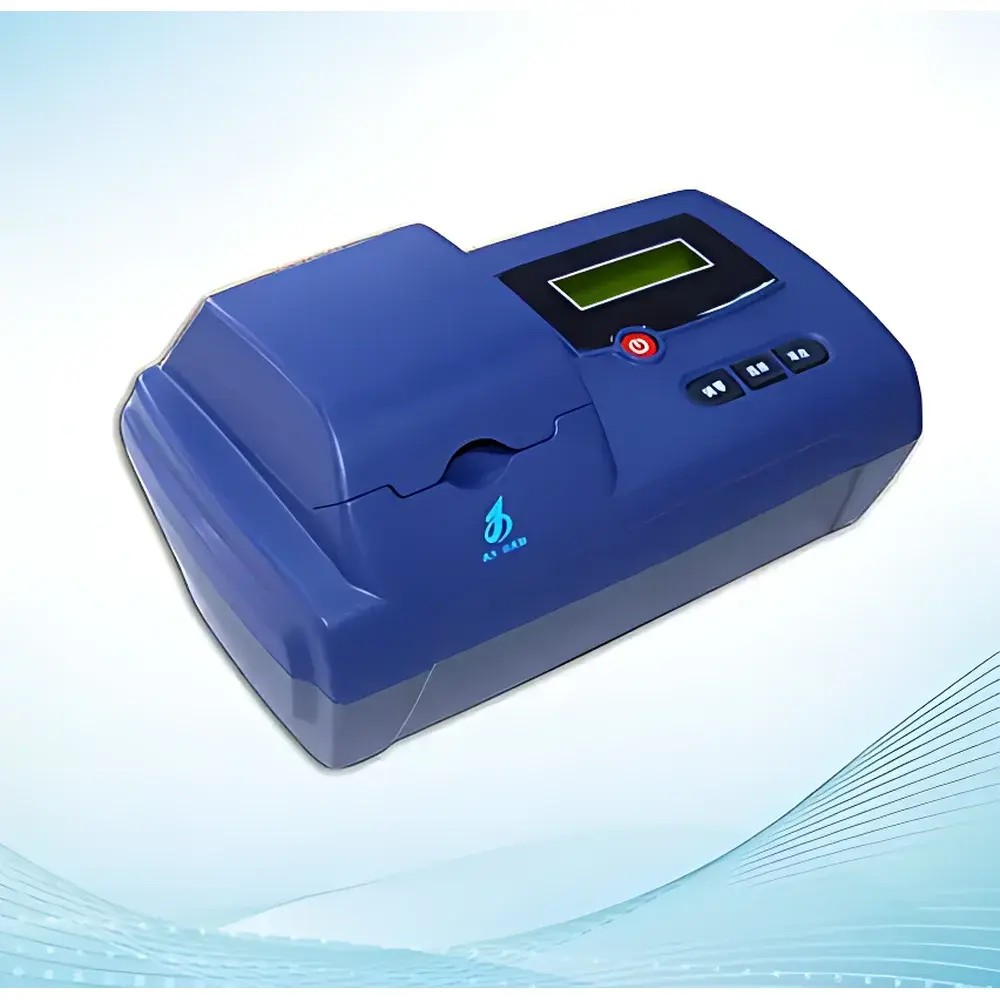
Beifen Sanpu GDYS-101SN Residual Chlorine and Total Chlorine Photometric Analyzer
| Brand | Beifen Sanpu |
|---|---|
| Origin | Beijing, China |
| Manufacturer Type | Direct Manufacturer |
| Product Origin | Domestic (China) |
| Model | GDYS-101SN |
| Application | Field-deployable photometric analyzer for residual and total chlorine in water |
| Detection Method | DPD colorimetric method per GB/T 5750.11–2006 |
| Detection Time | ≤3 min |
| Detection Range | 0.00–9.99 mg/L Cl₂ |
| LOD | 0.10 mg/L |
| Accuracy | ±5% of reading |
| Power Supply | 9 V alkaline battery (≥40 h continuous operation) |
| Reagent Format | Single-use, pre-packaged DPD reagent kits (50 tests per kit) |
| Included Accessories | Complete set of calibrated colorimetric cuvettes and reagents (50 tests) |
Overview
The Beifen Sanpu GDYS-101SN Residual Chlorine and Total Chlorine Photometric Analyzer is a portable, field-ready instrument engineered for rapid, quantitative determination of free residual chlorine and total chlorine concentrations in aqueous matrices. It operates on the standardized N,N-diethyl-p-phenylenediamine (DPD) colorimetric principle—fully compliant with GB/T 5750.11–2006, the Chinese national standard for drinking water quality analysis. The system employs fixed-wavelength photometry (typically 515 nm or 530 nm, optimized for DPD-chlorine chromophore development) to measure absorbance changes proportional to chlorine concentration. Designed for operational simplicity and analytical robustness, the GDYS-101SN eliminates the need for laboratory infrastructure while maintaining metrological traceability to reference methods. Its pulse-driven LED optical source and low-power analog signal processing architecture ensure stable performance across ambient temperature fluctuations (10–35 °C) and variable humidity conditions typical of field deployments.
Key Features
- Compliance with GB/T 5750.11–2006 for both residual and total chlorine measurement in potable and environmental waters
- Quantitative results delivered in ≤3 minutes per sample—enabling high-throughput screening during routine water safety inspections
- Integrated pulse-power electronics reduce average current draw; one 9 V alkaline battery supports ≥40 hours of intermittent use (typical field duty cycle)
- Dedicated single-use DPD reagent kits minimize cross-contamination risk and eliminate manual reagent preparation errors
- Pre-calibrated optical path with matched cuvettes ensures reproducibility without user calibration prior to each test
- Compact, ruggedized housing (IP54-rated) suitable for transport in mobile labs, municipal water vans, or emergency response kits
Sample Compatibility & Compliance
The GDYS-101SN is validated for direct analysis of clear, low-turbidity aqueous samples including distilled water, municipal tap water, treated surface water, and groundwater after minimal filtration (≤5 µm). It is not intended for highly colored, turbid, or high-oxidant matrices (e.g., chloraminated wastewater effluents above 10 mg/L NH₂Cl) without dilution or pretreatment. While GB/T 5750.11–2006 serves as its primary validation framework, method equivalence has been demonstrated against APHA Standard Methods 4500-Cl G (DPD titrimetric) and ISO 7393-2:2018 (colorimetric chlorine determination), supporting data acceptance in multi-jurisdictional monitoring programs. The instrument’s design aligns with GLP principles for field data integrity, including documented reagent lot traceability and operator-defined test identification.
Software & Data Management
The GDYS-101SN is a standalone, firmware-based analyzer with no embedded software or digital connectivity. All measurements are displayed numerically on a backlit LCD screen; no internal memory or data logging is provided. Users record results manually or integrate readings into external LIMS via handwritten logs or secondary digitization. This architecture intentionally avoids regulatory complexities associated with electronic records—making it suitable for environments where FDA 21 CFR Part 11 compliance is not mandated, yet audit-ready documentation (reagent lot numbers, time/date stamps, operator ID) remains fully achievable through procedural controls.
Applications
- Routine verification of disinfectant residuals at water treatment plant exit points and distribution system nodes
- Field validation of chlorine decay kinetics during pipeline flushing or storage tank maintenance
- Emergency response testing following natural disasters or infrastructure failures affecting water safety
- Educational laboratory instruction on redox-based water quality indicators and colorimetric assay fundamentals
- Third-party certification sampling for rural water supply schemes under national rural drinking water safety programs
FAQ
Does the GDYS-101SN differentiate between free chlorine and combined chlorine?
Yes—the instrument supports two distinct protocols: the standard DPD-1 method for free residual chlorine, and the DPD-1 + potassium monopersulfate (PMS) oxidation step for total chlorine. Combined chlorine is calculated by difference.
Can the device be used for wastewater or seawater samples?
Not without matrix-specific validation. High organic load, salinity (>5,000 mg/L TDS), or oxidant interference (e.g., ozone, chlorine dioxide) may suppress or overestimate DPD response. Dilution and spike recovery testing are required prior to deployment.
Are reagent kits compatible with other manufacturers’ photometers?
No—GDYS-101SN reagents are formulated and dosed specifically for its optical path length, LED wavelength, and detection algorithm. Cross-platform use invalidates accuracy claims and voids method compliance.
What maintenance is required beyond battery replacement?
None. The optical system contains no moving parts or consumable filters. Routine cleaning of the cuvette chamber with deionized water and lint-free wipes is recommended after each day’s use.



