
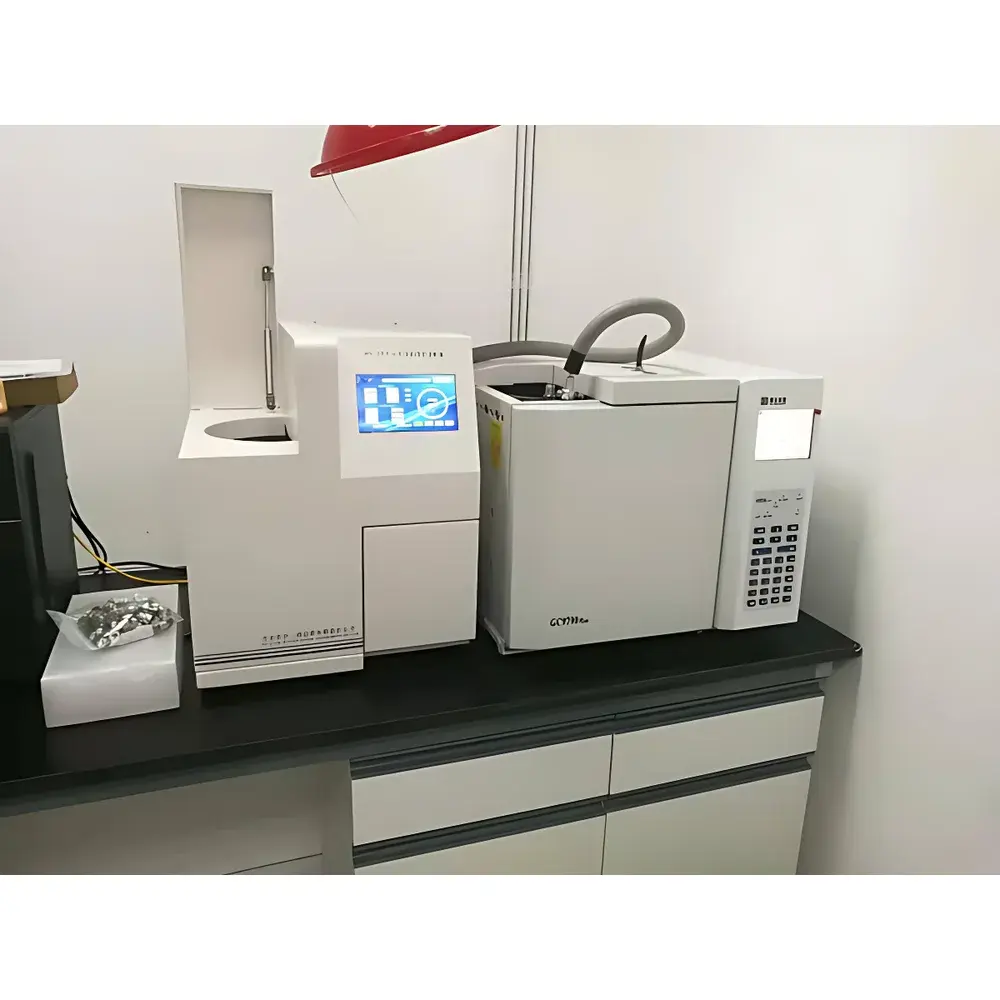
Beifen Sanpu GC-9790plus Laboratory Gas Chromatograph
| Brand | Beifen Sanpu |
|---|---|
| Origin | Beijing, China |
| Manufacturer Type | Direct Manufacturer |
| Product Category | Domestic Instrument |
| Model | GC-9790plus |
| Instrument Type | Laboratory Gas Chromatograph |
| Application Field | Alcohol Analysis |
| Oven Temperature Range | 100–350 °C |
| Ramp Rate | 0.1–40 °C/min |
| Cool-down Time | ~6 min (from 350 °C to 100 °C) |
| Carrier Gas Flow Control Range | 0–1200 mL/min |
| Carrier Gas Pressure Control Range | 0–970 kPa |
| Injector Maximum Operating Temperature | 100–350 °C |
| Injector Pressure Setting Range | 0–970 kPa |
| Injector Total Flow Setting Range | 0–1000 mL/min |
Overview
The Beifen Sanpu GC-9790plus is a benchtop laboratory gas chromatograph engineered for high reproducibility and method-compliant operation in regulated environmental and food safety testing environments. It operates on the principle of capillary gas chromatography—separating volatile and semi-volatile organic compounds based on differential partitioning between a mobile phase (high-purity carrier gas) and a stationary phase (fused-silica capillary column). The instrument supports both split and splitless injection modes and integrates precise oven temperature programming, pressure/flow-controlled pneumatic modules, and a flame ionization detector (FID) optimized for hydrocarbon and oxygenated VOC detection. Its design aligns with established analytical protocols such as EPA Method 8260D, ASTM D3699, and China’s HJ 741–2015 for headspace analysis of volatile organic compounds (VOCs) in soil and sediment matrices.
Key Features
- Programmable temperature-controlled oven with linear ramp rates from 0.1 to 40 °C/min and rapid cool-down (~6 min from 350 °C to 100 °C), enabling efficient method cycling without thermal lag.
- Dual independent pressure/flow control systems for carrier gas (0–970 kPa, 0–1200 mL/min) and auxiliary gases (H2, air), ensuring stable baseline performance and retention time repeatability (RSD < 0.5% over 24 h).
- Hot-swappable, temperature-regulated inlet capable of operation up to 350 °C, supporting both standard and high-temperature applications including fatty acid methyl ester (FAME) profiling and residual solvent analysis.
- Fully compatible with automated headspace sampling systems—including the AHS-20Aplus 20-position autosampler—enabling unattended, GLP-compliant batch processing.
- Integrated PID-based temperature control architecture with real-time sensor feedback and ±0.1 °C stability across the full operating range (100–350 °C).
- Modular detector bay accommodating FID, TCD, ECD, or NPD configurations; factory-optimized FID provides linear dynamic range of 107 and detection limits ≤ 3 pg C/s for n-decane.
Sample Compatibility & Compliance
The GC-9790plus is validated for use with aqueous, solid, and semi-solid samples following standardized pretreatment workflows—including headspace equilibration per HJ 741–2015, purge-and-trap (EPA 5021A), and direct liquid injection. Its pneumatic system meets ISO 8573-1 Class 1 compressed air purity requirements when paired with BF-2L zero-air generators. When operated with BF-300N nitrogen and BF-300E hydrogen generators (≥99.999% purity), it satisfies USP <621> and ICH Q2(R2) system suitability criteria for resolution, tailing factor, and theoretical plate count. Data acquisition and reporting support audit trail functionality compliant with FDA 21 CFR Part 11 when used with validated chromatography data systems (CDS).
Software & Data Management
The instrument interfaces with third-party CDS platforms (e.g., Chromeleon, OpenLab CDS, or Empower) via standard RS-232, USB, or Ethernet connections. All method parameters—including oven program, inlet pressure, detector settings, and valve timing—are stored in human-readable ASCII format for traceability. Raw data files (.CDF or .RAW) include embedded metadata: operator ID, instrument serial number, calibration date, and electronic signature fields. Optional firmware upgrades enable enhanced peak integration algorithms, automatic baseline correction, and customizable report templates aligned with ISO/IEC 17025 documentation requirements.
Applications
- Environmental analysis: Quantification of BTEX, chlorinated solvents, and petroleum hydrocarbons in soil, groundwater, and landfill leachate per HJ 741–2015 and EPA 8260D.
- Food & beverage quality control: Ethanol, fusel oils, and flavor congeners in distilled spirits and fermented beverages (GB/T 10345–2007).
- Pharmaceutical residual solvents: Class 2 and 3 solvents (ICH Q3C) in active pharmaceutical ingredients using USP <467>-compliant methods.
- Polymer additive screening: Plasticizers (e.g., phthalates), antioxidants, and monomer residuals in packaging materials (GB/T 23296.1–2009).
- Forensic toxicology: Volatile substance identification in blood and tissue extracts under ISO/IEC 17025-accredited workflows.
FAQ
Is the GC-9790plus compliant with Chinese national standards for environmental testing?
Yes—it is routinely deployed in laboratories performing HJ 741–2015 (soil VOCs), HJ 605–2011 (water VOCs), and GB 5009.266–2016 (food ethanol), with documented method validation reports available upon request.
Can the instrument be integrated into a LIMS environment?
Yes—via standard OPC UA or ASTM E1384-compliant data export protocols; all audit trails, calibration logs, and raw chromatograms are timestamped and digitally signed.
What maintenance intervals are recommended for routine operation?
Inlet liner replacement every 100 injections; septum change every 50–100 runs; FID jet cleaning monthly; oven seal inspection quarterly; full pneumatic leak check biannually.
Does the system support unattended overnight analysis?
Yes—when configured with an AHS-20Aplus autosampler and validated CDS, it supports 24+ hour sequence execution with automatic shutdown, peak reintegration, and email alert notifications.
Are application notes and SOP templates available for common regulatory methods?
Yes—Beifen Sanpu provides method-specific application notes (including HJ 741–2015, GB/T 10345–2007, and USP <467>) with complete instrument setup files, column specifications, and system suitability acceptance criteria.
Related Products





