
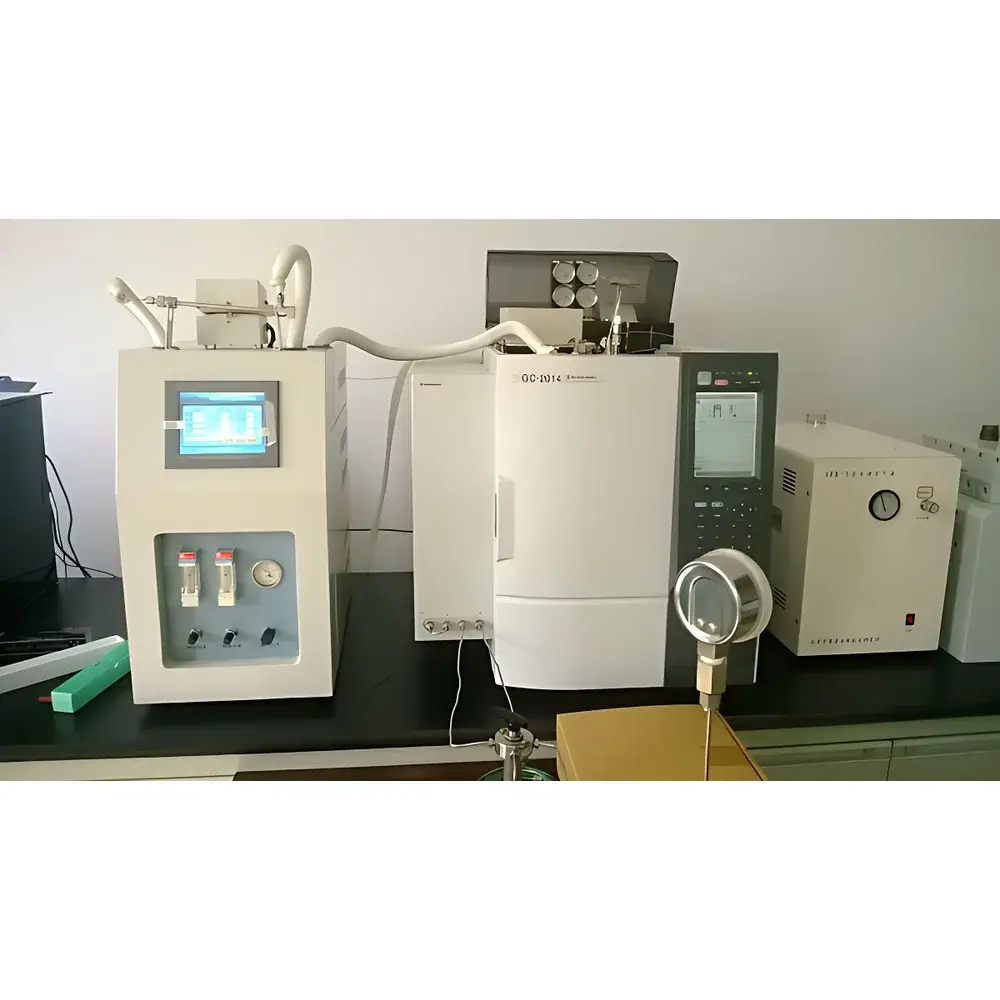
Beifen Sanpu AutoTDS-III Dual-Stage Thermal Desorber for Indoor Air VOC and Benzene-Series Analysis
| Brand | Beifen Sanpu |
|---|---|
| Model | AutoTDS-III |
| Instrument Type | Dual-stage thermal desorber |
| Desorption Temperature Range (1st stage) | 50–380 °C |
| Cold Trap Temperature Range | −30 °C |
| Desorption Temperature Range (2nd stage) | 150–380 °C |
| Heating Rate (2nd stage) | >1800 °C/min |
| Transfer Line Temperature Range | 50–200 °C |
| Power Consumption | <800 VA |
| Sample Capacity | 1 tube |
| Desorption Recovery Rate | ≥90% |
| Simulated Sampling Flow Rate | 0–1000 mL/min (adjustable) |
| Cooling Method | Peltier-based electronic cold trap |
Overview
The Beifen Sanpu AutoTDS-III is a fully automated dual-stage thermal desorber engineered for quantitative analysis of volatile organic compounds (VOCs), including benzene, toluene, ethylbenzene, xylenes (BTEX), and total volatile organic compounds (TVOC), in indoor air matrices. It operates on the principle of two-step thermal desorption: first, analytes are thermally released from sorbent tubes under controlled inert gas flow; second, evolved vapors are cryo-focused in an electronically cooled trap (−30 °C) and rapidly transferred—via resistive heating (>1800 °C/min)—to the GC or GC-MS inlet as a narrow, well-defined band. This architecture eliminates peak broadening and signal loss typical of single-stage desorption, delivering enhanced sensitivity, chromatographic resolution, and reproducibility for trace-level VOC quantification per ISO 16000-6, EPA TO-17, and GB/T 18883–2022.
Key Features
- Fully automated operation with integrated touchscreen interface and embedded real-time temperature monitoring for all critical zones (primary desorption oven, cold trap, transfer line)
- Peltier-cooled cold trap achieving stable −30 °C without liquid nitrogen or external chillers, enabling consistent cryofocusing across analytical batches
- High-speed secondary desorption with programmable ramp rates exceeding 1800 °C/min, ensuring sharp, symmetrical peaks and minimal carryover
- Independent temperature control for primary desorption (50–380 °C, ±1 °C accuracy), secondary desorption (150–380 °C), and transfer line (50–200 °C, ±1 °C accuracy)
- Onboard simulated sampling function with digitally adjustable flow (0–1000 mL/min), supporting calibration standard generation directly on the instrument
- Tool-free, ergonomic sorbent tube handling mechanism—designed for rapid loading/unloading while maintaining leak-tight integrity and minimizing operator exposure
- Modular architecture compatible with all major GC and GC-MS platforms via standardized pneumatic and electrical interfaces (e.g., TTL trigger, analog voltage output)
Sample Compatibility & Compliance
The AutoTDS-III accepts standard 6 mm OD stainless steel or glass sorbent tubes (e.g., Tenax TA, Carbopack B/C, Carboxen 1000) used in active and passive indoor air sampling per ISO 16000-2 and ASTM D5197. Its dual-stage protocol meets method requirements for TVOC determination in residential, commercial, and occupational environments—including compliance with China’s GB/T 18883–2022 (Indoor Air Quality Standard) and the U.S. EPA Compendium Method TO-17. The system supports audit-ready operation through time-stamped event logging, parameter change tracking, and user-access level management—facilitating GLP/GMP-aligned workflows and 21 CFR Part 11 readiness when paired with validated LIMS or chromatography data systems.
Software & Data Management
Control is executed via dedicated Windows-based software supporting method creation, sequence definition, real-time status visualization, and full audit trail generation. Each run logs desorption temperatures, cold trap setpoints, flow rates, timing events, and hardware status flags. Raw method files (.tds) include metadata required for traceability: operator ID, instrument serial number, calibration date, and version-controlled parameters. Export formats include CSV and XML for integration into enterprise laboratory informatics systems. Software updates are delivered via secure HTTPS with cryptographic signature verification to ensure integrity and regulatory alignment.
Applications
- Quantitative analysis of BTEX and C6–C16 aliphatic/aromatic VOCs in indoor air samples collected on multi-bed sorbent tubes
- Method validation and routine QC for environmental testing laboratories accredited to ISO/IEC 17025
- Occupational hygiene monitoring in manufacturing, printing, and coating facilities per OSHA and NIOSH guidelines
- Building material emissions testing (e.g., carpets, adhesives, furniture) using chamber-generated air samples
- Field-deployable sample preparation where portable sorbent tube transport precedes centralized lab analysis
- Supporting research into VOC source apportionment, indoor-outdoor concentration gradients, and ventilation efficiency studies
FAQ
What sorbent tube configurations are supported?
Standard 6 mm OD stainless steel or borosilicate glass tubes packed with single- or multi-bed sorbents (e.g., Tenax TA + Carbopack B + Carboxen 1000) are fully compatible.
Is nitrogen the only carrier gas option?
No—helium, hydrogen, and argon are equally supported; optimal choice depends on downstream GC column and detector configuration.
Can the AutoTDS-III perform splitless injection directly into a GC inlet?
Yes—the system delivers a focused, solventless plug of analytes suitable for both split and splitless GC injection modes.
How is calibration verified across the dynamic range?
Using certified gas standards or liquid-spiked sorbent tubes, with recovery checks at low (1–5 ng), mid (20–50 ng), and high (100–500 ng) levels per compound.
Does the instrument support remote diagnostics or service access?
Remote desktop support is available via encrypted VPN connection for troubleshooting and firmware updates—subject to customer network policy and IT approval.






