
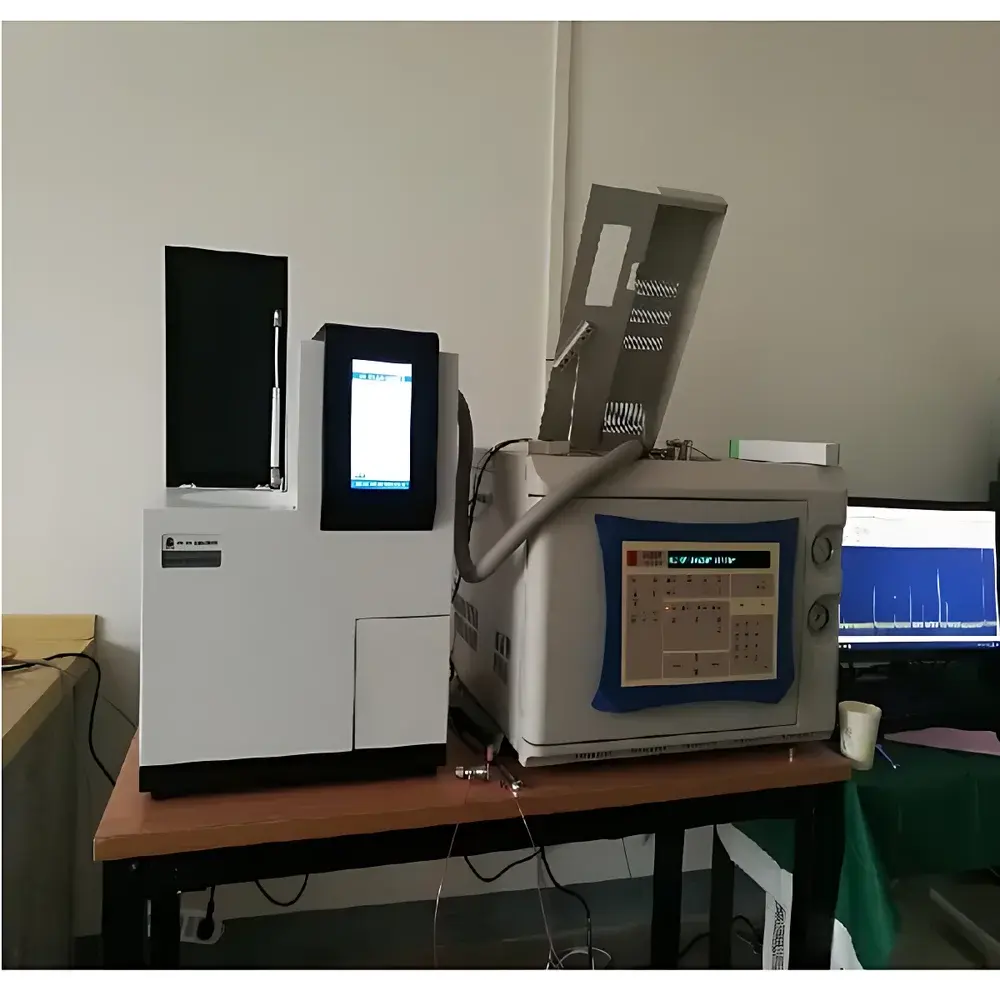
Beifen Sanpu ATD0S-20A Fully Automated Two-Stage Thermal Desorber with Cryogenic Trap
| Brand | Beifen Sanpu |
|---|---|
| Origin | Beijing, China |
| Manufacturer Type | OEM Manufacturer |
| Product Category | Domestic |
| Model | ATD0S-20A |
| Price Range | USD 1,400 – 7,200 |
| Instrument Type | Two-stage thermal desorber, thermal desorption unit |
| Desorption Stage 1 Temperature Range | Ambient to 450°C |
| Desorption Stage 2 Temperature Range | Ambient to 450°C |
| Cryogenic Trap Temperature Range | −35°C to ambient |
| Sample Capacity | 20 positions |
| Recovery Rate | >99% (compound-dependent) |
| RSD | ≤2.5% (benzene at 0.05 μg) |
Overview
The Beifen Sanpu ATD0S-20A is a fully automated two-stage thermal desorber engineered for high-fidelity volatile organic compound (VOC) and semi-volatile organic compound (SVOC) analysis in environmental, industrial hygiene, and indoor air quality applications. It operates on the principle of sequential thermal desorption—first-stage desorption from sorbent tubes followed by cryofocusing in a low-temperature trap (−35°C), then rapid second-stage thermal desorption directly into the gas chromatograph (GC) or GC–MS inlet. This two-stage architecture minimizes band broadening, enhances sensitivity, and delivers sharp, reproducible chromatographic peaks—critical for compliance with regulatory methods requiring sub-ppbv detection limits. Designed for seamless integration with all major GC and GC–MS platforms—including Agilent, Thermo Fisher, Shimadzu, and PerkinElmer—the ATD0S-20A supports method-standardized workflows aligned with U.S. EPA TO-17, ISO 16017-1, and Chinese national standards including HJ 644–2013, HJ 583–2010, and GB/T 18883–2002.
Key Features
- Fully automated 20-position sample carousel enabling unattended batch processing without manual intervention
- Independent four-zone temperature control: primary desorption oven, secondary desorption chamber, transfer line, and six-port valve—all heated and insulated to prevent condensation and carryover
- Integrated Peltier-based cryogenic trap capable of stable operation from −35°C to ambient, ensuring efficient analyte focusing and narrow peak widths
- Motor-driven six-port valve with precise timing and positional repeatability for reliable, contamination-free switching
- Programmable multi-step sequence: primary desorption → cold trap focusing → secondary desorption → GC injection → trap and transfer line backflush
- Onboard sample tube activation protocol with configurable heating duration, temperature ramp, and purge flow for consistent tube conditioning
- Simulated sampling function with adjustable flow (0–160 mL/min) for direct calibration curve generation using standard gases or permeation tubes
- Electronic backflush capability for transfer line and valve (0–100 mL/min, continuously adjustable) to eliminate cross-contamination between samples
- Touchscreen HMI with real-time status animation, method storage, and audit-ready event logging
- Dedicated hardware interfaces for synchronization with external GC start signals or chromatography data systems (CDS)
Sample Compatibility & Compliance
The ATD0S-20A accepts standard 1/4″ OD × 3.5″ stainless steel or quartz sorbent tubes compliant with ASTM D6196 and ISO 16017-1 dimensional specifications. Optional fused silica transfer lines are available for enhanced inertness when analyzing reactive compounds such as aldehydes, amines, or sulfur-containing VOCs. The system meets essential requirements for GLP and GMP-aligned laboratories: full method parameter traceability, time-stamped run logs, and user-accessible calibration records. Its performance validation aligns with QC criteria defined in HJ 644–2013 (recovery >99%, RSD ≤2.5% for benzene at 0.05 µg) and supports 21 CFR Part 11-compliant data integrity when paired with validated CDS software. All thermal zones maintain stability within ±0.5°C, ensuring inter-laboratory reproducibility across multi-day environmental monitoring campaigns.
Software & Data Management
Control is managed via embedded microprocessor firmware with no external PC dependency. Method files store complete thermal profiles (ramp rates up to 3000°C/min), timing sequences, flow parameters, and valve actuation logic. Each run generates a timestamped log containing setpoints, actual temperatures, valve states, and error flags—exportable as CSV for LIMS integration. The system supports remote diagnostics via Ethernet port and offers optional RS-232 or USB-C connectivity for legacy instrument interfacing. While the ATD0S-20A does not include proprietary acquisition software, it provides standardized TTL-level trigger outputs and analog voltage feedback compatible with OpenLab CDS, Chromeleon, and Empower platforms. Audit trail functionality satisfies internal QA/QC documentation requirements and facilitates third-party inspection readiness.
Applications
This thermal desorber is routinely deployed in accredited environmental testing labs for:
- Analysis of ambient and indoor air VOCs per HJ 644–2013 and GB/T 18883–2002
- Vehicle cabin air assessment per HJ/T 400–2007
- Building material emissions testing under GB 50325–2010
- Fixed source emission monitoring per HJ 734–2014
- Workplace exposure evaluation per OSHA Method 52 and NIOSH 1501
- Forensic fire debris analysis using ASTM E1618-compliant protocols
Its robust design supports routine use in high-throughput contract laboratories performing EPA Method TO-17 compliance testing, as well as academic research investigating atmospheric chemistry kinetics and sorbent breakthrough behavior.
FAQ
What sorbent tube formats are supported?
Standard 1/4″ OD × 3.5″ (US EPA TO-17 format) stainless steel or quartz tubes; custom tube adapters available upon request.
Does the system support method validation per ISO/IEC 17025?
Yes—temperature uniformity mapping reports, recovery studies, and precision data (RSD ≤2.5%) can be generated in accordance with ISO/IEC 17025 Clause 7.7 requirements.
Can the cold trap operate below −35°C?
No—the Peltier-based cooling system is rated for −35°C minimum; lower temperatures require liquid nitrogen cryotrap accessories (not included).
Is remote monitoring or network integration possible?
Ethernet-enabled firmware supports SNMP-based status polling and TCP/IP command triggering; integration with LabVantage or STARLIMS requires middleware configuration.
What maintenance intervals are recommended?
Valve lubrication every 6 months; trap cleaning and O-ring replacement annually; full thermal calibration biannually or after 500 cycles.
Related Products





