
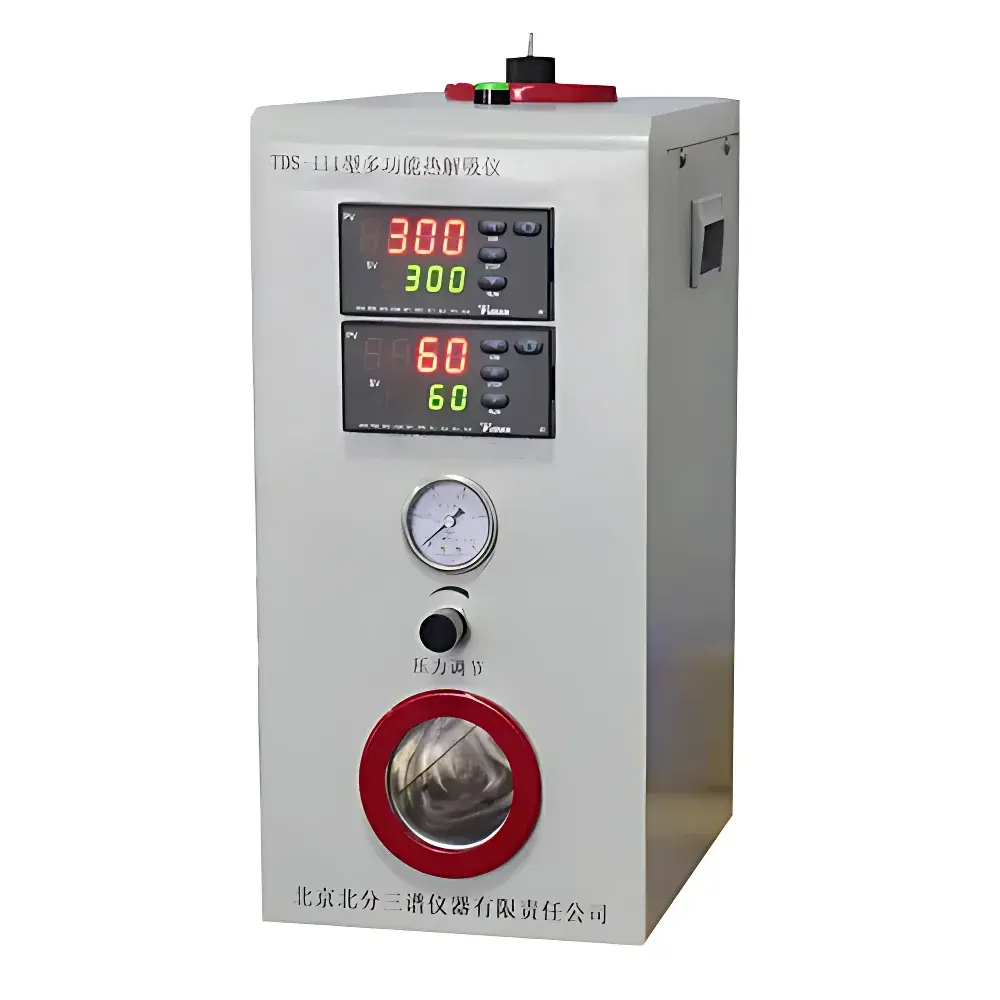
Beifen Sanpu FTDS-III Thermal Desorber for Vinyl Chloride, cis-/trans-1,2-Dichloroethylene, Trichloroethylene, and Tetrachloroethylene Analysis
| [Brand | Beifen Sanpu |
|---|---|
| Origin | Beijing, China |
| Manufacturer Type | OEM Manufacturer |
| Instrument Type | Single-Stage Thermal Desorber |
| Primary Desorption Temperature Range | 50–380 °C |
| Cryo-Focusing Trap Temperature Range | Down to –30 °C |
| Desorption Recovery Rate | >80% (compound-dependent) |
| Sample Capacity | 20 adsorbent tubes] |
Overview
The Beifen Sanpu FTDS-III Thermal Desorber is a dedicated single-stage thermal desorption system engineered for the quantitative analysis of volatile chlorinated hydrocarbons—including vinyl chloride, 1,1-dichloroethylene, 1,2-dichloroethylene (cis and trans isomers), trichloroethylene, and tetrachloroethylene—in ambient air, workplace atmospheres, and indoor environments. It operates on the principle of controlled thermal desorption: analytes pre-concentrated on activated carbon sorbent tubes are thermally released under inert carrier gas flow, transferred quantitatively into a large-volume gas-tight syringe (up to 100 mL), and manually injected into a gas chromatograph equipped with a flame ionization detector (FID). This methodology aligns with standardized analytical protocols including GBZ/T 300.62–2017 (Occupational Health Standards for Determination of Volatile Organic Compounds in Workplace Air) and GB 50325–2006 (Code for Control of Indoor Environmental Pollution in Civil Building Engineering). The instrument does not incorporate cryogenic focusing or automated valve switching; instead, it relies on precise temperature control, calibrated carrier gas flow stability (<0.1% drift), and reproducible manual syringe handling to ensure method robustness and trace-level sensitivity.
Key Features
- Integrated dual-temperature architecture: independent heating zones for the desorption furnace (50–380 °C, ±0.5 °C accuracy) and the 100 mL syringe heater (room temperature to 100 °C, ±0.5 °C accuracy), enabling simultaneous conditioning and injection-ready sample preparation.
- Optimized tube interface design with zero-dead-volume connections for 6 mm OD (¼″) sorbent tubes—compatible with standard charcoal-based sampling tubes containing 100 mg activated carbon per tube.
- Programmable carrier gas flow control (N₂, 10–200 mL/min), maintaining long-term stability essential for quantitative recovery across multi-sample batches.
- Compact benchtop footprint (390 × 170 × 360 mm) and low power consumption (~500 W), suitable for routine QC labs, occupational hygiene field laboratories, and third-party environmental testing facilities.
- Manual syringe-based injection pathway eliminates complex pneumatic valves and reduces maintenance requirements—ideal for laboratories prioritizing operational simplicity and operator training efficiency.
Sample Compatibility & Compliance
The FTDS-III is validated for use with activated carbon sorbent tubes per Chinese national standards GBZ/T 300.62–2017 and GB 50325–2006. It supports analysis of target analytes at concentrations ranging from sub-µg/m³ to mg/m³ levels when coupled with GC-FID. While not compliant with ASTM D6196 or ISO 16017-1 for automated thermal desorption, its performance meets GLP-aligned documentation requirements when used within defined SOPs—including full traceability of desorption temperature, hold time, carrier gas flow rate, and syringe volume. The system supports audit-ready recordkeeping for occupational exposure assessments, indoor air quality monitoring, and regulatory compliance reporting under China’s Ministry of Ecology and Environment (MEE) and National Health Commission (NHC) frameworks.
Software & Data Management
The FTDS-III operates as a hardware-only module without embedded firmware or proprietary software. All parameter settings—including desorption temperature, syringe heater setpoint, and gas flow calibration—are configured manually via front-panel digital controllers. Data acquisition and quantitation occur externally using the host GC’s data system (e.g., Shimadzu GCsolution, Agilent OpenLab CDS, or NIST-compatible chromatography software). Peak integration, calibration curve generation (linear regression, r² ≥ 0.999), and concentration back-calculation follow standard analytical chemistry practice. For laboratories requiring 21 CFR Part 11 compliance, electronic records must be maintained through the GC data system—not the desorber itself—making the FTDS-III compatible with validated LIMS and electronic lab notebook (ELN) workflows when deployed in regulated environments.
Applications
- Workplace air monitoring for OSHA- and MEE-regulated chlorinated solvents in PVC manufacturing, metal degreasing, dry cleaning, and semiconductor fabrication facilities.
- Indoor air quality (IAQ) assessment for vinyl chloride monomer (VCM) off-gassing from new building materials and piping systems.
- TVOC profiling in residential and commercial buildings, where activated carbon tubes serve as cost-effective passive samplers prior to thermal desorption-GC/FID analysis.
- Method development and validation studies for alternative sorbents (e.g., Tenax TA, Carbopack B) in conjunction with GC-MS confirmation.
- Training and educational use in university analytical chemistry laboratories due to its transparent, hands-on operation and alignment with fundamental chromatographic principles.
FAQ
What distinguishes the FTDS-III from automated or secondary thermal desorbers?
The FTDS-III is a single-stage, manually operated desorber. It lacks cryofocusing, automated transfer lines, or split/splitless interfaces—making it distinct from fully automated systems (e.g., Markes UNITY, Gerstel TD) or two-stage desorbers that enable re-collection and re-desorption for enhanced sensitivity.
Can the FTDS-III be used for benzene or other non-chlorinated VOCs?
Yes—its thermal range and compatibility with activated carbon tubes support broad-spectrum VOC analysis, including benzene, toluene, ethylbenzene, xylenes (BTEX), and aliphatic hydrocarbons, provided GC-FID conditions are optimized per compound volatility and polarity.
Is the >80% desorption recovery rate applicable to all target compounds?
Recovery is matrix- and compound-dependent. Vinyl chloride (low boiling point, high volatility) typically achieves >85% recovery at 250 °C; heavier compounds like tetrachloroethylene may require higher desorption temperatures (320–350 °C) and show slightly lower recovery due to adsorption hysteresis.
Does the instrument meet international regulatory requirements such as ISO/IEC 17025?
The FTDS-III itself is not certified, but laboratories can validate its performance per ISO/IEC 17025:2017 Clause 5.4 (method validation) using spike-recovery experiments, precision studies, and inter-laboratory comparison data.
What maintenance is required for long-term reliability?
Routine checks include verifying thermocouple calibration, inspecting O-rings and ferrule seals on tube fittings, cleaning the syringe plunger path, and confirming carrier gas purity (≥99.999% N₂) to prevent column contamination or baseline drift.
Related Products




