
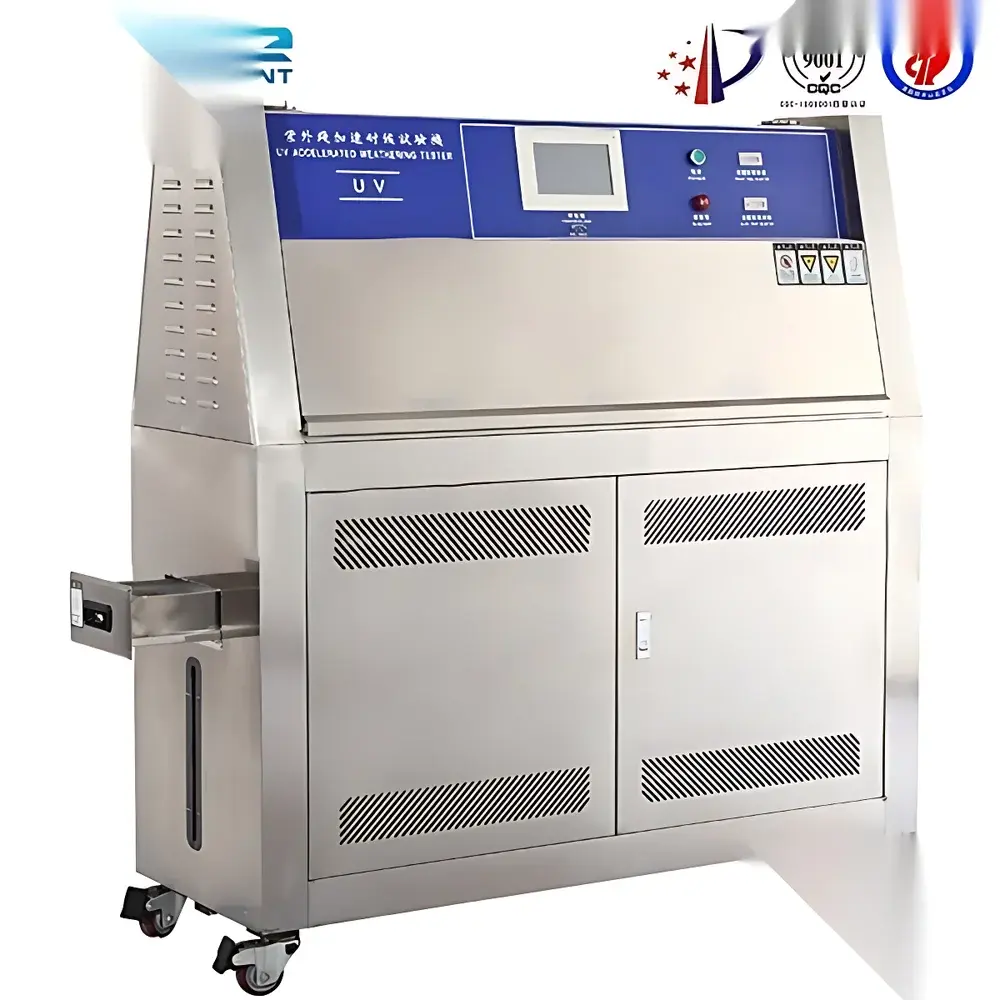
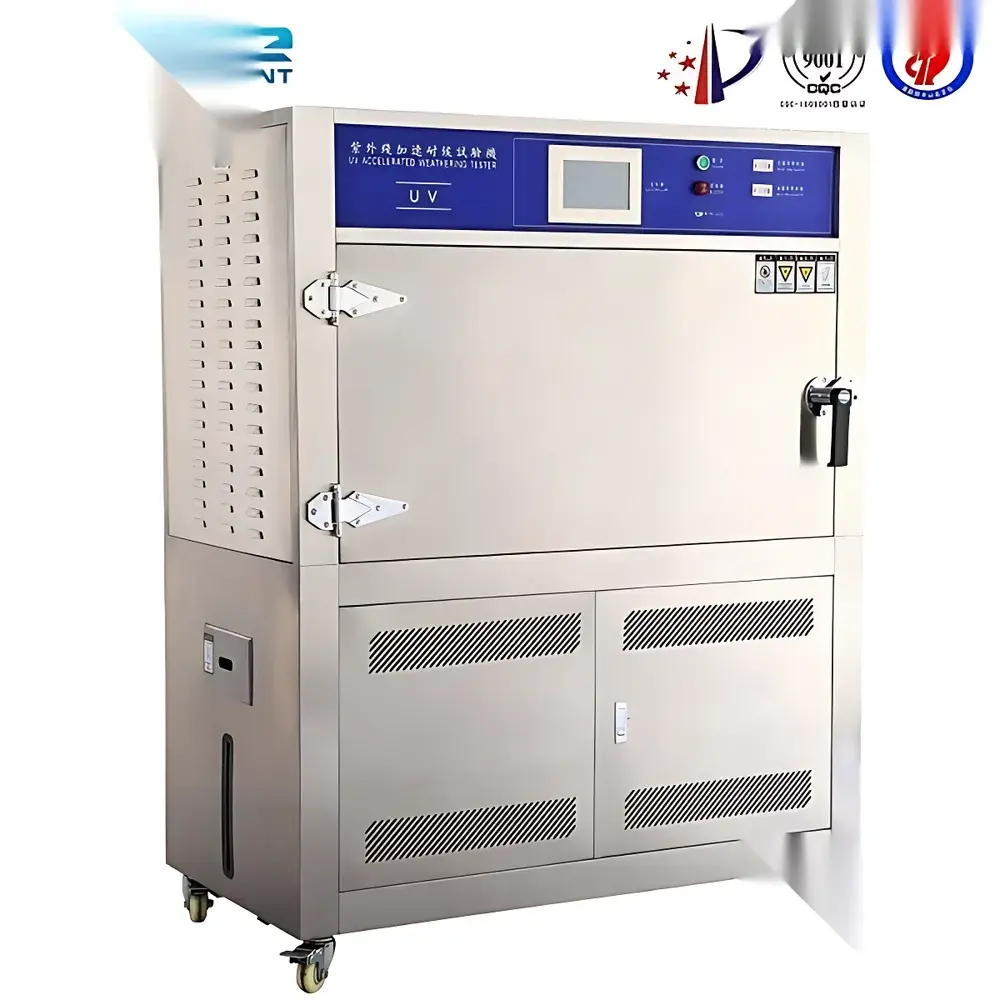
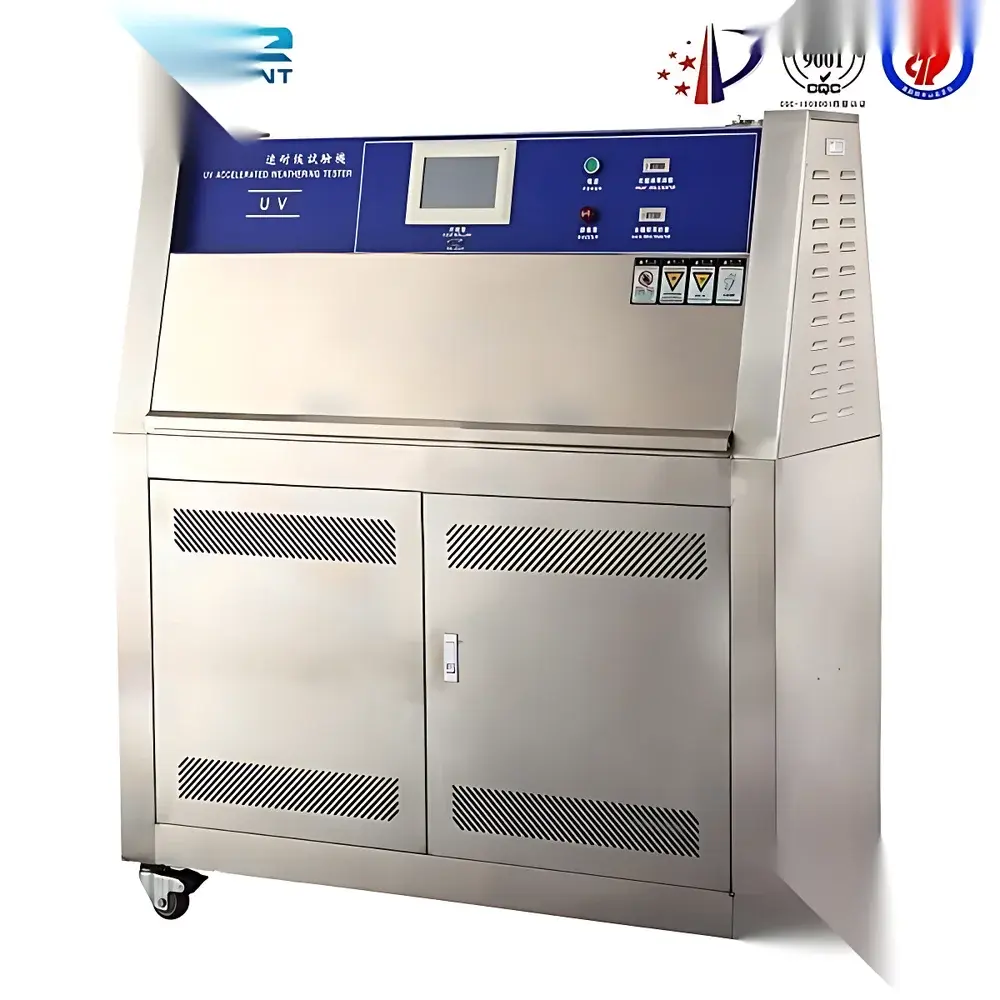
UV Aging Test Chamber OK-UV-290 by OEM Manufacturer
| Brand | OEM |
|---|---|
| Origin | Imported |
| Manufacturer Type | Authorized Distributor |
| Price | USD 3,200 (FOB) |
| Chamber Internal Dimensions (W×H×D) | 114 × 40 × 40 cm |
| External Dimensions (W×H×D) | 135 × 140 × 65 cm |
| Temperature Range | Ambient to 70 °C |
| Humidity Range | ≥95% RH |
| Temperature Control Accuracy | ≤±0.5 °C |
| Temperature Uniformity | ≤±2 °C (or ≤±3% of setpoint) |
| UV Source | Fluorescent UVA-340 or UVB-313 lamps (typical lifespan: ~1500 h) |
| UV Spectral Range | 280–400 nm |
| Exposure Time Setting | 0–999 h (digital timer with auto-stop) |
| Construction Material | Interior & Exterior – SUS304 stainless steel |
| Heating System | U-shaped titanium alloy high-speed heating elements |
| Safety Protections | Interlocked door cut-off for UV lamp power, overtemperature protection, low-water-level cutoff, thermal overload relay |
| Power Supply | AC 220 ±5 V, 50 ±0.5 Hz |
Overview
The OK-UV-290 UV Aging Test Chamber is an engineered environmental test system designed to accelerate photodegradation and moisture-induced degradation mechanisms in polymeric, coated, and composite materials under controlled ultraviolet radiation and condensation cycling. It operates on the principle of fluorescent UV irradiation—primarily utilizing UVA-340 (340 nm peak, closely matching terrestrial solar UV below 360 nm) or UVB-313 (280–360 nm, more aggressive spectral output)—combined with precisely regulated condensation humidity cycles to replicate key outdoor weathering stressors: photooxidation, hydrolysis, and thermal-mechanical fatigue. Unlike xenon arc or carbon arc testers, this chamber emphasizes spectral fidelity in the critical short-wavelength UV region where most polymer backbone scission and pigment bleaching occur. Its design conforms to core requirements of ASTM G154 (Standard Practice for Operating Fluorescent Ultraviolet (UV) Lamp Apparatus for Exposure of Non-Metallic Materials), ISO 4892-3 (Plastics — Methods of exposure to laboratory light sources — Part 3: Fluorescent UV lamps), and JIS D 0205 (Automotive paint durability testing).
Key Features
- Stainless steel construction (SUS304) throughout interior and exterior chambers ensures long-term corrosion resistance against UV-induced ozone and condensate accumulation.
- Dual-mode UV exposure control: programmable irradiance intensity (via lamp selection and ballast configuration) and precise cycle sequencing between UV irradiation and dark condensation phases.
- High-fidelity condensation system: saturated water vapor generation at elevated temperature maintains ≥95% RH during dark cycles—mimicking dew formation kinetics without direct water spray interference.
- Independent temperature regulation during both UV-on and dark-condensation phases; real-time PID-controlled heating via U-shaped titanium alloy elements enables rapid thermal stabilization and uniformity ≤±2 °C across the test plane.
- Interlocked safety architecture: automatic UV lamp de-energization upon door opening, redundant overtemperature cutoff (mechanical + electronic), and low-water-level detection prevent operational hazards and specimen damage.
- Digital timer with non-volatile memory supports unattended operation up to 999 hours; cycle logs are timestamped and retain settings after power interruption.
Sample Compatibility & Compliance
The OK-UV-290 accommodates flat-panel specimens up to 100 mm × 150 mm × 10 mm (standard rack configuration), with optional multi-tier sample holders for increased throughput. It is validated for use with organic coatings (automotive clearcoats, architectural paints), thermoplastics (PP, ABS, PC), elastomers (EPDM, silicone), adhesives, and fiber-reinforced composites. All operational parameters—including UV irradiance profiles, condensation duration, and thermal ramp rates—are traceable to NIST-traceable calibrations. The system supports GLP-compliant data integrity when integrated with external logging hardware and satisfies audit readiness requirements per ISO/IEC 17025 for accredited testing laboratories. While not inherently 21 CFR Part 11 compliant, its digital timer output can be interfaced with validated LIMS or ELN platforms for electronic record retention.
Software & Data Management
The OK-UV-290 operates via a dedicated microprocessor-based controller with LED display and membrane keypad—no proprietary PC software required. All operational parameters (setpoint temperature, exposure time, cycle count) are stored in EEPROM with battery-backed retention. For advanced data capture, analog outputs (0–10 V or 4–20 mA) are available for UV irradiance (via optional calibrated sensor) and chamber temperature, enabling integration with third-party SCADA systems or data loggers meeting IEC 61000-4-3 EMC standards. Calibration certificates for temperature sensors and UV radiometers (traceable to PTB or NPL standards) are provided with each unit shipment. Firmware updates are performed via USB interface using manufacturer-issued binaries under controlled change management protocols.
Applications
- Accelerated qualification of automotive exterior trim components per SAE J2020 and GMW14124.
- Formulation screening of UV stabilizers (HALS, benzotriazoles) and pigment systems in architectural coatings (ASTM D4587).
- Validation of weatherability claims for consumer electronics housings (IEC 60068-2-5, IEC 60068-2-30).
- Stability assessment of medical device polymer packaging exposed to ambient storage conditions (ISO 11607-1).
- Correlation studies between accelerated UV/condensation exposure and natural outdoor exposure in subtropical (e.g., Miami) and desert (e.g., Arizona) reference sites.
FAQ
What UV lamp types are compatible with the OK-UV-290?
Standard configurations include UVA-340 (for realistic sunlight simulation) and UVB-313 (for aggressive, high-acceleration testing). Lamp replacement requires recalibration of irradiance sensors and verification of spectral output per IEC 60068-2-5.
Can the chamber perform water spray cycles?
No—the OK-UV-290 implements condensation-only moisture cycling per ASTM G154 Cycle 1 and ISO 4892-3 Method A. Water spray functionality requires a separate UV+Rain model (e.g., OK-UV-RS series).
Is temperature calibration performed before shipment?
Yes—each unit undergoes full thermal mapping at 40 °C and 60 °C using six NIST-traceable PT100 probes; a calibration report is included.
How often must UV lamps be replaced?
Lamp output degrades approximately 20% after 1,500 hours of operation. Replacement intervals should be determined by periodic radiometric measurement—not calendar time—to maintain exposure dose consistency.
Does the system meet CE or UKCA marking requirements?
Yes—certified to EN 61000-6-2 (immunity) and EN 61000-6-4 (emissions); full Declaration of Conformity is supplied with delivery documentation.



