
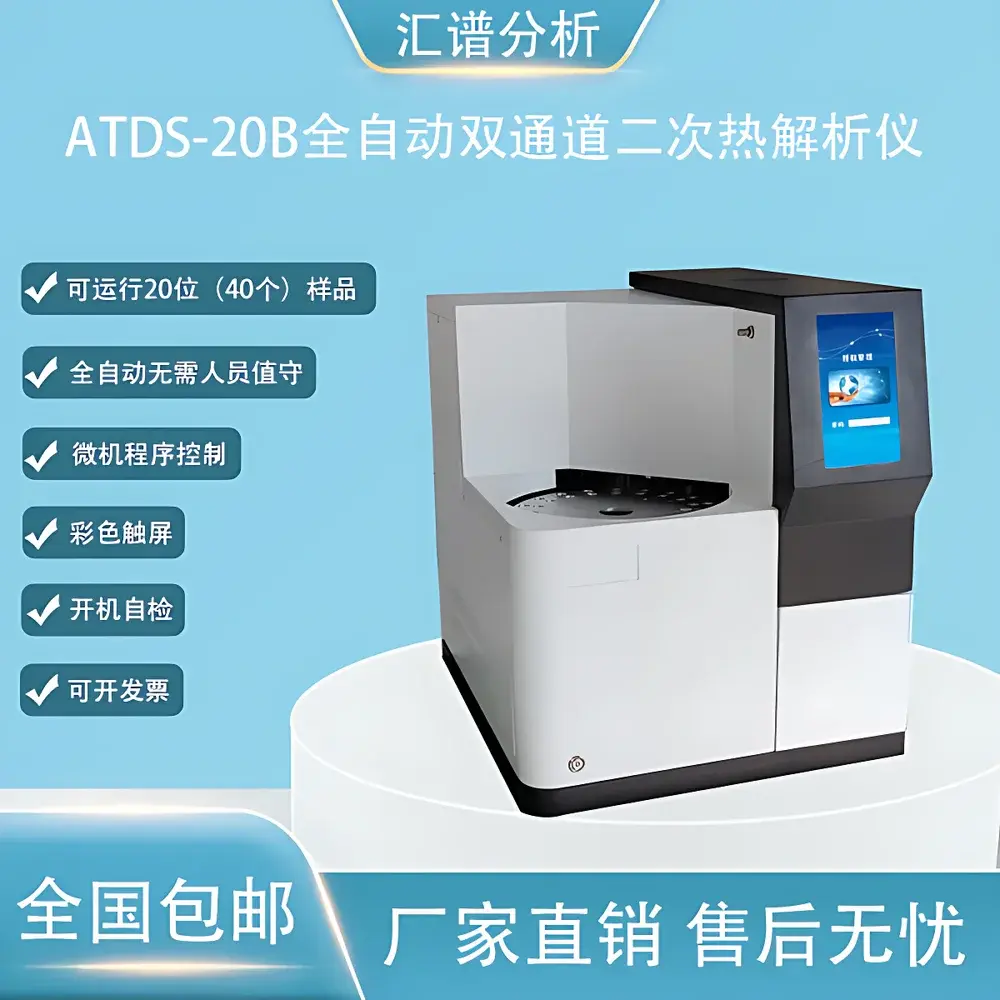
Beifen Sanpu ASTD-20B Dual-Channel Fully Automated Two-Stage Thermal Desorber
| Brand | Beifen Sanpu |
|---|---|
| Origin | Guangdong, China |
| Manufacturer Type | Direct Manufacturer |
| Product Category | Domestic |
| Model | ASTD-20B |
| Instrument Type | Two-Stage Thermal Desorber / Thermal Desorber |
| Automation Level | Fully Automated |
| Primary Desorption Temperature Range | Ambient to 450 °C (1 °C increments) |
| Valve Injection Zone Temperature Range | Ambient to 300 °C (1 °C increments) |
| Transfer Line Temperature Range | Ambient to 450 °C (1 °C increments) |
| Cryo-Focusing Trap Temperature Range | −35 °C to Ambient (1 °C increments) |
| Temperature Control Accuracy | < ±0.5 °C |
| Desorption Recovery Rate | >99% (compound-dependent) |
| Sample Capacity | 40 positions (dual 20-position trays) |
| Secondary Desorption Heating Rate | >3000 °C/min |
| Relative Standard Deviation (RSD) | ≤2.5% (benzene in 0.05 μg methanol) |
| Enrichment Time | 0–60 min |
| Injection Time | 0–60 min |
| Purge/Backflush Flow | 0–100 mL/min (adjustable) |
| Simulated Sampling Flow | 0–160 mL/min (adjustable) |
| Tube Format | 1/4″ OD × 3.5″ length (ASTM D6196-compliant) |
| Interface | Motor-driven 6-port switching valve |
| Dimensions | 350 × 450 × 550 mm (W × D × H) |
| Weight | ~40 kg |
Overview
The Beifen Sanpu ASTD-20B is a dual-channel, fully automated two-stage thermal desorber engineered for high-fidelity quantitative analysis of volatile and semi-volatile organic compounds (VOCs and SVOCs) in ambient air, indoor environments, building materials, automotive cabin air, and industrial emission samples. It operates on the principle of sequential thermal desorption: first-stage desorption releases analytes from sorbent tubes under controlled heating and inert gas flow; analytes are then refocused onto a cryogenically cooled trap (−35 °C minimum); finally, rapid secondary desorption (>3000 °C/min) delivers a narrow, solvent-free analyte band into the GC or GC-MS inlet. This two-stage architecture significantly enhances sensitivity, peak shape symmetry, and chromatographic resolution—critical for compliance with low-concentration regulatory methods such as EPA TO-17, ISO 16017-1, and HJ 644–2013. The instrument is designed for seamless integration with any commercial gas chromatograph or GC-MS system via standardized pneumatic and electronic interfaces.
Key Features
- Fully automated dual 20-position sample carousel (40 total slots), enabling unattended overnight operation with programmable sequence control.
- Independent, precision temperature control across four critical zones: primary desorption oven (ambient–450 °C), secondary desorption zone (ambient–450 °C), valve manifold (ambient–300 °C), and transfer line (ambient–450 °C), all regulated to < ±0.5 °C accuracy.
- Integrated Peltier-based cryo-trap with adjustable setpoint from −35 °C to ambient, ensuring efficient analyte focusing without liquid cryogens.
- Motor-driven 6-port switching valve with inert, passivated flow paths and automated backflush capability (0–100 mL/min) to eliminate carryover between samples.
- Onboard simulated sampling module (0–160 mL/min flow control) for direct preparation of calibration standards and working curves without external gas dilution systems.
- 7-inch capacitive touchscreen interface with real-time status animation, method navigation, and local parameter editing; supports English/Chinese language toggle and multi-user role-based access control with audit-trail logging.
- USB 2.0 host interface for direct PC communication; full method definition—including time-segmented dry purge, adsorption, primary desorption, cryo-trap focusing, secondary desorption, injection, and post-run valve/line backflush—is performed via dedicated Windows-based software compliant with GLP data integrity requirements.
Sample Compatibility & Compliance
The ASTD-20B accepts standard 1/4″ OD × 3.5″ stainless steel or glass sorbent tubes meeting ASTM D6196 and ISO 16017-1 dimensional specifications. Its robust thermal management and low-diffusion pneumatic design ensure compatibility with common multi-bed sorbents (e.g., Tenax TA, Carbopack B/C, Carboxen 1000) and supports both single- and multi-step desorption protocols. The system meets technical performance criteria outlined in Chinese national standards including HJ 644–2013 (ambient VOCs), HJ 583–2010 (benzene series), GB/T 18883–2022 (indoor air quality), HJ 734–2014 (stationary source emissions), and GB 50325–2020 (civil construction). All temperature zones are calibrated traceably to NIST-traceable references, and software supports 21 CFR Part 11–compliant electronic signatures, user authentication, and immutable audit trails for regulated laboratory environments.
Software & Data Management
Control and data acquisition are managed through Beifen Sanpu’s proprietary ThermalDesorb Pro™ software (v3.2+), compatible with Windows 10/11. The software provides comprehensive method development tools, including time-segmented event scheduling, real-time graphical monitoring of temperature and pressure profiles, automatic GC start synchronization, and export of raw desorption parameters (e.g., trap temperature ramp rates, valve timing, flow profiles) alongside chromatographic metadata. All method files, run logs, and audit records are stored in encrypted SQLite databases with configurable backup intervals. Software-generated reports include full system self-test results, calibration verification logs, and RSD validation summaries (e.g., benzene recovery at 0.05 μg level), supporting ISO/IEC 17025 and CNAS accreditation documentation requirements.
Applications
- Regulatory environmental monitoring: ambient air, workplace air, and stack emissions per HJ 644–2013, HJ 734–2014, and GB 12/524–2020.
- Indoor air quality assessment in residential, commercial, and educational buildings per GB/T 18883–2022 and GB 50325–2020.
- VOC profiling in automotive interior materials and cabin air (HJ/T 400–2007).
- Quality control of polymer, adhesive, coating, and composite materials for residual monomer and extractable organics.
- Forensic and occupational hygiene investigations requiring trace-level benzene, toluene, ethylbenzene, xylenes (BTEX), aldehydes, and C2–C12 hydrocarbons.
FAQ
What sorbent tube formats are supported?
The ASTD-20B accepts standard 1/4″ OD × 3.5″ (8.9 mm × 89 mm) stainless steel or glass tubes conforming to ASTM D6196 and ISO 16017-1 physical dimensions. Custom-length tubes require mechanical adapter verification.
Does the system support 21 CFR Part 11 compliance?
Yes—ThermalDesorb Pro™ software includes role-based user accounts, electronic signatures, audit trail generation (with timestamped operator actions), and tamper-evident data storage, satisfying core requirements for FDA-regulated laboratories.
Can the instrument be synchronized with third-party GC data systems?
Yes—via TTL trigger output and USB command protocol, the ASTD-20B initiates GC acquisition automatically and accepts external start commands from ChromaTOF, MassHunter, Chromeleon, or OpenLab CDS platforms.
Is liquid nitrogen required for cryo-focusing?
No—the integrated thermoelectric (Peltier) cooling system achieves −35 °C without consumables, reducing operational cost and improving lab safety and workflow continuity.
How is carryover minimized between samples?
Through automated high-flow backflush of the valve manifold and transfer line (0–100 mL/min) prior to each desorption cycle, combined with passivated stainless-steel internal surfaces and inert gas purging during idle periods.





