
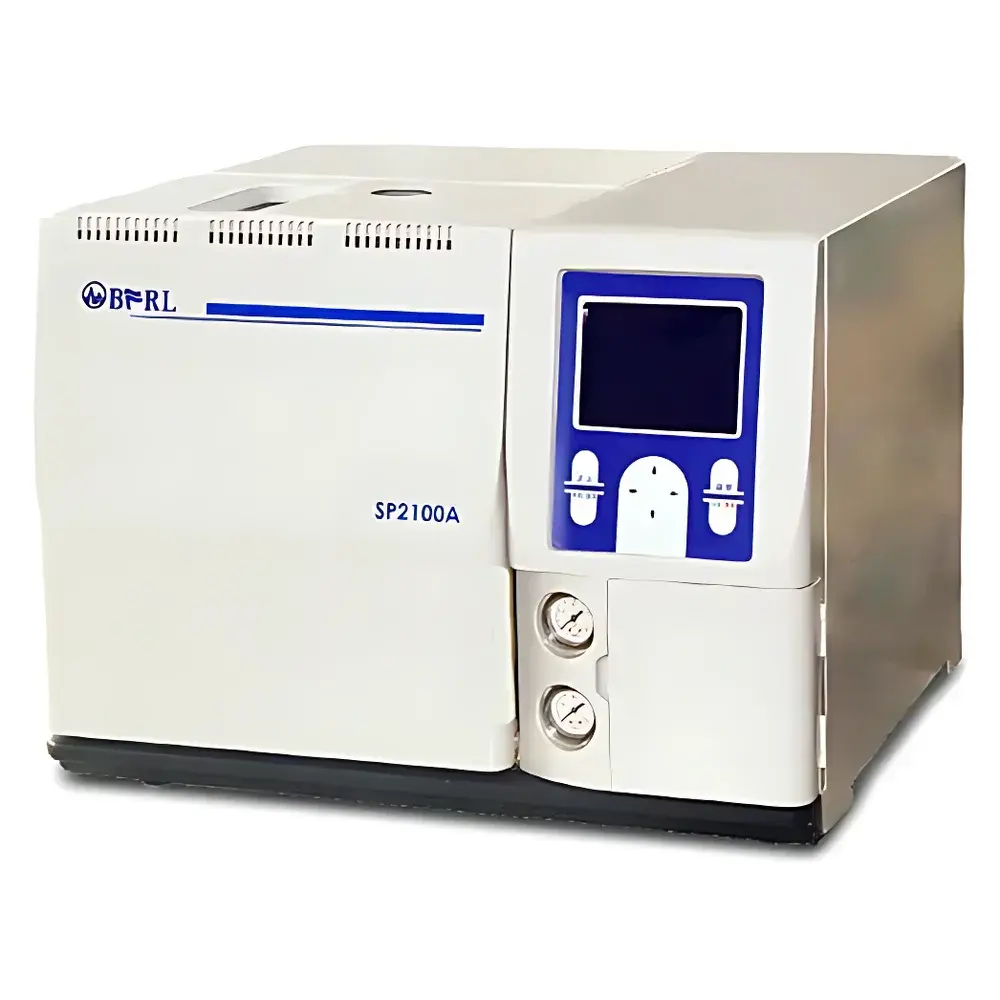
SP-2100A Gas Chromatograph with Microcomputer Remote Control
| Brand | Beifen Sanpu |
|---|---|
| Origin | Beijing, China |
| Manufacturer Type | Direct Manufacturer |
| Region of Origin | Domestic (China) |
| Model | SP-2100A |
| Instrument Type | Laboratory Gas Chromatograph |
| Application Scope | General-Purpose |
| Oven Temperature Range | 20 °C to 400 °C |
| Ramp Rate | 0.1–40 °C/min |
| Cool-Down Rate | 400 °C → 20 °C |
| Carrier Gas Flow Range & Control | 0–1200 mL/min |
| Carrier Gas Pressure Range & Control | 0–970 kPa |
| Injector Maximum Operating Temperature | 400 °C |
| Injector Pressure Setpoint Range | 0–970 kPa |
| Injector Total Flow Setpoint Range | 0–1200 mL/min |
| Detector Options | TCD, FID, ECD, FPD |
| TCD Sensitivity | ≥5000 mV·mL/mg n-C₁₆ |
| FID Detection Limit | ≤1×10⁻¹¹ g/s |
| ECD Detection Limit | ≤4×10⁻¹³ g/s (α-HCH) |
| FPD [P] Detection Limit | ≤5×10⁻¹² g/s (parathion) |
| FPD [S] Detection Limit | ≤1×10⁻¹⁰ g/s (parathion) |
| Column Oven Programmable Steps | 5-stage ramp |
| Injector Configurations | Dual packed-column injectors + 1 capillary injector |
| Power Supply | AC 220 V ±10%, 50 Hz ±0.5 Hz, 15 A |
| Dimensions (W×D×H) | 445 × 550 × 560 mm |
| Net Weight | ~38 kg |
Overview
The SP-2100A Gas Chromatograph is a benchtop laboratory-scale analytical instrument engineered for precision separation and quantitative detection of volatile and semi-volatile organic compounds. Based on the fundamental principle of gas–solid or gas–liquid partition chromatography, it utilizes an inert carrier gas (e.g., helium, nitrogen, or hydrogen) to transport vaporized sample components through a temperature-controlled column, where differential retention enables compound resolution. Designed as an evolution of the SP-2100 platform, the SP-2100A integrates microprocessor-based remote control architecture with full Chinese-language UI support—optimized for laboratories in regulatory, academic, and industrial environments where operational familiarity and traceability are essential. Its robust thermal management system, multi-detector compatibility, and programmable temperature gradients support method development aligned with ASTM D3612, ISO 10302, USP , and EPA Method 8021B.
Key Features
- Four Independent Temperature Zones: Fully programmable control of column oven, dual injector compartments, and detector blocks (TCD, FID, ECD, or FPD), each maintaining stability within ±0.1 °C over full operating range (20–400 °C).
- Five-Stage Programmable Ramp: Linear heating rates adjustable from 0.1 to 40 °C/min, supporting complex elution profiles for multi-component mixtures without peak co-elution.
- Multi-Injector Flexibility: Simultaneous installation of two packed-column injectors and one split/splitless capillary injector, enabling method transfer between legacy and modern column formats.
- Real-Time Baseline Correction: On-the-fly zero adjustment prior to injection ensures signal integrity and minimizes baseline drift during extended sequence runs.
- Comprehensive Self-Diagnostic Routine: Automated power-on verification of heater circuits, valve actuation, detector bias, and communication bus integrity—with fault codes displayed in plain Chinese text for rapid troubleshooting.
- Carrier Gas Management System: Digital mass flow and pressure controllers deliver stable, reproducible flow (0–1200 mL/min) and pressure (0–970 kPa) across all operating conditions, critical for retention time repeatability and method robustness.
Sample Compatibility & Compliance
The SP-2100A accommodates a broad spectrum of sample matrices—including aqueous extracts, solvent-diluted residues, headspace vapors, and direct liquid injections—when paired with appropriate column chemistry (e.g., DB-5ms, HP-INNOWAX, or Porapak Q). It meets functional requirements for routine analysis under GLP-compliant workflows when operated with audit-trail-enabled data acquisition software. While not pre-certified for FDA 21 CFR Part 11, its deterministic control architecture and parameter logging capability provide foundational traceability required for GMP-aligned validation protocols. Regulatory applicability includes environmental monitoring (EPA SW-846), food safety screening (AOAC 996.06), and pharmaceutical residual solvent testing (ICH Q2(R2)).
Software & Data Management
Control and data acquisition are executed via embedded firmware with optional PC-based software (Windows-compatible, USB/RS-232 interface). The system supports export of raw chromatograms (.csv, .txt), integration reports, and calibration curves compliant with LIMS ingestion standards. All method parameters—including temperature programs, detector settings, and flow configurations—are stored with timestamped versioning. Audit trail functionality (optional add-on module) records user logins, parameter changes, and run initiation events—enabling alignment with ISO/IEC 17025 clause 7.7 and internal quality assurance procedures.
Applications
- Environmental analysis: VOCs in air/water per EPA TO-17 and Method 502.2
- Petrochemical QA/QC: Hydrocarbon distribution in gasoline, diesel, and lubricants (ASTM D5186, D6730)
- Agricultural chemistry: Pesticide residue screening in soil and produce (AOAC 2007.01)
- Pharmaceutical manufacturing: Residual solvents in APIs and excipients (USP )
- Public health: Disinfection by-products (e.g., chloroform, bromodichloromethane) in drinking water
- Academic research: Reaction monitoring, polymer degradation studies, and metabolite profiling
FAQ
Is the SP-2100A compatible with third-party chromatography data systems (CDS)?
Yes—via ASCII-based data export and standard RS-232/USB serial protocols, it interfaces with common CDS platforms including OpenLab CDS, Chromeleon, and Empower when configured with appropriate drivers.
Can the instrument be validated for GxP environments?
The hardware architecture supports IQ/OQ documentation; PQ execution requires site-specific protocol development and use of qualified software modules with electronic signature and audit trail capabilities.
What maintenance intervals are recommended for detector components?
FID jet cleaning every 200 injections; TCD filament inspection quarterly; ECD Ni-63 source replacement every 2–3 years depending on usage intensity and sample cleanliness.
Does the system support unattended operation overnight?
Yes—programmable start/stop sequences, auto-shutdown after final run, and thermal safety cutoffs at 450 °C ensure safe extended operation.
Are consumables such as septa, liners, and columns available through the manufacturer?
Beifen Sanpu supplies OEM-certified inlet septa, glass liners, and GC column bundles—including custom-cut lengths and phase-matched options for method transfer.





