
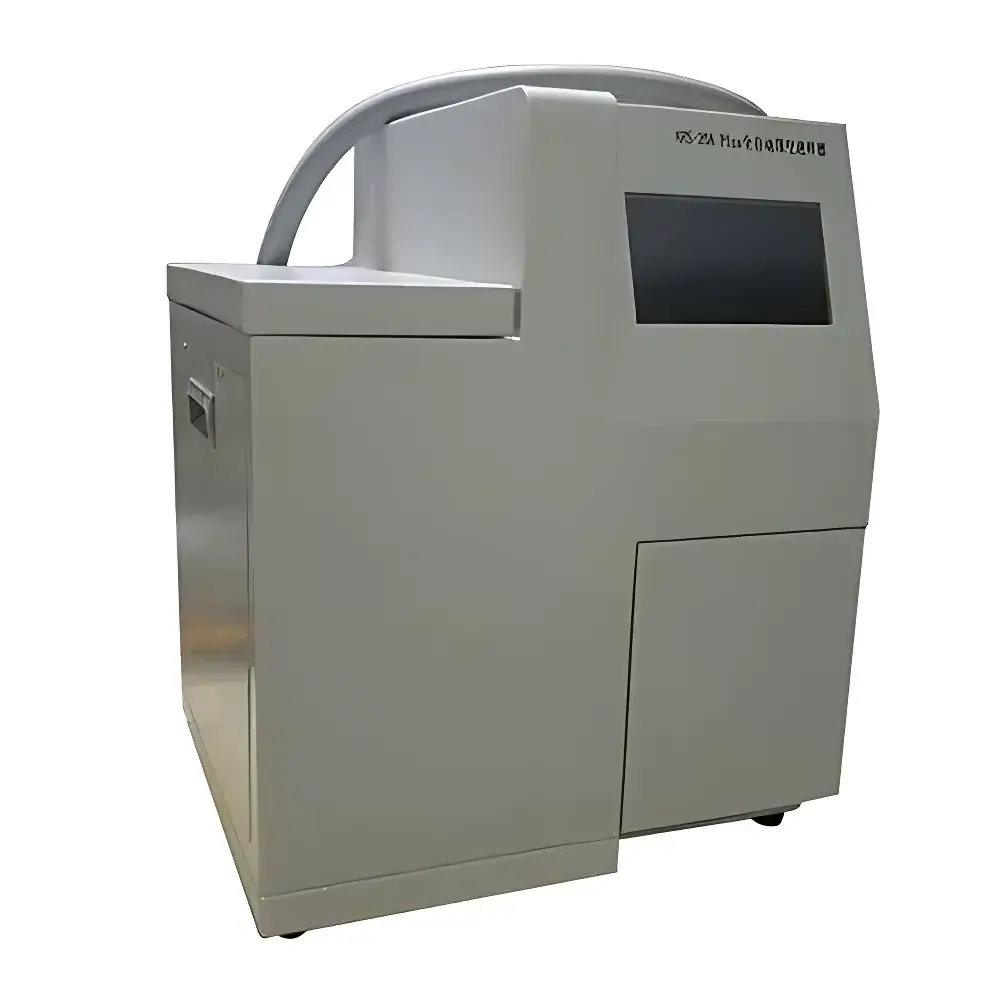
Beifen Sanpu AHSD-20A Plus Fully Automated Headspace Sampler
| Brand | Beifen Sanpu |
|---|---|
| Model | AHSD-20A Plus |
| Origin | Beijing, China |
| Manufacturer Type | Direct Manufacturer |
| Heating Range (Sample/Valve/Transfer Line) | 40–220 °C (configurable up to 300 °C) |
| Temperature Accuracy | ±0.5 °C |
| Temperature Stability | <±0.5 °C |
| Pressure Range | 0–0.25 MPa (continuously adjustable) |
| Pressurization Time | 0–999 s |
| Sampling Time | 0–30 min |
| Injection Time | 0–999 s |
| Purge Time | 0–30 min |
| Minimum Time Resolution | 1 ms |
| Quantitative Loop Volume | 1 mL (customizable: 0.5 / 2 / 5 mL) |
| Vial Capacity | 10 mL or 20 mL (customizable: 50 / 100 mL) |
| Sample Positions | 20 |
| Simultaneous Heating Zones | 1 or 2 |
| RSD (Ethanol in Water, 100 ppm) | <1.0% |
| Purge Flow Rate | 0–100 mL/min (adjustable) |
| Communication Interface | USB |
| Compliance | ASTM D6866, ISO 17025-compatible operation |
Overview
The Beifen Sanpu AHSD-20A Plus Fully Automated Headspace Sampler is a precision-engineered sample introduction system designed for quantitative analysis of volatile and semi-volatile organic compounds (VOCs and SVOCs) in complex matrices—including aqueous solutions, polymers, pharmaceuticals, foodstuffs, and environmental solids—prior to gas chromatographic separation. It operates on the principle of equilibrium headspace analysis: sealed sample vials are heated to a controlled temperature, allowing analytes to partition into the vapor phase above the matrix. A precisely metered volume of this equilibrated headspace gas is then transferred under positive pressure through a thermally insulated pathway directly into the GC injector. This method eliminates solvent interference, minimizes matrix effects, and delivers high reproducibility without derivatization or extraction solvents. The AHSD-20A Plus implements a robust, motor-driven actuation architecture—requiring no external carrier gas for mechanical operation—ensuring intrinsic safety, reduced infrastructure dependency, and long-term operational stability in regulated laboratory environments.
Key Features
- 20-position rotary sample carousel with automatic vial detection and intelligent position fault avoidance—prevents mechanical collision during unattended operation
- Triple-zone independent temperature control (sample oven, valve block, transfer line), each calibrated to ±0.5 °C stability and configurable up to 300 °C for high-boiling analyte applications
- High-inertness fluidic path: de-activated fused-silica capillary tubing and electropolished stainless-steel components minimize adsorption, carryover, and memory effects
- Optimized low-dead-volume configuration: heated six-port valve integrated within the thermal enclosure, eliminating cold spots and preserving analyte integrity during transfer
- Sub-millisecond time resolution (1 ms) for pressurization, sampling, injection, and purge cycles—enabling precise kinetic method development
- Full USB-based bidirectional communication with GC systems and chromatography data systems (CDS); supports synchronized start/stop triggers and remote parameter configuration
- Self-diagnostic firmware with real-time status monitoring, automatic carousel homing, and hardware fault logging (e.g., heater failure, motor stall, sensor disconnect)
- Multi-mode sampling logic: single-vial multi-injection, single-vial single-injection, and sequential multi-vial single-injection—programmable per sequence
- EPC (Electronic Pressure Control) option available for enhanced pressure regulation accuracy and method transferability across instrument platforms
Sample Compatibility & Compliance
The AHSD-20A Plus accommodates standard 10 mL and 20 mL crimp-top headspace vials, with custom configurations available for 50 mL and 100 mL formats to support regulatory batch testing and residual solvent analysis per ICH Q3C guidelines. Its inert flow path and low-RSD performance (<1.0% RSD at 100 ppm ethanol in water) meet routine QC requirements for pharmaceutical stability studies, forensic toxicology, and environmental VOC screening. The system supports GLP/GMP-aligned workflows when paired with 21 CFR Part 11-compliant CDS software, providing electronic signatures, audit trails, and user-access controls. Method validation parameters—including linearity, LOD/LOQ, precision, and recovery—are fully traceable using built-in timing logs and event timestamps synchronized with GC acquisition.
Software & Data Management
All operational parameters—including temperature setpoints, timing sequences, pressure profiles, and purge flows—are configurable either locally via the 7-inch TFT LCD interface or remotely via USB-connected PC software. The embedded GUI features animated workflow diagrams that visually map valve switching, heating stages, and gas transfer events—reducing operator training time and minimizing configuration errors. Sequence files store full method metadata (date/time stamp, operator ID, vial positions, calibration history) and export as CSV or XML for LIMS integration. When interfaced with third-party GC workstations (Agilent OpenLab, Thermo Chromeleon, Shimadzu GC Solutions), the sampler transmits hardware-level status codes and accepts external trigger signals—ensuring deterministic synchronization without timing drift.
Applications
- Residual solvent analysis in APIs and excipients per USP and Ph. Eur. 2.4.24
- VOC profiling in drinking water (EPA Method 502.2, 524.4) and soil headspace (EPA Method 8260D)
- Flavor and fragrance release kinetics in packaged foods and beverages
- Monomer quantification in polymer manufacturing (e.g., styrene, vinyl chloride, acrylonitrile)
- Alcohol content determination in forensic blood samples (headspace-GC-FID)
- Stability-indicating assays for oxidized lipids and degradation volatiles in biologics formulations
FAQ
Does the AHSD-20A Plus require external compressed air or nitrogen for valve actuation?
No—it uses brushless DC motors for all mechanical movements, eliminating dependence on auxiliary gases and reducing safety hazards in confined lab spaces.
Can the system be validated for GMP environments?
Yes—when operated with a 21 CFR Part 11-enabled CDS and documented IQ/OQ protocols, it supports full GMP compliance including electronic records, audit trails, and role-based access control.
Is customization available for non-standard vial sizes or elevated temperature requirements?
Yes—custom heating modules (up to 300 °C), extended vial trays (50/100 mL), and specialty inertized needles or valves can be factory-integrated upon request.
How does the system handle vial positioning errors or missing vials?
Integrated optical sensors detect vial presence and orientation; the controller automatically skips empty positions and recalibrates carousel indexing to maintain sequence integrity.
What maintenance intervals are recommended for long-term reliability?
Routine inspection of septa and O-rings every 500 injections; quantitative loop cleaning with methanol every 2,000 runs; annual calibration verification using NIST-traceable temperature probes and pressure standards.




