
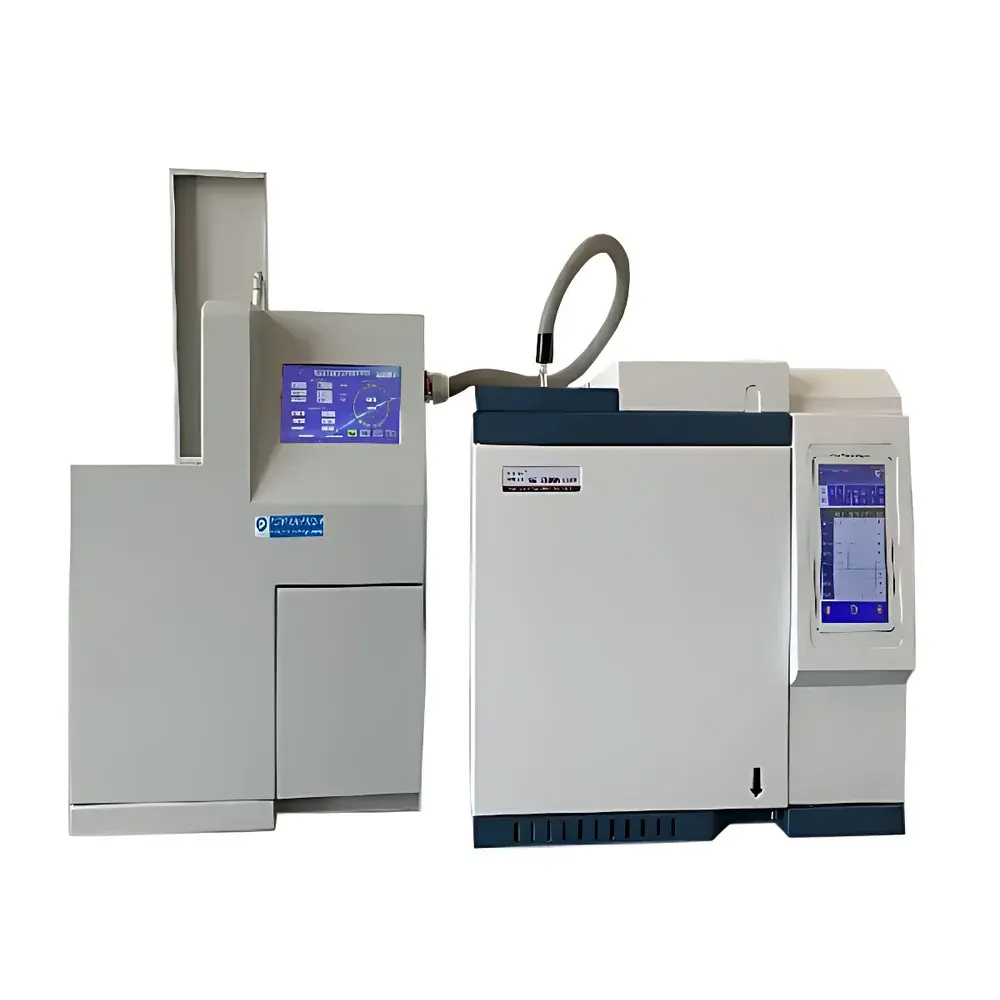
Beifen Sanpu AzHS-20A Plus Fully Automated Static Headspace Sampler
| Brand | Beifen Sanpu |
|---|---|
| Origin | Beijing, China |
| Manufacturer Type | Direct Manufacturer |
| Instrument Type | Static Headspace Sampler |
| Automation Level | Fully Automated |
| Sample Vial Capacity | 20 positions |
| Vial Size Compatibility | 10 mL or 20 mL |
| Vial Heating Range | Ambient to 200 °C (1 °C increments) |
| Valve & Transfer Line Temperature Range | 40–220 °C (±1 °C accuracy) |
| Quantitative Loop Volume | 1 mL |
| Pressure Control Range | 0–0.25 MPa (continuously adjustable) |
| Sampling Time | 0–30 min |
| Injection Time | 0–999 s |
| Wash Time | 0–30 min |
| RSD | <1.0% (at 100 ppm ethanol in water) |
Overview
The Beifen Sanpu AzHS-20A Plus is a fully automated static headspace sampler engineered for precise, reproducible, and unattended volatile compound analysis in conjunction with gas chromatography (GC). It operates on the fundamental principle of phase equilibrium partitioning: solid or liquid samples are heated in sealed vials to establish vapor-phase equilibrium between the sample matrix and its headspace. A precisely metered volume of equilibrated headspace gas is then transferred—via pressurized, temperature-controlled pathways—to the GC injection port using a high-inertness six-port valve and fixed-volume loop. This method eliminates matrix interference, minimizes carryover, and delivers exceptional sensitivity for trace-level volatiles such as residual solvents, environmental contaminants, flavor compounds, and sterilant residuals—including ethylene oxide (EO)—in pharmaceutical, medical device, food, environmental, and polymer applications.
Key Features
- Fully automated 20-position carousel with intelligent vial detection: automatically skips empty or misaligned positions to prevent mechanical collision and ensure operational continuity.
- Triple-zone independent temperature control: sample vial oven (ambient to 200 °C), valve block (40–220 °C), and transfer line (40–220 °C), all maintained within ±1 °C stability and <0.5 °C long-term drift.
- High-inertness fluidic path: all internal tubing, quantitative loop (1 mL standard), and valve surfaces are passivated with proprietary deactivation treatment to eliminate adsorption, catalytic degradation, and cross-contamination—critical for reactive analytes like EO, aldehydes, and low-molecular-weight halocarbons.
- Positive-pressure sampling architecture: enables robust, baseline-stable injections without carrier gas disturbance; compatible with both liquid and solid matrices without derivatization or extraction.
- 7-inch graphical LCD interface with animated workflow guidance: supports full local operation—including method setup, real-time status monitoring, and diagnostic logging—while also enabling remote configuration via USB-connected PC.
- Comprehensive system diagnostics: automatic power-on self-test, positional encoder validation, thermal fault detection, pressure sensor verification, and motion error handling with safe shutdown protocols.
- Flexible sampling modes: single-vial multi-injection, single-vial single-injection, or sequential multi-vial single-injection—programmable down to 1 ms time resolution for optimized method development.
Sample Compatibility & Compliance
The AzHS-20A Plus accommodates standard 10 mL and 20 mL crimp-top headspace vials (custom sizes available upon request), supporting diverse sample types including aqueous solutions, polymers, pharmaceutical tablets, medical device packaging, soil slurries, and food matrices. Its design aligns with internationally recognized analytical standards governing residual solvent and volatile contaminant testing, including ISO 10993-7 (biological evaluation of medical devices—EO residue), USP (Residual Solvents), EP 2.4.24, and Chinese Pharmacopoeia 2020 Edition Vol. IV (Headspace GC Method). The instrument’s thermal precision, pressure repeatability, and inert flow path meet the technical prerequisites for GLP-compliant laboratories performing EO release testing per GB/T 16886.7–2015 and ASTM F1838–22. All critical parameters—including temperature setpoints, pressure values, timing sequences, and event logs—are timestamped and exportable for audit readiness.
Software & Data Management
The AzHS-20A Plus integrates seamlessly with third-party GC data systems via TTL/RS-232 or USB-triggered synchronization. It supports full method parameter upload/download through Beifen Sanpu’s BF-2002 Chromatographic Data Processing Software (Windows-based), which provides 21 CFR Part 11–compliant user access controls, electronic signatures, audit trail generation, and raw data integrity assurance. All instrument events—including vial position indexing, heating ramp profiles, valve actuation timestamps, pressure transients, and error codes—are logged internally with date/time stamps and retained for ≥30 days. Export formats include CSV and XML for LIMS integration. Optional EPC (Electronic Pressure Control) module enhances carrier gas consistency across multi-day unattended runs, improving retention time stability and quantitative reproducibility.
Applications
This headspace sampler is routinely deployed in regulated quality control environments for: residual ethylene oxide quantification in sterilized medical devices and implants; residual solvents (e.g., acetone, methanol, dichloromethane) in pharmaceutical excipients and APIs per ICH Q3C guidelines; volatile organic compounds (VOCs) in drinking water (HJ 810–2016, GB 5749–2022); flavor and fragrance profiling in beverages and cosmetics; monomer migration testing in food-contact plastics (SN/T 4068–2014); and VOC screening in soil and sediment per HJ 642–2013 and HJ 736–2015. Its robustness and method flexibility make it suitable for routine QC labs, contract testing organizations, and R&D facilities requiring high-throughput, low-maintenance headspace analysis.
FAQ
Is the AzHS-20A Plus compatible with non-Beifen Sanpu gas chromatographs?
Yes—it features universal TTL and USB triggering interfaces and is validated for interoperability with Agilent, Shimadzu, Thermo Fisher, and PerkinElmer GC systems.
Can the instrument be used for dynamic headspace or purge-and-trap applications?
No—the AzHS-20A Plus is designed exclusively for static headspace analysis; dynamic methods require dedicated purge-and-trap instrumentation.
What maintenance is required to sustain optimal performance?
Recommended quarterly inspection of septa, valve rotor seal integrity, and quantitative loop cleanliness; annual calibration of temperature sensors and pressure transducers using NIST-traceable references.
Does the system support 21 CFR Part 11 compliance out of the box?
Full compliance requires use of BF-2002 software with enabled audit trail, role-based permissions, and electronic signature modules—hardware-level event logging is embedded.
Can the 1 mL loop be replaced with alternative volumes?
Yes—0.5 mL, 2 mL, and 5 mL loops are available as factory-installed options; custom configurations require recalibration and validation documentation.
Related Products




