
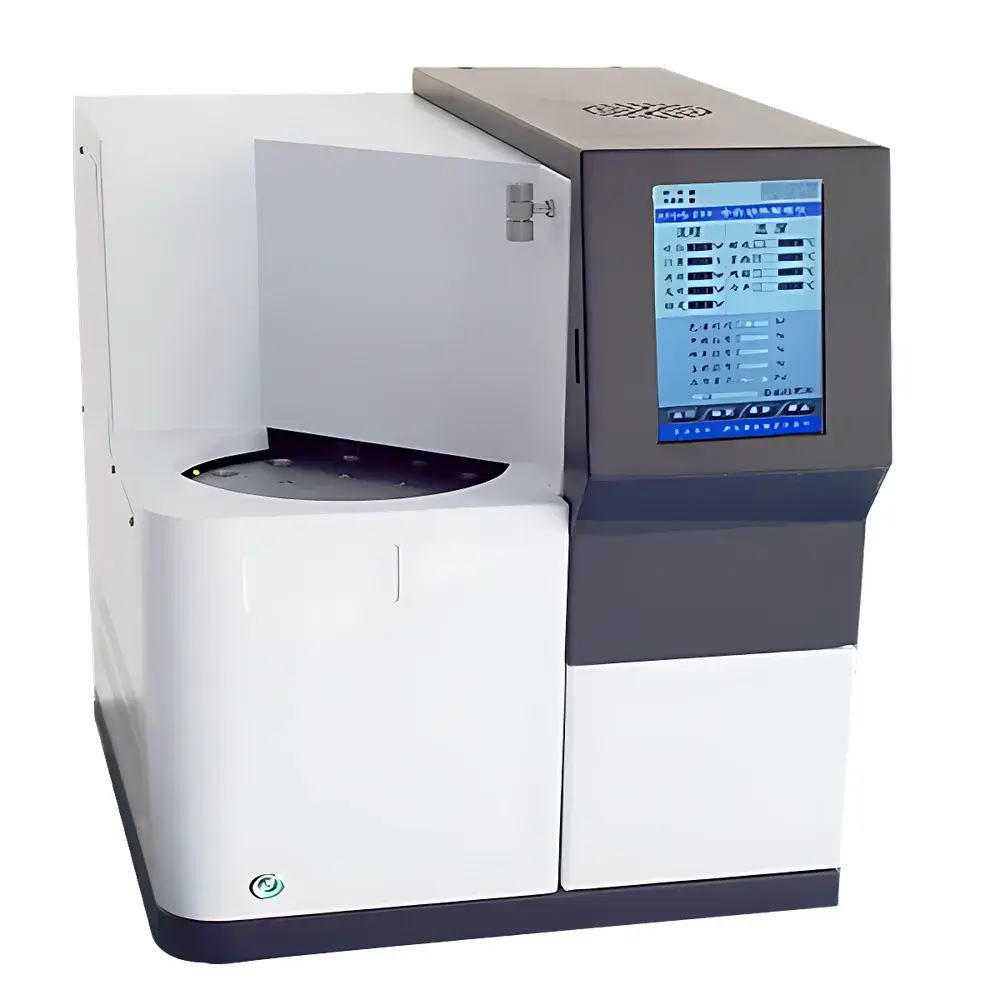
Beifen Sanpu A1TDS-20A Low-Temperature Cold Trap Automated Two-Stage Thermal Desorber
| Brand | Beifen Sanpu |
|---|---|
| Origin | Beijing, China |
| Manufacturer Type | Manufacturer |
| Country of Origin | Domestic (China) |
| Model | A1TDS-20A |
| Price | USD 21,800 (approx. based on ¥156,000 at 7.15 exchange rate) |
| Sample Capacity | 20 positions |
| Cold Trap Range | −35 °C to ambient |
| Primary Desorption Temp | up to 450 °C |
| Secondary Desorption Temp | up to 450 °C |
| Valve & Transfer Line Temp | up to 300 °C |
| Temperature Resolution | 1 °C |
| Temp Stability | ±0.5 °C |
| Recovery Rate | >99% (compound-dependent) |
| RSD | ≤2.5% (benzene at 0.05 μg) |
| Enrichment Time | 0–60 min |
| Injection Time | 0–60 min |
| Carrier Gas Flow Control | 0–100 mL/min (purge/flush), 0–160 mL/min (simulated sampling) |
| Sample Tube Format | 1/4″ OD × 3.5″ (ASTM D6196-compliant) |
| Interface | Motorized 6-port valve |
| Power Supply | 24 V DC for transfer line |
| Dimensions | 350 × 450 × 510 mm (W × D × H) |
| Weight | ~40 kg |
Overview
The Beifen Sanpu A1TDS-20A Low-Temperature Cold Trap Automated Two-Stage Thermal Desorber is a fully integrated, laboratory-grade thermal desorption system engineered for high-fidelity volatile organic compound (VOC) and semi-volatile organic compound (SVOC) analysis in environmental, occupational health, and indoor air quality applications. It implements a two-stage thermal desorption workflow—comprising primary desorption from the sorbent tube, cryofocusing in a thermoelectrically cooled cold trap (−35 °C minimum), and secondary rapid desorption directly into the GC or GC-MS inlet—enabling sharp, reproducible chromatographic peaks with minimal band broadening. This architecture meets the physical requirements of ASTM D6196, ISO 16017-1, and EPA TO-17 methodologies, and is validated for compliance with Chinese national standards including HJ 644–2013, HJ 583–2010, HJ 734–2014, and GB/T 18883–2002. The system is designed for seamless integration with any domestic or international gas chromatograph or GC-MS platform via standardized pneumatic and electronic interfaces.
Key Features
- 20-position automated sample carousel with self-calibrating tray positioning—eliminates manual alignment and ensures positional repeatability across extended unattended runs.
- Four independently controlled temperature zones: primary desorption oven (RT–450 °C), secondary desorption zone (RT–450 °C), valve manifold (RT–300 °C), and heated transfer line (RT–300 °C, powered by isolated 24 V DC supply for safety and stability).
- Integrated Peltier-based cold trap capable of sustained operation down to −35 °C—enables efficient cryofocusing of C2–C16 VOCs and improves detection sensitivity by 5–10× versus single-stage desorption.
- Motor-driven 6-port switching valve with precise dwell-time control—ensures accurate timing for desorption, transfer, back-flush, and GC trigger synchronization.
- Onboard method programming with real-time status animation, runtime tracking, and event logging—supports complex multi-step sequences including pre-desorption bake-out, inert gas purge, cryo-trap conditioning, thermal refocusing, and post-injection trap cleaning.
- Dual functional modes: configurable as either ambient-temperature or low-temperature secondary desorption system—provides flexibility for method development and regulatory alignment.
- Integrated sample tube activation protocol—automatically heats used tubes under controlled flow to remove residual analytes and restore sorbent integrity prior to re-use.
- Simulated sampling module with adjustable flow (0–160 mL/min)—facilitates calibration curve generation without requiring external mass flow controllers or separate sampling hardware.
- Back-flush capability for valve and transfer line (0–100 mL/min, continuously adjustable)—prevents carryover between samples and extends component service life.
- Modular GC interface kit—includes hardware adapters and electrical triggers compatible with Agilent, Thermo Fisher, Shimadzu, PerkinElmer, and major domestic GC platforms.
Sample Compatibility & Compliance
The A1TDS-20A accepts standard 1/4-inch OD × 3.5-inch stainless steel or quartz-lined sorbent tubes conforming to ASTM D6196 geometry specifications. It supports common multi-bed sorbents—including Tenax TA, Carbopack B/C, Carboxen 1000, and graphitized carbon blacks—for broad-spectrum VOC capture. All thermal zones maintain ±0.5 °C stability over full operating ranges, ensuring method robustness under GLP and ISO/IEC 17025 conditions. The instrument’s firmware logs all critical events—including temperature setpoints, valve actuation times, gas flows, and error states—with timestamped records suitable for audit trails. While not natively 21 CFR Part 11 compliant, its event log structure supports export to LIMS or ELN systems meeting FDA-regulated data integrity requirements when deployed within validated laboratory workflows.
Software & Data Management
Operation is managed via an embedded 7-inch capacitive touchscreen running a deterministic real-time OS. Method files (.tds) store complete thermal, pneumatic, and timing parameters and support version control and user-level access restriction. All run data—including actual vs. setpoint temperatures, valve state transitions, and alarm history—are written to non-volatile memory and exportable via USB to CSV or XML. The system provides TTL-level GC start/stop signals and accepts external trigger inputs, enabling synchronization with third-party chromatography data systems (CDS) such as OpenLab, Chromeleon, or GC Image. No proprietary software installation is required on host PCs; remote monitoring is achievable via optional Ethernet-to-RS232 bridge for integration into centralized lab automation networks.
Applications
This thermal desorber is routinely deployed in accredited environmental testing laboratories for analysis of regulated compounds per:
- HJ 644–2013: Ambient air VOCs using TD-GC-MS
- HJ 583–2010: Benzene series in ambient air via TD-GC-FID
- HJ 734–2014: VOCs from stationary emission sources
- GB/T 18883–2002 & GB 50325–2010: Indoor air quality screening for formaldehyde, benzene, toluene, ethylbenzene, xylenes (BTEX), and C3–C12 aliphatics
- HJ/T 400–2007: In-vehicle air assessment for aldehydes and VOCs
It is also applied in materials emissions testing (e.g., carpets, adhesives, insulation), workplace exposure monitoring (NIOSH 2549 adaptation), and forensic trace vapor analysis where cold-trap focusing enhances resolution of co-eluting isomers.
FAQ
What sorbent tube formats are supported?
Standard 1/4″ OD × 3.5″ (6.35 mm × 89 mm) metal or quartz-lined tubes compliant with ASTM D6196. Custom-length tubes require mechanical adapter modification.
Does the system support EPA TO-17 compliance?
Yes—when operated with certified sorbents, calibrated flow controllers, and validated methods, it fulfills TO-17 hardware requirements for two-stage desorption and cold trapping.
Can the cold trap temperature be verified independently?
The Peltier cooling module includes dual NTC sensors—one for control, one for redundant monitoring—with calibration traceability documented in the factory certificate.
Is remote diagnostics available?
Basic status polling is supported via RS232; full remote control requires integration through a lab-wide automation middleware layer (e.g., LabArchives or custom SCADA).
What maintenance intervals are recommended?
Valve lubrication and O-ring inspection every 6 months; cold trap surface cleaning quarterly; sorbent tube holder calibration annually—or after any mechanical impact to the carousel assembly.
Related Products




