
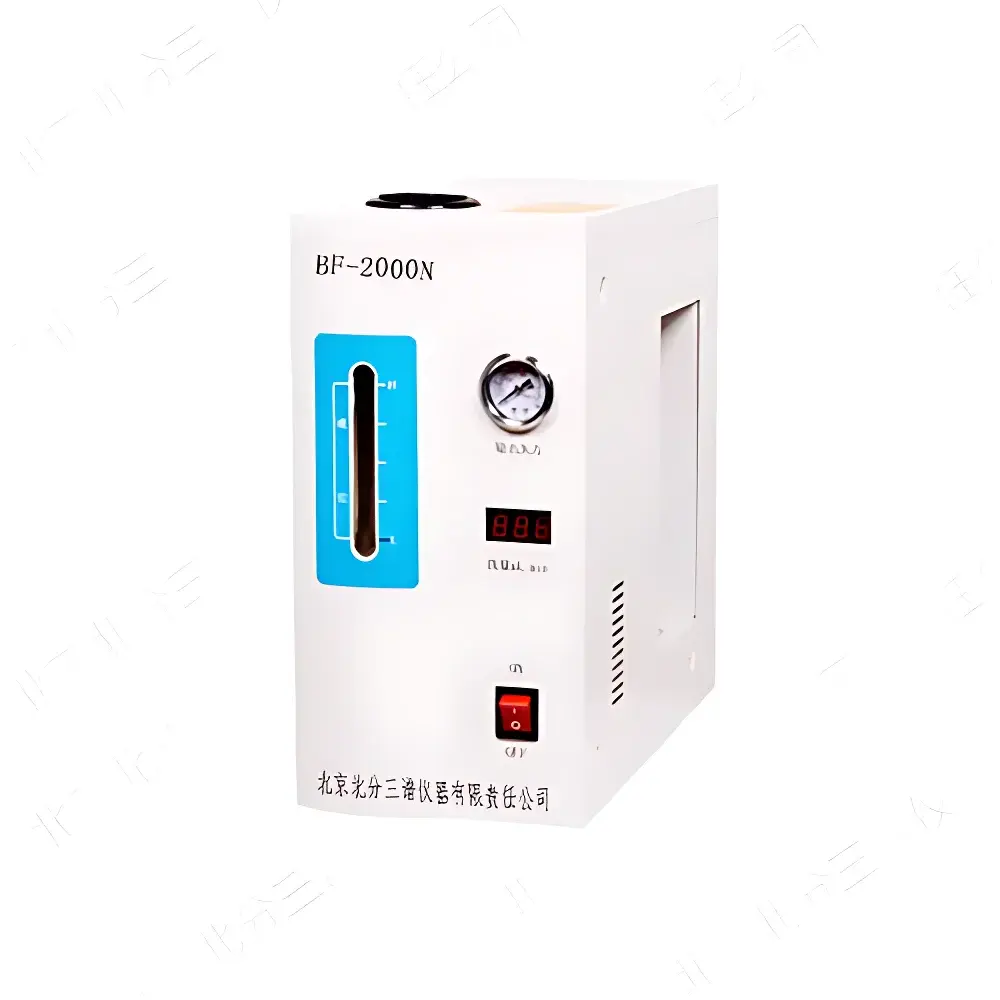
BF-2000N Nitrogen Generator by Beifen Sanpu
| Brand | Beifen Sanpu |
|---|---|
| Origin | Hebei, China |
| Manufacturer Type | Direct Manufacturer |
| Origin Category | Domestic (China) |
| Model | BF-2000N |
| Nitrogen Generation Principle | Electrolytic Membrane Separation |
| Output Flow Rate | 0–2000 mL/min |
| Output Pressure | 0.4 MPa (4 bar) |
| Nitrogen Purity | 99.9% (v/v, residual O₂ < 1000 ppm) |
| Dew Point | −40 °C |
| Input Air Pressure | ≤ 0.5 MPa |
| Power Consumption | 140 W |
| Dimensions (L×W×H) | 360 × 190 × 380 mm |
| Weight | 20 kg |
| Operating Temperature | 10–40 °C |
| Relative Humidity | < 85% RH (non-condensing) |
| Ambient Conditions | Dust-free, non-corrosive environment |
Overview
The BF-2000N Nitrogen Generator is an electrolytic membrane-based gas generation system engineered for reliable, on-demand nitrogen supply in analytical laboratories and industrial process environments. Unlike pressure swing adsorption (PSA) or hollow-fiber membrane systems, this generator employs a proton exchange membrane (PEM) electrolysis cell to separate nitrogen from compressed air feedstock—effectively removing oxygen, water vapor, and trace hydrocarbons through electrochemical oxidation and selective permeation. The resulting nitrogen stream meets ISO 8573-1 Class 2:2:2 specifications for particulate, moisture, and oil content, with a consistent purity of 99.9% (v/v) and a dew point of −40 °C, making it suitable for GC carrier gas, LC-MS blank gas, sample preparation purging, and inert atmosphere maintenance. Designed for continuous or intermittent operation, the BF-2000N integrates seamlessly into existing lab infrastructure without requiring external cryogenic tanks or high-pressure cylinder logistics.
Key Features
- Electrolytic PEM membrane technology ensures stable nitrogen output without consumable adsorbents or periodic regeneration cycles.
- Large-surface-area electrolysis cell operates at low thermal load, extending service life and minimizing maintenance intervals.
- Integrated anti-backflow valve prevents liquid carryover from upstream compressors, eliminating risk of electrolyte contamination or membrane degradation.
- Automated purge sequence at startup removes residual ambient air from internal lines, ensuring rapid stabilization of nitrogen purity within ≤ 5 minutes.
- Fail-safe shutdown logic activates automatic gas-line isolation upon power loss, preventing uncontrolled venting or pressure decay during outage events.
- Front-panel digital display shows real-time flow rate, outlet pressure, and system status indicators; all controls are accessible via tactile push-button interface.
Sample Compatibility & Compliance
The BF-2000N is compatible with standard laboratory-grade compressed air sources meeting ISO 8573-1 Class 3:4:3 requirements (oil content ≤ 0.1 mg/m³, particles ≤ 5 µm, dew point ≤ +3 °C). It delivers nitrogen compliant with ASTM D6299-22 for instrumental gas purity validation and supports method qualification under USP for residual solvent analysis. While not certified to IEC 61000-6-3 for EMC emissions or ATEX for hazardous area use, its design adheres to GLP-aligned operational documentation practices—including logbook-ready event timestamps and manual calibration verification records. The unit satisfies general safety requirements per GB 4793.1–2019 (equivalent to IEC 61010-1) for electrical laboratory equipment.
Software & Data Management
The BF-2000N operates as a standalone hardware system with no embedded firmware or network connectivity. All operational parameters are monitored and adjusted manually, supporting audit-trail integrity in regulated environments where software validation burdens must be minimized. Users may document runtime logs—including date/time stamps, flow setpoints, and pressure readings—in accordance with 21 CFR Part 11 Annex 11 principles when paired with external electronic lab notebooks (ELNs) or LIMS-integrated data capture workflows. Optional analog 0–10 V or 4–20 mA output signals (available upon request) enable integration with building management systems (BMS) or centralized gas monitoring dashboards.
Applications
- Gas chromatography (GC) carrier and detector make-up gas, particularly for FID, TCD, and ECD systems requiring stable, low-moisture nitrogen.
- LC-MS instrument purge and curtain gas supply where oxygen interference must be minimized during ionization.
- Inert blanketing of reagent storage vessels, glove boxes, and synthesis reactors operating below atmospheric oxygen thresholds.
- Sample preparation workflows including headspace vial pressurization, solid-phase extraction (SPE) drying, and nitrogen evaporation concentrators.
- Calibration gas blending support when used in conjunction with precision mass flow controllers (MFCs) and certified reference standards.
FAQ
What compressed air quality is required for optimal BF-2000N performance?
A clean, oil-free air supply meeting ISO 8573-1 Class 3:4:3 is mandatory. Use of coalescing filters and refrigerated dryers upstream is strongly recommended to prevent membrane fouling.
Can the BF-2000N be used as a backup for high-purity (99.99%) applications?
No—its rated purity is 99.9% (1000 ppm O₂), which is insufficient for applications demanding sub-10 ppm oxygen levels such as FTIR purge or ultra-high-vacuum chamber conditioning.
Is routine maintenance required beyond filter replacement?
Yes: inlet particulate filters should be replaced every 6 months under continuous operation; annual inspection of electrolyte level and membrane integrity is advised per manufacturer’s service bulletin.
Does the unit include pressure regulation for downstream instruments?
Yes—the integrated pressure regulator maintains a constant 0.4 MPa output; additional fine-tuning regulators may be added externally for instrument-specific requirements.
How does ambient temperature affect nitrogen dew point stability?
Within the specified 10–40 °C operating range, the −40 °C dew point remains stable; operation below 10 °C may reduce membrane conductivity and delay startup stabilization time.



