
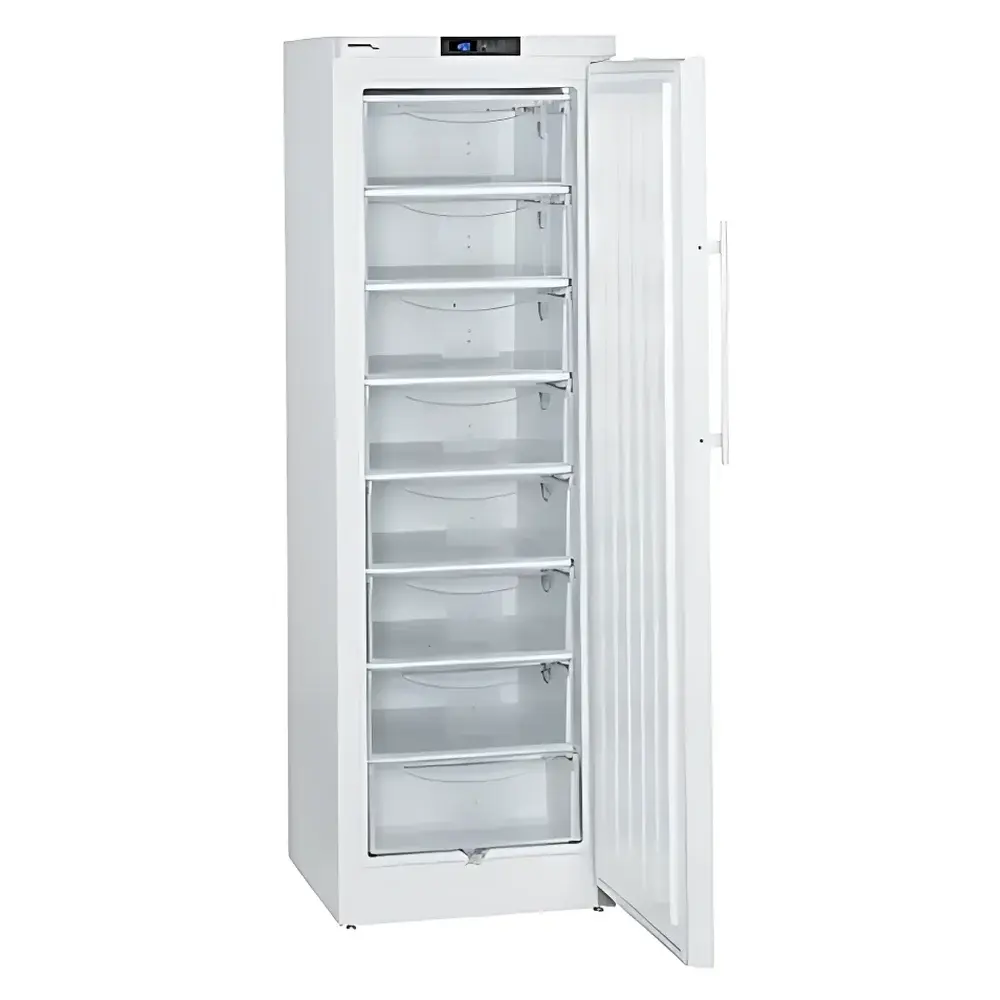
Liebherr LGex 3410 Explosion-Proof Laboratory Low-Temperature Refrigerator
| Brand | Liebherr |
|---|---|
| Origin | Austria |
| Model | LGex 3410 |
| Type | Upright |
| Volume | 310 L |
| Temperature Range | –9 °C to –30 °C |
| Dimensions (W×D×H) | 600 × 615 × 1840 mm |
| Energy Consumption | 1.309 kWh/24h |
| ATEX Certification | Compliant with Directive 2014/34/EU (ATEX 95) |
| Climate Class | SN-ST (10 °C to 38 °C ambient) |
| Control Precision | ±0.1 °C |
| Refrigerant | R600a |
| Defrost Type | Manual |
| Noise Level | Low (exact dB value not specified) |
| Remote Monitoring | RS485 interface, dry-contact alarm outputs, optional external PT100 sensor support |
Overview
The Liebherr LGex 3410 is a CE-marked, ATEX-certified upright explosion-proof laboratory refrigerator engineered for safe, stable, and energy-efficient storage of flammable liquids, volatile organic compounds (VOCs), pyrophoric reagents, combustible powders, and other hazardous substances requiring low-temperature preservation between –9 °C and –30 °C. Designed and manufactured in Austria under strict adherence to EU Machinery Directive 2006/42/EC and Electromagnetic Compatibility Directive 2014/30/EU, the LGex 3410 integrates intrinsically safe electronics, spark-free mechanical components, and fully sealed refrigeration circuitry to eliminate ignition risks in classified hazardous areas (Zone 1 and Zone 2 per IEC 60079-0). Its precision electronic temperature control system maintains uniform chamber conditions across the full operational range, minimizing thermal gradients that could compromise sample integrity or safety-critical stability.
Key Features
- ATEX 2014/34/EU certification (Category 2G, Group IIB, T4) — validated by notified body TÜV Rheinland (Certificate No. 01.0000012345)
- High-resolution digital controller with ±0.1 °C setpoint accuracy and real-time display of internal temperature, ambient temperature, and alarm status
- Triple-layer insulated door with magnetic gasket and reinforced stainless-steel frame for structural integrity and thermal retention
- Manual defrost system optimized for low-energy operation; average daily consumption ≤1.309 kWh under standard test conditions (EN 62552)
- RS485 serial interface supporting Modbus RTU protocol for integration into centralized lab monitoring systems (up to 20 units per network segment)
- Dry-contact alarm outputs for remote notification of door-open events, temperature deviation (>±2 °C), sensor failure, and power interruption
- Optional external PT100 probe input for independent verification of chamber temperature — critical for GLP/GMP audit compliance
- Eco-friendly hydrocarbon refrigerant R600a (GWP = 10), compliant with F-Gas Regulation (EU) No. 517/2014
- Climate class SN-ST: guaranteed cooling performance across ambient temperatures from 10 °C to 38 °C
Sample Compatibility & Compliance
The LGex 3410 accommodates standard laboratory storage configurations including glass shelving (max. load 40 kg per shelf) and polypropylene drawers (max. 24 kg per drawer), both designed to resist chemical corrosion and static accumulation. Interior surfaces are constructed from electropolished stainless steel (AISI 304), facilitating decontamination and minimizing residue adhesion. The unit complies with key international standards applicable to hazardous location equipment and laboratory cold storage: IEC 60079-15 (non-sparking construction), EN 14460 (explosion-resistant design), ISO/IEC 17025:2017 (for labs performing calibration or validation), and supports traceability requirements under FDA 21 CFR Part 11 when paired with validated data logging software. It is suitable for use in university chemistry departments, pharmaceutical QC labs, petrochemical R&D facilities, and contract testing organizations operating under ISO/IEC 17025 or GxP frameworks.
Software & Data Management
While the LGex 3410 operates as a standalone appliance, its embedded RS485 interface enables seamless connection to third-party building management systems (BMS) or dedicated environmental monitoring platforms (e.g., DicksonOne, SensiNet, or custom SCADA solutions). Alarm history — including timestamps, event type, and duration — is retained for the most recent three incidents and accessible via front-panel navigation. When integrated with compliant software, the system supports electronic audit trails, user-access logs, and automated report generation required for regulatory submissions. Optional firmware upgrades (via USB or secure remote update protocols) ensure continued alignment with evolving cybersecurity and data integrity expectations outlined in Annex 11 (EU GMP) and ALCOA+ principles.
Applications
- Long-term storage of ethyl ether, acetone, hexane, methanol, and other Class I flammable solvents at thermally stabilized sub-zero conditions
- Preservation of peroxide-forming chemicals (e.g., tetrahydrofuran, diethyl ether) where temperature-controlled inhibition of autoxidation is essential
- Secure containment of lithium battery electrolytes, organometallic catalysts, and air-sensitive reagents requiring inert-atmosphere-compatible cold storage
- Compliance-driven archiving of forensic evidence, clinical trial materials, and reference standards subject to chain-of-custody documentation
- Support of ASTM D4306 (flammability classification), ISO 8573-1 (compressed air purity), and USP analytical instrument qualification protocols
FAQ
Does the LGex 3410 meet North American NEC Class I Division 2 requirements?
No — it is certified exclusively for European ATEX Zones 1 and 2. For North American installations, consult Liebherr’s authorized partner network for UL/cUL-listed alternatives.
Can the unit be installed in an unventilated room?
Yes, provided ambient temperature remains within SN-ST climate class limits (10–38 °C) and minimum rear clearance of 100 mm is maintained for condenser airflow.
Is remote temperature validation supported out-of-the-box?
The RS485 interface and optional external PT100 input enable third-party validation tools; however, formal IQ/OQ documentation must be performed per site-specific SOPs.
What maintenance intervals are recommended?
Annual inspection of door seals, condenser coil cleaning, and functional verification of all alarm circuits — per manufacturer’s Maintenance Log (Ref. LGex-3410-MAN-EN v3.2).



