
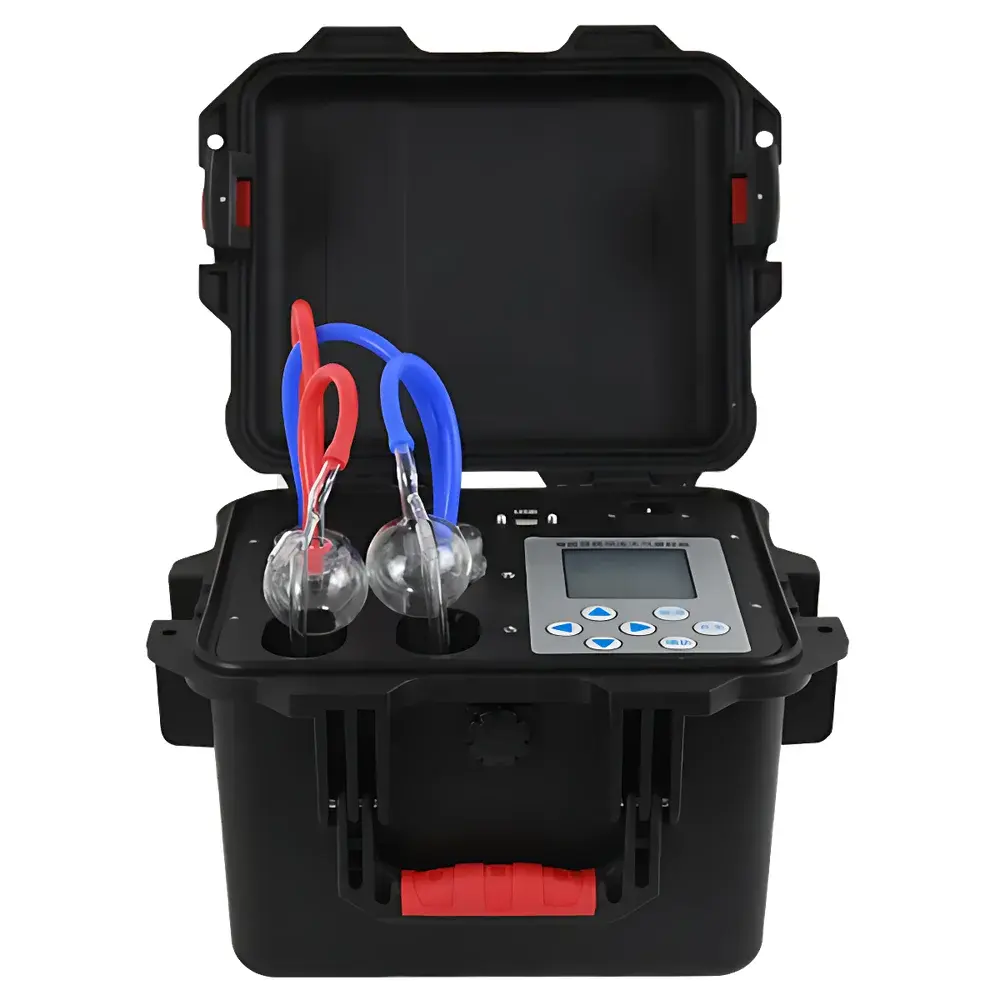
Beifen Sanpu JF-2040 Quad-Channel Constant-Flow Air Sampler
| Brand | Beifen Sanpu |
|---|---|
| Origin | Beijing, China |
| Manufacturer Type | Direct Manufacturer |
| Product Category | Domestic |
| Model | JF-2040 |
| Instrument Type | 24-Hour Temperature- and Flow-Controlled Air Sampler |
| Instrument Configuration | Quad-Channel Gas Sampler |
| Flow Range | 0.1–2.0 L/min |
| Maximum Vacuum Pressure | 70–130 kPa |
| Flow Stability | ±2.0% |
| Flowmeter Accuracy | ±2.0% |
| Service Life Under Max Flow & Backpressure | >5,000 h |
| Continuous Operation Time at Max Flow & Backpressure | >8 h |
| Delay Time Range | 1 min–99 h 59 min |
| Sampling Time Range | 1 min–99 h 59 min |
| Interval Time Range | 1 min–99 h 59 min |
| Programmable Sampling Cycles | 1–99 |
| Pre-Filter Pressure Range | −20–0 kPa |
| Ambient Pressure Range | 70–130 kPa |
| Temperature Control Range | 15–30 °C |
| Operating Temperature Range | −30 to +50 °C |
| Power Supply | AC 220 V ±10%, 50 Hz |
| Internal Li-ion Battery | 8.4 V / 15 Ah |
| Battery Runtime | >15 h |
| Noise Level | <55 dB(A) |
| Dimensions | 330 × 280 × 230 mm |
| Weight | ~5.2 kg |
Overview
The Beifen Sanpu JF-2040 Quad-Channel Constant-Flow Air Sampler is a field-deployable, microprocessor-controlled environmental sampling instrument engineered for regulatory-compliant collection of gaseous and vapor-phase pollutants—including SO2, NOx, ozone precursors, volatile organic compounds (VOCs), and other airborne contaminants—from ambient air. It operates on the principle of volumetric displacement via precision-regulated suction through calibrated orifices or impingers, maintaining true constant flow across all four independent channels regardless of filter loading or variable system backpressure. Designed in strict accordance with JJG 956–2013 “Verification Regulation for Air Samplers” and HJ/T 375–2007 “Technical Requirements and Test Methods for Ambient Air Samplers”, the JF-2040 meets the metrological and operational benchmarks required for data acceptance by national environmental monitoring networks in China. Its architecture integrates real-time thermobarometric compensation, active temperature stabilization, and intelligent power management—enabling robust, unattended 24-hour sampling campaigns under diverse climatic conditions, from sub-zero field sites to high-humidity urban environments.
Key Features
- Four independent, digitally controlled sampling channels—supporting simultaneous multi-analyte collection, parallel sampling for statistical validation, or staggered time-integrated profiles;
- Electronic mass flow control using high-stability thermal anemometer-based flow sensors, delivering ±2.0% full-scale accuracy and ≤±2.0% short-term flow deviation over the entire 0.1–2.0 L/min range;
- Imported ultra-low-noise diaphragm vacuum pump (noise 5,000 hours of operation under maximum load and offering consistent performance across temperature extremes;
- Integrated anti-backflow desiccant dryer with hydrophobic membrane barrier—prevents absorption solution ingress during pump shutdown or pressure transients, safeguarding analytical integrity;
- Real-time temperature and pressure sensing (ambient, pre-filter, and post-filter) with automatic volumetric correction to standard reference conditions (273.15 K, 101.325 kPa);
- Heated sampling manifold (15–30 °C adjustable, ±1.5 °C accuracy) mitigates condensation-induced adsorption losses for semi-volatile compounds;
- Auto-dimming, wide-temperature LCD interface with intuitive Chinese-language menu navigation—optimized for readability in low-light and sub-zero field conditions;
- Embedded non-volatile memory stores up to 99 sampling sessions with timestamps, flow logs, thermobarometric readings, and error flags;
- Intelligent power arbitration: seamless transition between AC mains and internal 8.4 V / 15 Ah Li-ion battery; auto-resume functionality preserves sampling state during power interruption.
Sample Compatibility & Compliance
The JF-2040 supports standardized sampling media including glass fiber filters (for PM-bound species), quartz filters (for organic carbon analysis), impinger solutions (e.g., KI for ozone, NaOH for SO2, triethanolamine for NO2), and sorbent tubes (e.g., Tenax TA, Carbopack B/C for VOCs). All flow paths are chemically inert (PTFE-lined tubing, stainless-steel manifolds) and compatible with EPA TO-17, ISO 16000-6, and HJ 618–2011 methodologies. The instrument’s metrological traceability aligns with national verification protocols, and its data logging structure supports audit-ready documentation per GLP principles. While not certified to IEC 61000-4 electromagnetic compatibility standards or ATEX hazardous area classification, it is suitable for outdoor, roadside, industrial fence-line, and indoor air quality monitoring per GB/T 18883–2002 and HJ 212–2017 data transmission requirements.
Software & Data Management
Data export is performed via USB 2.0 interface to standard CSV files containing timestamped records of cumulative volume, instantaneous flow, ambient temperature/pressure, battery voltage, pump status, and user-defined sampling parameters. No proprietary software is required: raw logs are directly importable into Excel, R, Python (pandas), or LIMS platforms. Each session includes a unique identifier, calibration date stamp, and operator code field. Firmware supports remote parameter updates via encrypted USB key and retains full event history—including low-battery warnings, over-pressure alerts, and flow deviation exceedances—for root-cause analysis during QA/QC review. Audit trails comply with basic data integrity expectations for environmental laboratories operating under CNAS-CL01 (equivalent to ISO/IEC 17025) accreditation scopes.
Applications
- Ambient air quality monitoring networks (AQMN) conducting routine SO2, NOx, and particulate matter precursor sampling;
- Source emission characterization at industrial facilities using multi-point, time-synchronized grab sampling;
- Indoor air quality (IAQ) assessments in schools, hospitals, and office buildings per GB/T 18883–2002;
- Method validation studies requiring replicate or interlaboratory comparison datasets;
- Mobile monitoring campaigns using vehicle-mounted or backpack configurations (weight: 5.2 kg; dimensions: 330 × 280 × 230 mm);
- Long-term trend analysis supported by >15-hour battery autonomy and auto-recovery logic after grid failure.
FAQ
What standards does the JF-2040 comply with?
It conforms to JJG 956–2013 and HJ/T 375–2007 for metrological verification and technical performance, and supports sampling protocols referenced in HJ 482–2009 (SO2), HJ 479–2009 (NOx), and HJ 644–2013 (VOCs).
Can the instrument operate unattended for 24 hours?
Yes—when connected to AC power, it supports continuous operation; with the internal battery, it delivers >15 hours runtime, and auto-resumes sampling upon power restoration.
Is flow calibration traceable to national standards?
The built-in thermal mass flow sensors are factory-calibrated against NIM-traceable primary standards, and users may perform field verification using a dry gas meter or bubble flowmeter per HJ/T 375–2007 Annex B.
Does the JF-2040 support external data integration?
Yes—CSV-formatted logs are compatible with common laboratory informatics systems and require no proprietary drivers or cloud dependencies.
What maintenance intervals are recommended?
Pump diaphragms should be inspected every 2,000 operating hours; desiccant cartridges replaced after 50 sampling cycles or visible saturation; flow sensors cleaned quarterly using isopropyl alcohol and lint-free swabs.







