
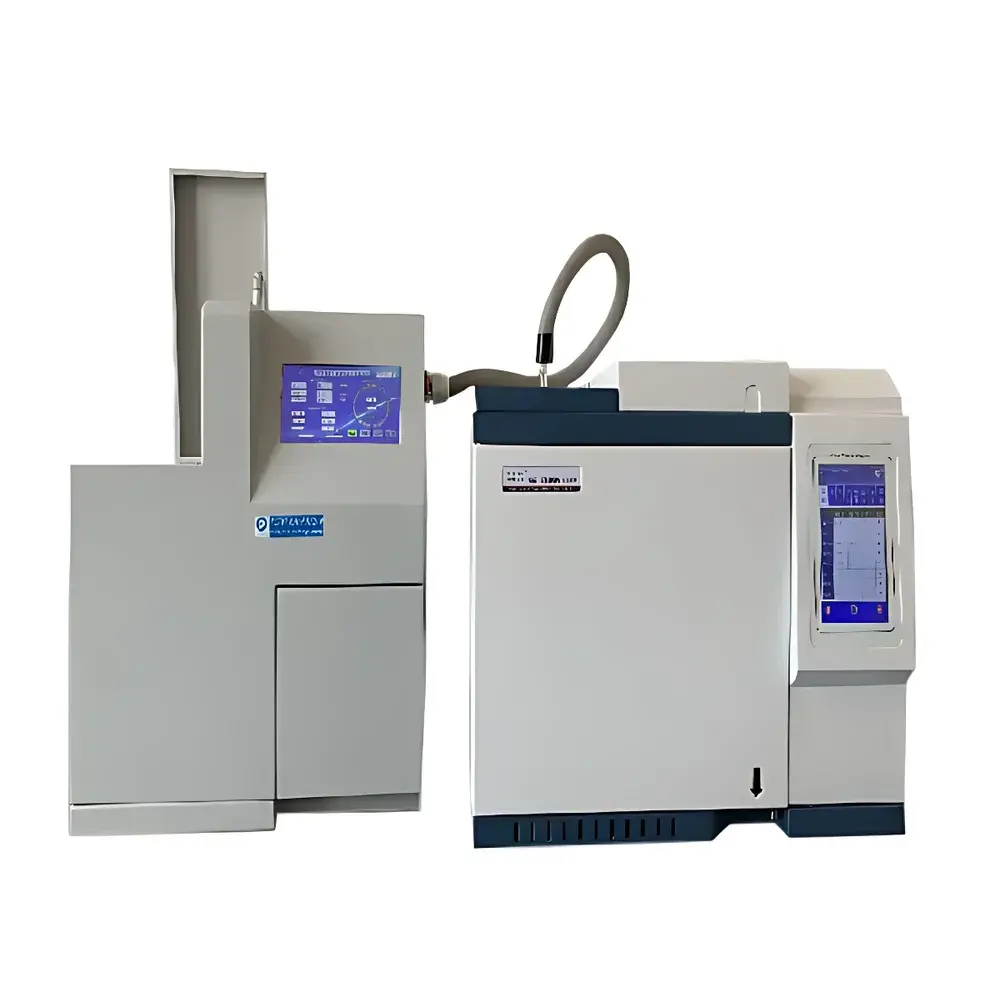
Beifen Sanpu AHS-20A Plus Fully Automated Static Headspace Sampler
| Brand | Beifen Sanpu |
|---|---|
| Origin | Beijing, China |
| Manufacturer Type | Direct Manufacturer |
| Instrument Type | Static Headspace Sampler |
| Automation Level | Fully Automatic |
| Sample Vial Heating Range | Ambient to 200 °C (1 °C increments) |
| Valve Oven Temperature Range | 40–220 °C (±1 °C accuracy) |
| Loop Volume | 1 mL |
| Sample Capacity | 20 positions |
| Vial Size Compatibility | 10 mL or 20 mL vials |
Overview
The Beifen Sanpu AHS-20A Plus Fully Automated Static Headspace Sampler is an engineered solution for precise, reproducible extraction and introduction of volatile organic compounds (VOCs) from liquid and solid matrices into gas chromatography (GC) systems. Based on the fundamental principle of phase equilibrium—where analytes partition between sample matrix and headspace gas at controlled temperature—the AHS-20A Plus enables quantitative static headspace analysis without solvent interference or manual handling errors. Its design adheres to thermodynamic rigor: equilibration occurs under sealed, pressurized conditions within thermostatically regulated vials, ensuring consistent vapor-phase concentration prior to loop-based sampling. The instrument integrates seamlessly with GC platforms via hardware-triggered synchronization, supporting compliance-driven workflows in environmental, pharmaceutical, food safety, and clinical laboratories. As a domestically developed but internationally aligned system, it meets foundational requirements for method validation per ISO/IEC 17025 and supports traceability frameworks essential for GLP and GMP environments.
Key Features
- Full automation of all thermal and mechanical steps: vial heating, pressurization, equilibration, loop filling, injection, and post-injection purge—eliminating operator variability.
- 20-position carousel with automatic vial recognition and collision-avoidance logic; skips empty or misaligned positions without interrupting sequence execution.
- Triple-zone independent temperature control: sample vial oven (ambient–200 °C), valve oven (40–220 °C), and transfer line (40–220 °C), all with ±1 °C stability and <±0.5 °C long-term drift.
- Inert, de-activated capillary pathways—including six-port valve and 1 mL quantitative loop—minimize adsorption, carryover, and cross-contamination; RSD ≤1.0% demonstrated for 100 ppm ethanol in water.
- Positive-pressure sampling architecture ensures compatibility with aqueous, viscous, and heterogeneous samples; eliminates baseline drift associated with vacuum-assisted systems.
- Motor-driven actuation—no external carrier gas required for sampler mechanics—enhances operational safety and simplifies lab infrastructure.
- 7-inch full-color TFT LCD interface with animated workflow guidance; parameter entry, real-time status monitoring, and method recall accessible via front panel or USB-connected PC.
- Configurable timing resolution down to 0.01 s across all phases (pressurization, equilibration, sampling, injection, purge), enabling fine-tuned method optimization.
Sample Compatibility & Compliance
The AHS-20A Plus accommodates standard 10 mL and 20 mL crimp-top headspace vials, with optional support for custom formats (e.g., 50 mL, 100 mL). It processes diverse sample types including drinking water, soil slurries, pharmaceutical excipients, polymer coatings, and biological fluids—provided volatility and thermal stability permit equilibrium-based extraction. Methodologically, the system aligns with numerous international and national standards, including EPA Method 502.2, ISO 15681-2, ASTM D7622, HJ 642–2013, HJ 643–2013, HJ 810–2016, and GB 5749–2022 (China’s updated “Hygienic Standard for Drinking Water”). Its architecture supports audit-ready operation: time-stamped event logs, parameter change history, and user-accessible calibration records satisfy documentation requirements for FDA 21 CFR Part 11–compliant environments when paired with validated GC data systems.
Software & Data Management
All operational parameters—including temperature setpoints, timing sequences, pressure profiles, and vial mapping—are programmable via USB interface using vendor-provided configuration software. The system supports bidirectional triggering: initiation by GC start signal or external TTL pulse, and synchronous launch of third-party chromatography data systems (CDS) such as OpenLab CDS, Chromeleon, or Empower. No proprietary acquisition software is required; raw method files are stored in human-readable XML format for version control and backup. Audit trails capture user ID, timestamp, and parameter modifications—enabling reconstruction of analytical conditions for regulatory review. Optional EPC (Electronic Pressure Control) integration allows dynamic headspace pressure regulation during equilibration, improving precision for low-volatility analytes.
Applications
The AHS-20A Plus serves critical roles in regulated testing domains: quantification of residual solvents in pharmaceutical APIs per ICH Q3C guidelines; detection of disinfection by-products (e.g., chloroform, bromodichloromethane) in municipal water per GB 5749–2022; screening of VOC emissions from packaging materials (SN/T 4068–2014); analysis of volatile contaminants in soil and sediment (HJ 736–2015); and determination of ethanol, methanol, and acetone in clinical toxicology specimens (HJ 895–2017). Its robustness across matrix complexity—from saline aqueous solutions to high-fat food extracts—makes it suitable for routine QC labs requiring >50 injections/day with minimal maintenance.
FAQ
What sample types can be analyzed using the AHS-20A Plus?
Liquid samples (e.g., water, blood, solvents), semi-solids (e.g., creams, gels), and solids (e.g., soils, polymers, tablets) — provided target analytes exhibit sufficient vapor pressure at the selected equilibration temperature.
Is the instrument compatible with GC-MS systems?
Yes; its inert flow path, precise timing control, and synchronization capability ensure reliable coupling with both single-quadrupole and triple-quadrupole mass spectrometers.
Can the system be validated for GLP compliance?
It supports IQ/OQ protocols through documented temperature uniformity mapping, loop volume verification, and repeatability testing; full PQ requires integration with a validated CDS and laboratory-specific SOPs.
What maintenance is required for long-term reliability?
Routine tasks include quarterly valve seal inspection, annual loop volume verification using certified gas standards, and periodic cleaning of vial tray and septum piercer mechanism.
Does the AHS-20A Plus support unattended overnight operation?
Yes; the 20-position carousel, internal event logging, and fault-recovery logic enable fully autonomous batch processing over extended periods.




