
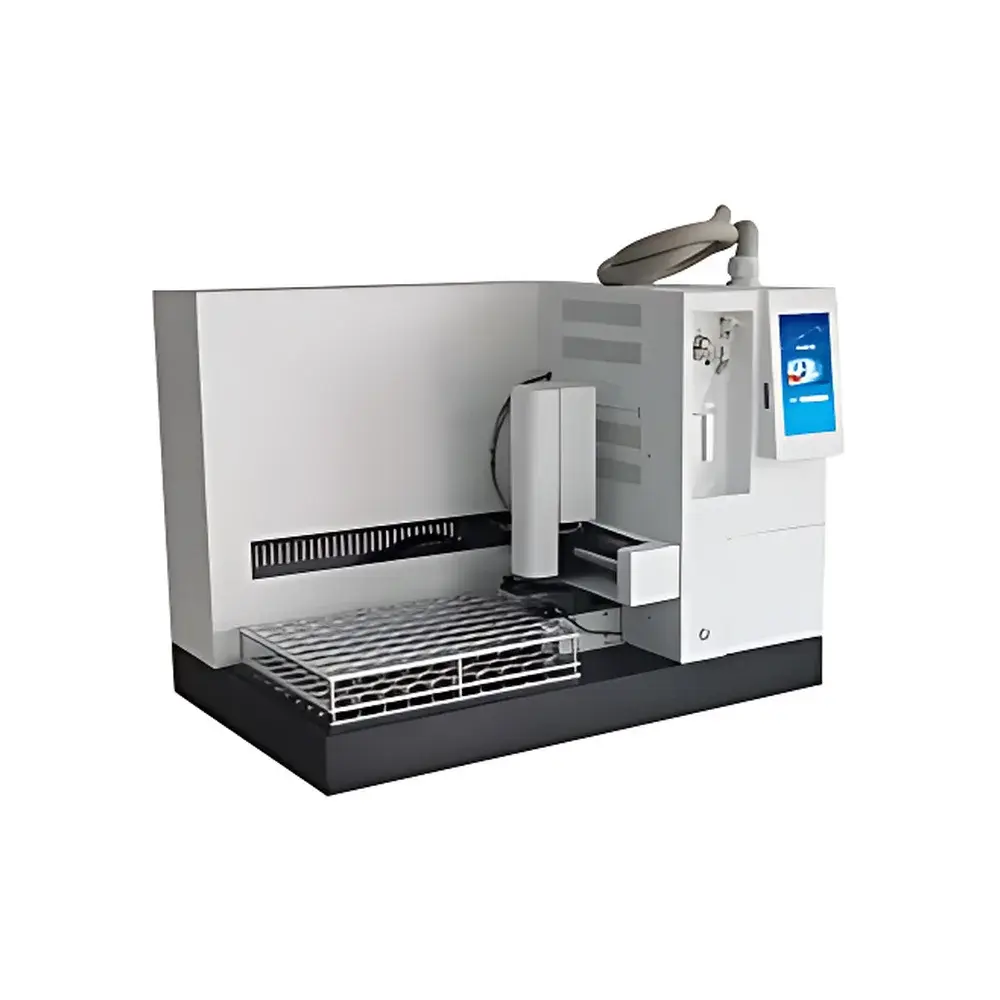
Sanfen Sanpu PT-80A Fully Automated Purge and Trap Concentrator
| Brand | Sanfen Sanpu |
|---|---|
| Origin | Beijing, China |
| Manufacturer Type | Direct Manufacturer |
| Country of Origin | Domestic (China) |
| Model | PT-80A |
| Instrument Category | Water-and-Soil Integrated |
| Sample Tray Capacity | 80 positions |
| Injection Precision | RSD ≤ 3% |
| Trap Temperature Range | Ambient to 380 °C |
| Cooling | 250 °C → 35 °C in ≤ 90 s |
| Sample Heating (Liquid) | Ambient to 95 °C |
| Sample Chilling | Ambient only |
| Cold Trap Temperature | −40 °C to ambient (Peltier + air cooling) |
| Blowback Flow Separation | Yes |
| Foam Sensor | Integrated |
| PEEK & Silanized Stainless Steel Tubing | Yes |
| Hot Water Rinse Capability | Yes |
| GC/GC-MS Synchronization | Dual TTL outputs, 1–2 s trigger latency |
Overview
The Sanfen Sanpu PT-80A Fully Automated Purge and Trap Concentrator is a robust, laboratory-grade sample introduction system engineered for trace-level volatile organic compound (VOC) analysis in aqueous and solid environmental matrices. Based on the established purge-and-trap principle—where VOCs are volatilized from liquid or slurry samples under controlled inert gas flow, trapped on a sorbent-packed cold trap, and subsequently thermally desorbed into a gas chromatograph (GC) or GC-mass spectrometer (GC-MS)—the PT-80A delivers high reproducibility and method flexibility for regulatory-compliant testing. Designed specifically for compliance with U.S. EPA Method 502.2, 524.2, 624, and 8260, as well as Chinese standard methods HJ 605–2011, HJ 639–2012, and HJ 686–2014, the instrument supports both drinking water, wastewater, soil, sediment, and food matrix applications without hardware modification.
Key Features
- 80-position autosampler compatible with standard 40-mL VOA vials; accommodates both liquid and solid samples via integrated heating and vortex-assisted aqueous extraction (5 mL distilled water, programmable agitation).
- High-fidelity thermal control: Peltier-based cold trap (−40 °C to ambient, 1 °C resolution); trap desorption up to 380 °C with >2000 °C/min ramp rate and rapid cooling (<90 s from 250 °C to 35 °C) for minimized carryover and enhanced peak sharpness.
- Cross-contamination mitigation architecture: Independent blowback gas pathways isolate trap eluate from purge gas lines; dedicated water removal trap (heatable to 400 °C) upstream of the cold trap reduces moisture-induced GC column degradation and MS source contamination.
- Chemically inert fluidic path: All wetted surfaces constructed from PEEK and silanized stainless steel; heated transfer lines (ambient to 220 °C) eliminate cold spots and adsorptive losses.
- Integrated foam detection prevents overfoaming during soil/slurry purging—automatically halting purge if foam breaches sensor threshold, protecting downstream components.
- Full software-driven operation: Touchscreen interface and PC-based control software enable full parameter configuration (purge time, flow rate 0–150 mL/min, heating profiles, rinse cycles), remote monitoring, and audit-ready method storage.
- GC/GC-MS synchronization: Two TTL-compatible digital outputs provide precise timing coordination (1–2 s latency) for simultaneous trap desorption, GC oven ramp initiation, and data acquisition start.
Sample Compatibility & Compliance
The PT-80A supports direct analysis of drinking water, groundwater, surface water, wastewater, soil, sediment, and homogenized food samples. Solid-phase analysis is enabled by on-deck heating (ambient to 100 °C) and automated aqueous slurry preparation. The system meets critical performance criteria defined in ISO 15681-2:2021 (water quality — determination of VOCs — part 2: purge-and-trap GC-MS), ASTM D5003 (standard test method for VOCs in water by purge-and-trap GC), and aligns with GLP and GMP documentation requirements. Its electronic logbook records all method parameters, run timestamps, temperature profiles, and error events—supporting FDA 21 CFR Part 11 compliance when deployed with validated software configurations.
Software & Data Management
The instrument is operated via Sanfen Sanpu’s proprietary Windows-based control suite, supporting method creation, sequence scheduling, real-time status monitoring, and event-triggered alerts (e.g., low coolant, valve timeout, foam detection). All operational logs—including temperature setpoints, actual readings, purge flow calibration history, and trap desorption curves—are timestamped and exportable in CSV or PDF format. Software architecture permits integration with LIMS environments through ODBC-compliant database hooks and supports user role-based access control (administrator, analyst, reviewer) for secure audit trails.
Applications
- Regulatory VOC screening per U.S. EPA Methods 524.2 (drinking water), 624 (wastewater), and 8260D (soil/sediment)
- Compliance testing for HJ 605–2011 (soil VOCs), HJ 639–2012 (water VOCs), and HJ 686–2014 (volatile halocarbons in water)
- Analysis of chlorinated solvents (e.g., TCE, PCE), BTEX compounds, vinyl chloride, and low-boiling aldehydes in environmental matrices
- Food aroma profiling and off-flavor compound identification in beverages and dairy products
- Method development for emerging contaminants including 1,4-dioxane and haloacetonitriles
FAQ
Does the PT-80A require liquid nitrogen for cryofocusing?
No. The cold trap utilizes a dual-stage Peltier cooler coupled with forced-air heat dissipation, achieving stable operation down to −40 °C at ambient room temperature (20 °C), eliminating dependency on consumable cryogens.
Can the system handle high-salinity or turbid water samples without clogging?
Yes. Integrated foam detection and programmable purge flow modulation prevent overfoaming. Optional inline particulate filtration (0.45 µm PTFE) may be installed upstream of the purge chamber for highly suspended samples.
Is the instrument compatible with third-party GC and GC-MS systems?
Yes. The PT-80A features universal GC interface compatibility via standard 1/16″ stainless steel transfer lines and TTL synchronization—validated with Agilent, Thermo Fisher, Shimadzu, and PerkinElmer platforms.
What maintenance intervals are recommended for routine operation?
Cold trap sorbent cartridges should be replaced every 200–300 injections depending on sample cleanliness; purge lines and valves require cleaning every 500 runs using hot water rinse cycles; annual calibration of temperature sensors and flow meters is advised per ISO/IEC 17025 guidelines.
Does the system support unattended overnight operation?
Yes. The 80-position tray, automated method sequencing, and built-in fault recovery (e.g., resume after power interruption) enable fully unattended batch processing for up to 48 hours with appropriate solvent and trap management.




