
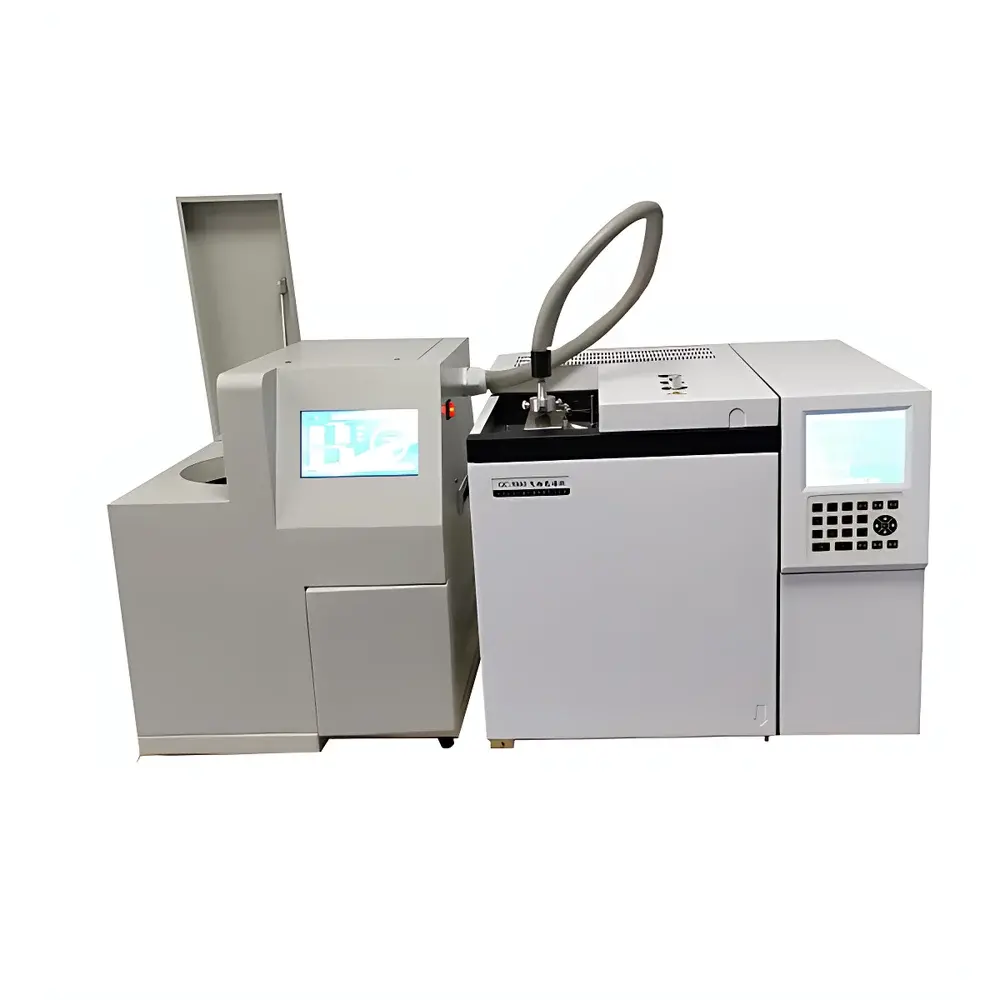
Brookfield AHnS-20A PLUS Fully Automated Static Headspace Sampler
| Brand | Beifen Sanpu |
|---|---|
| Origin | Beijing, China |
| Manufacturer Type | Direct Manufacturer |
| Region Classification | Domestic (China) |
| Model | AHnS-20A PLUS |
| Instrument Type | Static Headspace Sampler |
| Automation Level | Fully Automatic |
| Oven Temperature Range | Ambient to 200 °C (1 °C increment) |
| Valve & Transfer Line Temperature Range | 40–220 °C (±1 °C stability) |
| Sample Loop Volume | 1 mL |
| Sample Tray Capacity | 20 positions |
| Vial Size Compatibility | 10 mL or 20 mL vials |
Overview
The Brookfield AHnS-20A PLUS is a fully automated static headspace sampler engineered for precise, reproducible quantification of residual ethylene oxide (EO) in medical devices, pharmaceutical packaging, and sterilized polymeric materials. It operates on the principle of equilibrium headspace gas-phase extraction: solid or liquid samples are sealed in heated vials, allowing volatile EO to partition into the headspace above the matrix. Once thermodynamic equilibrium is achieved, a precisely metered volume of headspace vapor is transferred via a thermostated sampling valve and loop into a coupled gas chromatograph (GC) for separation and detection—typically using a flame ionization detector (FID) or mass spectrometer (MS). This method complies with ISO 10993-7:2008, USP , and ASTM F1980 for EO residue testing in biocompatible materials, where regulatory limits are commonly set at ≤10 µg/g for most Class II/III devices.
Key Features
- Fully automated 20-position sample carousel with programmable sequence control, enabling unattended overnight operation and high-throughput batch analysis.
- Independent dual-zone temperature control: sample oven (ambient to 200 °C, ±1 °C) and transfer line/valve system (40–220 °C, ±1 °C), minimizing condensation and ensuring quantitative transfer of low-boiling analytes.
- 1 mL fixed-volume sampling loop with inert internal surface (siliconized stainless steel), calibrated per ISO 17025 traceable procedures to ensure volumetric accuracy and long-term repeatability.
- Integrated pressure-balanced vial pressurization using carrier gas (N₂ or He), eliminating negative-pressure artifacts during syringeless loop filling and improving precision across variable matrix types.
- Robust architecture with corrosion-resistant internal pathways and electro-mechanical valve actuation, validated for >500,000 cycles under GLP-compliant laboratory conditions.
Sample Compatibility & Compliance
The AHnS-20A PLUS accommodates standard 10 mL and 20 mL crimp-top headspace vials with PTFE/silicone septa. It supports aqueous, semi-solid, and solid matrices—including PVC tubing, polyethylene pouches, gauze, catheters, and lyophilized drug product containers—following validated extraction protocols (e.g., solvent-assisted equilibration in chloroform or acetone). Method performance meets requirements of ISO/IEC 17025:2017 for calibration traceability, and system suitability testing includes precision (RSD ≤3% for replicate injections), linearity (r² ≥0.999 over 0.5–20 µg/g EO range), and limit of quantitation (LOQ ≤0.2 µg/g). When integrated with GC systems compliant with FDA 21 CFR Part 11, full audit trails, electronic signatures, and instrument control logs are maintained for GMP-regulated environments.
Software & Data Management
Controlled via Windows-based Brookfield HS-Link software, the AHnS-20A PLUS supports method-driven workflows with customizable parameters: equilibration time (0–120 min), agitator speed (0–500 rpm), oven ramp rates, and multi-step temperature programming. All method files, run logs, and raw acquisition data are stored in encrypted SQLite databases with automatic timestamping and user-access controls. Software output integrates seamlessly with third-party chromatography data systems (CDS), including OpenLab CDS, Chromeleon, and Empower, enabling automated peak integration, calibration curve generation (linear or quadratic), and EO concentration calculation using the standardized formula: CEO = 1.775 × V × C₁ × 10³ (where CEO = µg EO/g sample; V = interpolated standard curve volume in mL; C₁ = ethylene glycol reference standard concentration in g/L). Audit trail reports comply with ALCOA+ principles.
Applications
Primary applications include residual EO testing in pre-sterilized medical device components (e.g., sutures, syringes, IV sets), validation of ethylene oxide sterilization cycles, stability studies of EO-sterilized drug products, and quality control of packaging materials used in aseptic manufacturing. Secondary uses extend to volatile organic compound (VOC) profiling in food contact materials, residual solvent analysis in polymer films per ICH Q3C guidelines, and headspace screening for formaldehyde, acetaldehyde, and other low-molecular-weight aldehydes in pharmaceutical excipients.
FAQ
What is the recommended equilibration temperature and time for EO analysis in polymeric medical devices?
For most rigid or semi-crystalline polymers (e.g., polypropylene, polyethylene), 70 °C for 30 minutes achieves optimal partitioning without thermal degradation. Softer elastomers may require lower temperatures (e.g., 50 °C) and longer times (60–90 min) to prevent matrix swelling artifacts.
Can the AHnS-20A PLUS be used with GC-MS systems?
Yes—its inert flow path, low-dead-volume transfer line, and compatibility with helium or hydrogen carrier gases support direct coupling to single-quadrupole and triple-quadrupole MS detectors without modification.
Is method validation documentation provided with the instrument?
Brookfield supplies a comprehensive IQ/OQ protocol package, including installation checklist, operational verification templates, and system suitability test procedures aligned with ISO 10993-7 Annex B.
How is carryover minimized between high-concentration and low-concentration samples?
The system employs an integrated bake-out routine (220 °C for 5 min) after each high-level injection, combined with nitrogen purge cycles and valve flushing—validated to reduce carryover to <0.1% for EO at 20 µg/g levels.
Does the sampler support custom vial racks or non-standard vial sizes?
Standard configuration supports only 10 mL and 20 mL screw-thread or crimp-top vials per ASTM D6866 and ISO 11358. Custom trays require factory retrofit and recalibration.
Related Products




