
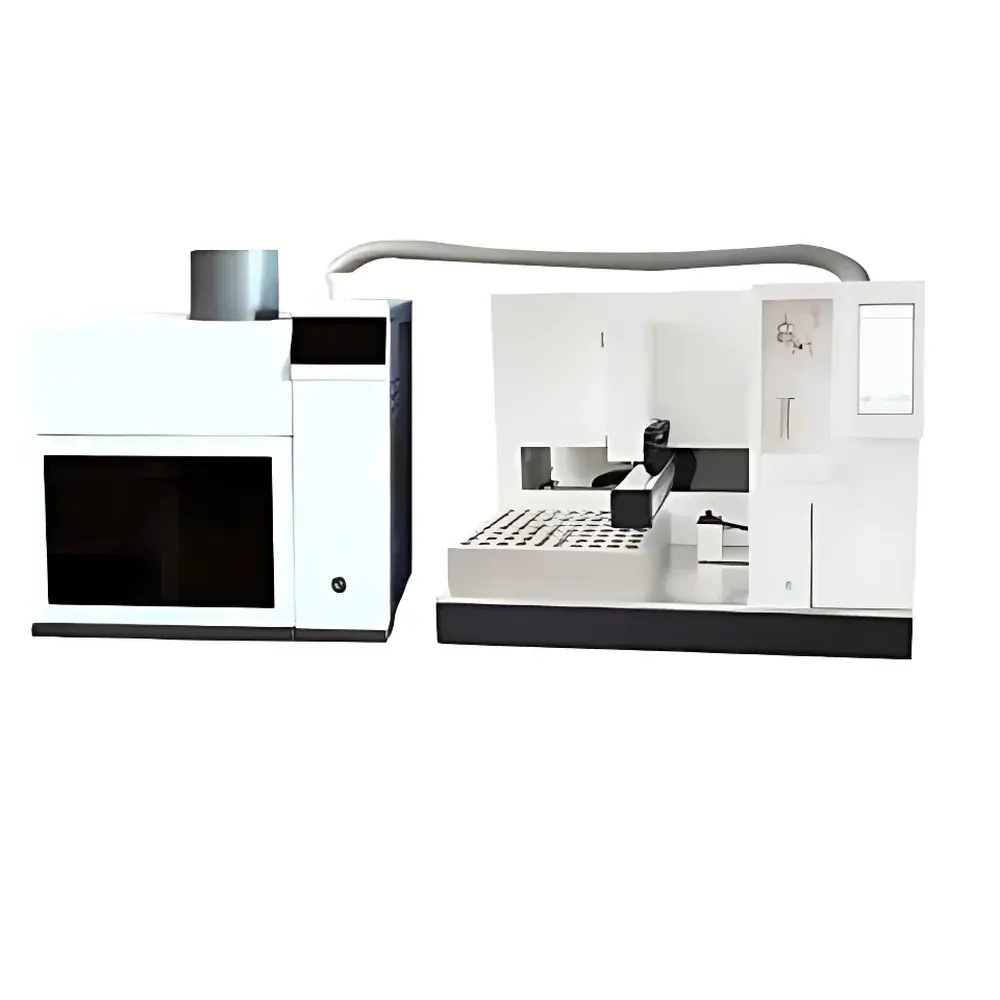
Beifen Sanpu Multi-2025 Multi-Element Alkylmercury Analyzer for Water and Environmental Matrices
| Brand | Beifen Sanpu |
|---|---|
| Origin | Beijing, China |
| Manufacturer Type | Direct Manufacturer |
| Country of Origin | China |
| Model | Multi-2025 |
| Instrument Type | Laboratory-Based Water Quality Analyzer |
| Target Analytes | Methylmercury (CH₃Hg⁺), Ethylmercury (C₂H₅Hg⁺) |
| Detection Principle | Purge-and-Trap Coupled with Gas Chromatography–Cold Vapor Atomic Fluorescence Spectrometry (PT-GC-CVAFS) |
| Compliant Standards | HJ 977–2018, HJ 1269–2022, HJ 1268–2022, SNT 5517–2023 |
| Sample Compatibility | Aqueous matrices (surface water, wastewater, drinking water), soil extracts, sediment pore water, biological tissues (e.g., fish muscle, blood), agricultural products, cosmetics, traditional Chinese medicinal materials |
| Elemental Coverage | As, Hg, Pb, Se, Sb, Bi, Cd, Te, Sn, Ge, Zn, Cu (12 elements via hydride generation atomic fluorescence) |
Overview
The Beifen Sanpu Multi-2025 Multi-Element Alkylmercury Analyzer is a laboratory-grade analytical platform engineered for the selective, sensitive, and reproducible quantification of alkylated mercury species—primarily methylmercury (CH₃Hg⁺) and ethylmercury (C₂H₅Hg⁺)—in complex environmental and biological matrices. It integrates two well-established analytical techniques into a single modular architecture: purge-and-trap (PT) sample introduction, gas chromatographic (GC) separation, and cold vapor atomic fluorescence spectrometry (CVAFS) detection. This hybrid configuration enables sub-pg/L level detection limits for methylmercury in aqueous samples, fulfilling the stringent sensitivity requirements defined in HJ 977–2018 (Water Quality — Determination of Alkylmercury by Purge-and-Trap/GC-CVAFS) and HJ 1269–2022 (Soil and Sediment — Determination of Methylmercury and Ethylmercury). Unlike conventional total mercury analyzers, the Multi-2025 preserves speciation integrity through thermally controlled derivatization, on-column separation using a modified OV-3 packed column, and post-column pyrolysis at up to 1050 °C to ensure quantitative conversion of alkylmercury species to atomic mercury vapor prior to CVAFS detection.
Key Features
- Modular PT-GC-CVAFS architecture compliant with ISO/IEC 17025 method validation requirements for trace metal speciation.
- Interchangeable purge-and-trap interface compatible with commercially available concentrators (e.g., Tekmar, OI Analytical, or domestic equivalents), enabling integration with existing laboratory infrastructure and minimizing capital expenditure.
- Packed-column GC system utilizing surface-modified OV-3 stationary phase—offering superior robustness, longer column lifetime (>2000 injections), and reduced maintenance compared to fragile capillary columns under high-moisture sample conditions.
- Integrated 3D-printed reaction manifold for hydride generation atomic fluorescence (HG-AFS) mode, consolidating gas-liquid separator, reaction chamber, and quartz cell into a single monolithic flow path fabricated from mercury-inert polymer composites; eliminates dead volume, minimizes memory effects, and reduces carryover to <0.3% (measured per USP guidelines).
- Thermal decomposition module capable of precise temperature ramping up to 1050 °C, ensuring complete thermal cleavage of C–Hg bonds without carbon residue formation or catalytic interference.
- Dual-mode operation: dedicated alkylmercury speciation (PT-GC-CVAFS) and multi-element total elemental analysis (HG-AFS) for As, Hg, Pb, Se, Sb, Bi, Cd, Te, Sn, Ge, Zn, and Cu—supporting method flexibility across regulatory testing programs.
Sample Compatibility & Compliance
The Multi-2025 supports direct analysis of filtered aqueous samples (including drinking water, wastewater, seawater, and leachates), acid-digested soil/sediment extracts, tissue homogenates (e.g., fish liver, human blood), and plant-derived matrices (e.g., herbal medicines, feedstuffs). All workflows adhere to internationally recognized quality frameworks: data acquisition and audit trails comply with FDA 21 CFR Part 11 requirements for electronic records; calibration verification meets ASTM D6709–22 criteria for mercury speciation instruments; and method performance aligns with GLP principles for environmental testing laboratories. Validation documentation includes spike recovery studies (85–115%), method detection limits (MDLs ≤ 0.05 ng/L for CH₃Hg⁺ in ultrapure water), and inter-laboratory precision data per ISO 5725-2.
Software & Data Management
The proprietary graphical user interface provides real-time visualization of instrument status—including GC oven temperature, trap desorption profile, CVAFS lamp intensity, and carrier gas pressure—enabling immediate troubleshooting. The software logs all critical operational parameters with time-stamped metadata, supports full audit trail functionality (user login, method changes, calibration events), and generates reports compliant with ISO/IEC 17025 reporting clauses. Export formats include editable Microsoft Word (.docx), tabular Excel (.xlsx), and print-ready PDF documents with embedded chromatograms, calibration curves, and QC summary tables. Consumables monitoring tracks cumulative usage hours for peristaltic pump tubing, hollow cathode lamps, and quartz UV cells—triggering configurable alerts when replacement thresholds are approached.
Applications
- Regulatory compliance testing for methylmercury in municipal drinking water supplies per HJ 977–2018 and WHO provisional guideline values (1.0 µg/L).
- Monitoring of bioaccumulative mercury species in aquatic food webs—especially in aquaculture facilities and export seafood processing plants, as required by SNT 5517–2023.
- Speciation analysis of contaminated sediments and floodplain soils under national soil pollution surveys (HJ 1269–2022).
- Multi-element screening of toxic metals in traditional Chinese medicine raw materials, cosmetic ingredients, and animal feed formulations.
- Research applications in biogeochemical cycling studies, including microbial methylation/demethylation kinetics and redox-dependent mercury transformation pathways.
FAQ
Does the Multi-2025 require dedicated purge-and-trap hardware, or can it interface with existing systems?
Yes—the instrument features standardized pneumatic and electrical interfaces (4–20 mA analog outputs, RS-232/USB control) compatible with third-party purge-and-trap concentrators. No proprietary consumables or firmware locks are enforced.
What is the typical analysis time per sample for methylmercury using the PT-GC-CVAFS method?
A full cycle—including purge (15 min), trap desorption (2 min), GC separation (8 min), and CVAFS measurement (1 min)—requires approximately 26 minutes, excluding sample preparation and calibration.
How does the system prevent mercury memory effects during high-throughput analysis?
The 3D-printed reaction module uses low-surface-area, non-wetting polymer alloys with integrated quartz UV cell geometry; combined with automated post-run high-temperature baking (600 °C for 5 min), residual mercury adsorption is reduced to undetectable levels (<0.01 pg) between injections.
Is method validation support provided for laboratory accreditation?
Yes—Beifen Sanpu supplies comprehensive IQ/OQ/PQ protocols, certified reference material (CRM) test data (NIST SRM 2710a, ERM-CC580), and application notes aligned with CNAS-CL01:2018 requirements.
Can the instrument quantify both methylmercury and inorganic mercury simultaneously?
No—the PT-GC-CVAFS configuration is optimized exclusively for volatile alkylmercury species. Inorganic mercury requires separate HG-AFS analysis after chemical reduction; speciation workflows must be performed sequentially using distinct sample aliquots and method files.
Related Products







