
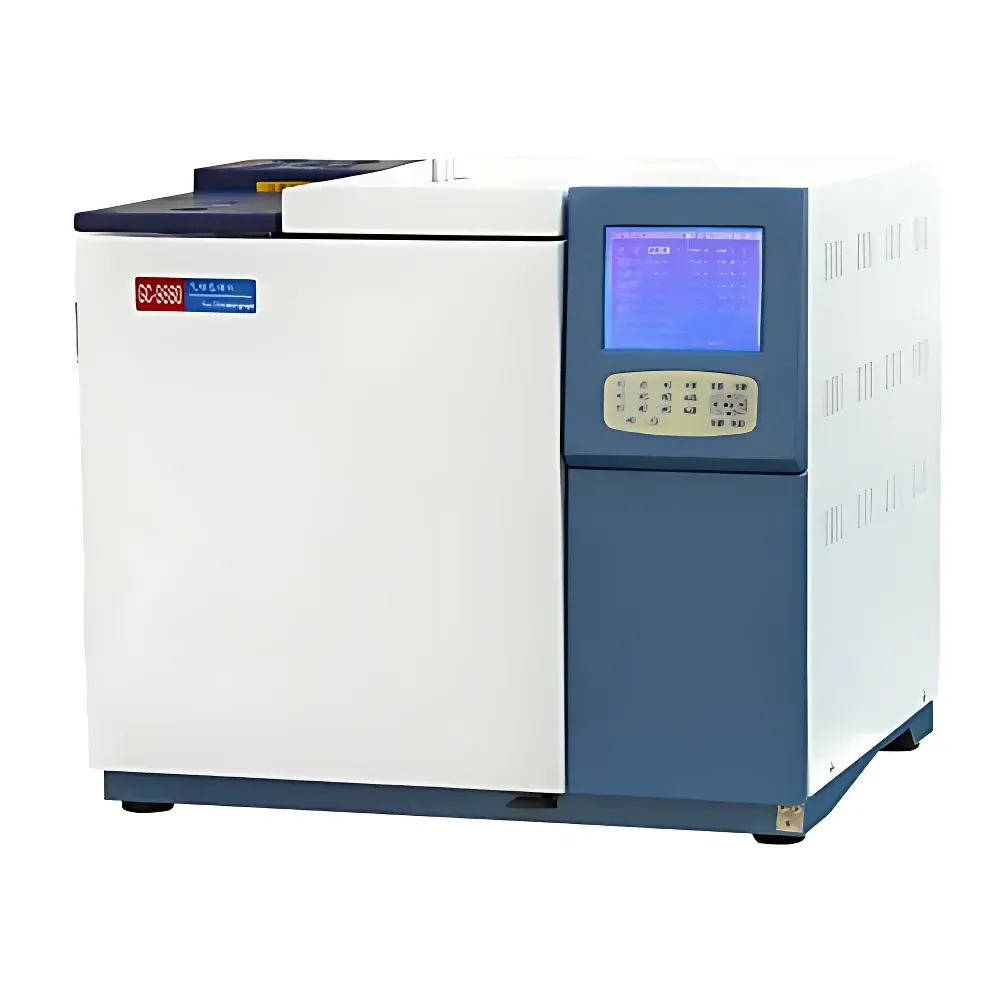
Beifen Sanpu GC-9860 Dedicated Gas Chromatograph for Baijiu (Chinese Distilled Spirit) Analysis
| Brand | Beifen Sanpu |
|---|---|
| Origin | Beijing, China |
| Manufacturer Type | Direct Manufacturer |
| Instrument Type | Laboratory Gas Chromatograph |
| Model | GC-9860 |
| Temperature Control Range | 100–350 °C |
| Oven Ramp Rate | 0.1–40 °C/min |
| Cool-down Time | ~6 min (from 350 °C to 100 °C) |
| Carrier Gas Flow Range | 0–1200 mL/min |
| Carrier Gas Pressure Range | 0–970 kPa |
| Injector Maximum Temperature | 100–350 °C |
| Injector Pressure Setting Range | 0–970 kPa |
| Injector Total Flow Setting Range | 0–1000 mL/min |
| Detector | Hydrogen Flame Ionization Detector (FID) |
Overview
The Beifen Sanpu GC-9860 is a purpose-built gas chromatograph engineered for routine, high-reproducibility analysis of volatile organic compounds in baijiu — China’s traditional distilled spirit. It operates on the fundamental principle of gas-liquid partition chromatography: samples are vaporized at elevated temperatures and swept through a capillary or packed column by an inert carrier gas (typically nitrogen or helium). Separation occurs based on differential partitioning coefficients of analytes between the mobile gas phase and stationary liquid phase coated on the column interior. This system is specifically optimized to resolve complex mixtures of alcohols (e.g., ethanol, methanol, propanol), aldehydes (acetaldehyde, furfural), esters (ethyl acetate, ethyl lactate), and organic acids — all critical markers for quality control, authenticity verification, and regulatory compliance in baijiu production. The instrument conforms to key national standards including GB/T 10345–2007 (Method for Analysis of Chinese Baijiu) and GB 5009.266–2016 (Determination of Methanol in Alcoholic Beverages), supporting both DNP-packed column and fused-silica capillary column configurations.
Key Features
- Integrated hydrogen flame ionization detector (FID) with high sensitivity (detection limit ≤ 3 pg C/s for n-decane) and linear dynamic range > 107, enabling accurate quantification across trace-to-major component concentrations.
- Programmable oven with precise temperature control (±0.1 °C) and rapid thermal ramping (0.1–40 °C/min), facilitating method optimization for multi-component elution profiles typical in baijiu matrices.
- Dual independent inlet systems configurable for split/splitless injection, each supporting pressure- and flow-controlled operation (0–970 kPa; 0–1200 mL/min), ensuring robustness across varying sample viscosities and volatility ranges.
- Modular architecture allowing seamless integration with optional accessories: nitrogen/hydrogen/air gas generators, certified calibration standards (methanol, acetaldehyde, ethyl acetate, etc.), and analytical columns (e.g., DB-WAX, HP-INNOWAX, or custom DNP-packed).
- Stainless-steel fluidic pathways and inert surface treatment minimize adsorption of polar analytes (e.g., fusel oils, short-chain acids), preserving chromatographic integrity and peak symmetry.
Sample Compatibility & Compliance
The GC-9860 is validated for direct injection of diluted baijiu samples (typically 1:10–1:100 in ethanol or water), requiring no derivatization. It supports full quantification of regulated contaminants per Chinese national food safety standards: methanol (limit: ≤0.12 g/100 mL for grain-based baijiu), total aldehydes (as acetaldehyde; limit: ≤0.02 g/100 mL), and phthalate plasticizers (e.g., DEHP, DBP, DINP) per GB 5009.271–2016. Data output meets GLP/GMP documentation requirements, with audit-trail-capable software supporting 21 CFR Part 11-compliant electronic records when paired with validated chromatography data systems. All hardware components comply with IEC 61010-1 safety standards for laboratory electrical equipment.
Software & Data Management
The system operates with Beifen Sanpu’s proprietary ChromaLink™ GC workstation, a Windows-based platform offering real-time signal acquisition, automated peak integration (with customizable baseline algorithms), retention time locking, and internal standard calibration workflows. Raw data files (.cdf) are exportable in ASTM E1957-compliant format for third-party statistical analysis or LIMS integration. The software includes built-in method templates aligned with GB/T 10345–2007, enabling one-click method loading for routine QC testing. Audit trails record user actions, parameter changes, and sequence modifications, satisfying ISO/IEC 17025 documentation requirements for accredited testing laboratories.
Applications
- Quantitative determination of methanol and higher alcohols (propanol, isobutanol, active amyl alcohol) as indicators of fermentation hygiene and distillation cut accuracy.
- Profiling of ester composition (ethyl acetate, ethyl lactate, ethyl caproate) to assess aging status, storage conditions, and sensory quality correlation.
- Screening and quantification of toxic aldehydes (acetaldehyde, furfural) linked to raw material quality and thermal degradation during distillation.
- Multi-residue analysis of six priority phthalates (DEHP, DBP, DIBP, DINP, DNOP, BBP) in finished baijiu products using EPA Method 8270D-adapted protocols.
- Batch release testing, supplier qualification, and forensic authenticity investigation (e.g., detecting adulteration with synthetic ethanol or flavorings).
FAQ
What column types are recommended for full-spectrum baijiu analysis?
For comprehensive profiling of >40 components (alcohols, esters, aldehydes, acids), a polar fused-silica capillary column (e.g., 30 m × 0.32 mm ID, 0.25 µm DB-WAX film) is recommended. For routine methanol and ester screening per GB/T 10345, a 2 m × 3 mm stainless-steel DNP-packed column remains compliant and cost-effective.
Does the GC-9860 support unattended overnight analysis?
Yes — the system supports automated sequence execution via the ChromaLink™ workstation, including programmable oven cooling, injector purging, and FID ignition control. Up to 99 sample injections can be queued with integrated auto-sampler compatibility (optional upgrade).
How is calibration traceability maintained?
Calibration is performed using NIST-traceable reference standards (e.g., AccuStandard® methanol/acetaldehyde/ethyl acetate mixtures). Certificate of Analysis (CoA) and batch-specific uncertainty statements are provided with each standard shipment, aligning with ISO/IEC 17025 Clause 5.6 requirements.
Is technical support available post-installation?
Beifen Sanpu provides on-site installation, commissioning, and operator training by certified field application scientists. Remote diagnostics, firmware updates, and spare parts logistics (including septa, liners, FID jets, and column ferrules) are supported under extended service agreements.
Related Products




