
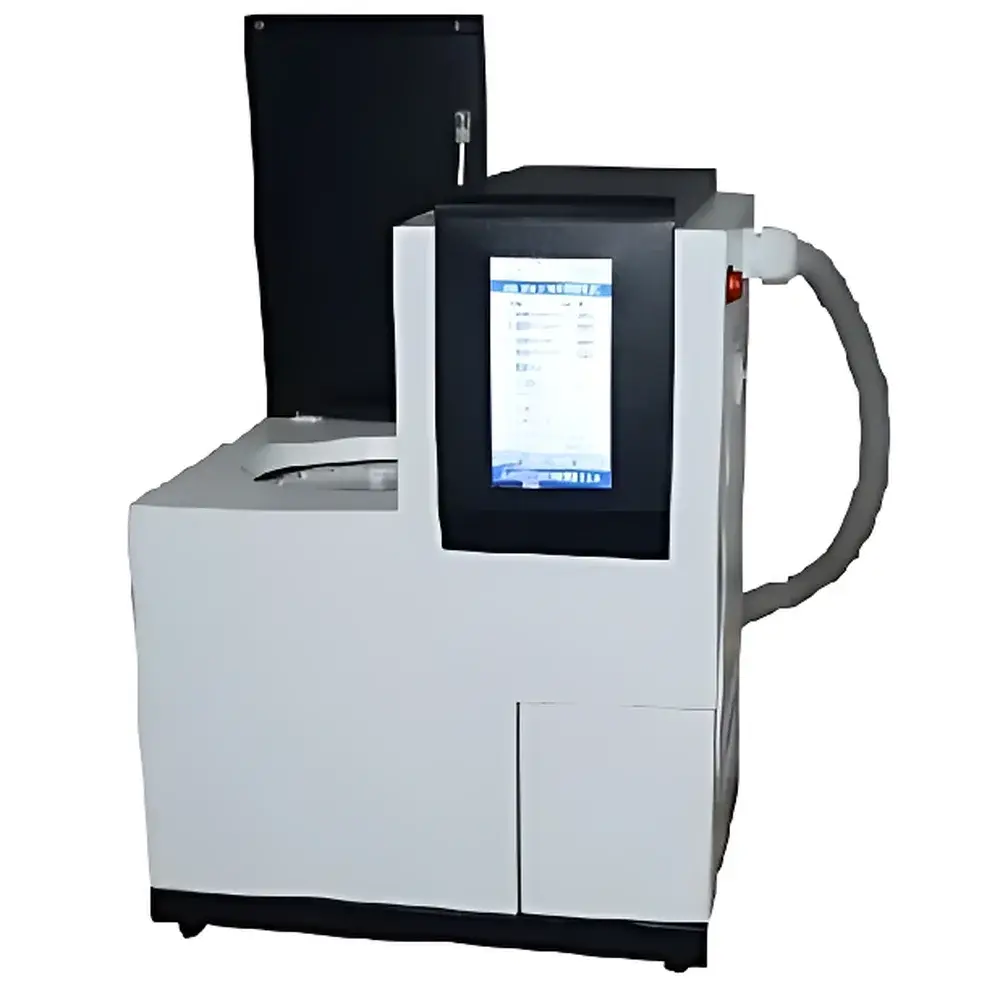
Beifen Sanpu TADS-20A Automated Dual-Stage Thermal Desorber for Unattended 20-Sample Analysis
| Brand | Beifen Sanpu |
|---|---|
| Model | TADS-20A |
| Origin | Beijing, China |
| Manufacturer Type | Direct Manufacturer |
| Instrument Type | Dual-Stage Thermal Desorber |
| Primary Desorption Temperature Range | Ambient to 450 °C |
| Secondary Desorption Temperature Range | 100–450 °C |
| Cold Trap Temperature Range | −35 °C to Ambient |
| Desorption Recovery Rate | >99% (compound-dependent) |
| Sample Capacity | 20 positions |
| Temperature Control Accuracy | < ±0.5 °C |
| RSD | ≤2.5% (for 0.05 μg benzene in methanol) |
| Cold Trap Cooling Method | Electronic Peltier |
| Sample Tube Format | 1/4″ OD × 3.5″ (ASTM D6196-compliant) |
| Valve Actuation | Motor-driven 6-port switching valve |
| GC Synchronization | TTL/RS-232 trigger support |
| Dimensions (L×W×H) | 350 mm × 450 mm × 510 mm |
| Weight | ~40 kg |
Overview
The Beifen Sanpu TADS-20A is an automated dual-stage thermal desorber engineered for high-throughput, unattended analysis of volatile organic compounds (VOCs) and semi-volatile organic compounds (SVOCs) in environmental, industrial hygiene, and indoor air quality applications. It operates on the principle of two-step thermal desorption: first, analytes are thermally released from sorbent tubes under controlled inert gas flow; second, they are refocused onto a cryogenically cooled trap (down to −35 °C), followed by rapid thermal desorption directly into the gas chromatograph (GC) inlet. This two-stage process ensures sharp, reproducible chromatographic peaks, minimizes breakthrough, and maximizes sensitivity—particularly critical for trace-level VOC quantification per EPA TO-17, ASTM D6196, and ISO 16000-6 methodologies.
Key Features
- Unattended 20-sample batch processing with full system self-diagnostics, fault detection, and audible/visual alerts—enabling overnight or weekend operation without operator intervention.
- Independent four-zone temperature control: primary desorption oven, secondary desorption chamber, sample transfer line, and valve manifold—all adjustable in 1 °C increments (range: ambient to 450 °C for desorption zones; ambient to 300 °C for transfer line and valve).
- Integrated Peltier-based cold trap with precise −35 °C to ambient control, enabling efficient analyte focusing and narrow peak widths (<0.5 °C stability).
- Motor-driven 6-port valve with low-dead-volume configuration and automated back-flush capability for transfer line and valve cleaning—eliminating carryover between samples.
- Programmable time-sequence operation: includes primary desorption, purge-and-trap, secondary desorption, GC injection, and post-injection valve/line backflush—all user-definable via embedded microprocessor.
- Built-in tube activation module for automated reconditioning of Tenax®, Carbopack™, and multi-bed sorbent tubes prior to sampling—reducing blank contamination and extending tube lifetime.
- Native GC synchronization via TTL or RS-232 handshake; supports triggered start of GC oven ramp and data acquisition software (e.g., OpenLAB CDS, Chromeleon, Empower).
- Compatible with standard 1/4″ OD × 3.5″ adsorption tubes (ASTM D6196 format); optional quartz-lined transfer lines available for reactive analytes (e.g., aldehydes, sulfur compounds).
Sample Compatibility & Compliance
The TADS-20A is validated for use with widely adopted sorbent media—including Tenax TA, Carbopack B/C, and graphitized carbon black composites—and accommodates both single- and multi-bed configurations. Its performance meets or exceeds requirements specified in key regulatory methods: HJ 644–2013 (ambient air VOCs by TD-GC/MS), HJ 583–2010 (benzene series in ambient air), HJ 734–2014 (stack emissions), GB/T 18883–2002 (indoor air), and GB 50325–2020 (civil construction IAQ). The instrument’s temperature accuracy (99% for benzene, toluene, ethylbenzene, xylenes), and precision (RSD ≤2.5% at 0.05 μg level) align with GLP-compliant laboratory practice. All firmware logs—including method parameters, run timestamps, temperature profiles, and error events—are timestamped and non-erasable, supporting audit readiness under ISO/IEC 17025 and FDA 21 CFR Part 11 (when paired with compliant LIMS or CDS).
Software & Data Management
The TADS-20A operates via an embedded 32-bit ARM-based controller with a graphical LCD interface. Method development is performed locally using intuitive menu navigation: users define desorption times, temperatures, purge flows (0–100 mL/min), and simulated sampling parameters (0–160 mL/min). Full method export/import via USB is supported. While the unit does not include proprietary PC software, it outputs standardized ASCII log files containing complete thermal history, valve timing, and event markers—readily ingestible by third-party chromatography data systems. Audit trails are retained onboard for ≥10,000 runs, with automatic overwrite protection enabled only after manual confirmation. Firmware updates are delivered as signed binary packages to ensure integrity and traceability.
Applications
- Regulatory monitoring of ambient, indoor, and workplace air per EPA, ISO, and Chinese MEE standards.
- Method validation and calibration curve generation using integrated simulated sampling and standard addition routines.
- High-volume screening of building materials, automotive interiors, and consumer products for VOC emissions.
- Support for TD-GC-FID, TD-GC-MS, and TD-GC-MS/MS workflows in environmental laboratories accredited to CNAS-CL01 (equivalent to ISO/IEC 17025).
- Research applications requiring reproducible thermal release kinetics studies—leveraging programmable ramp rates (>3000 °C/min during secondary desorption).
FAQ
Does the TADS-20A support compliance with US EPA Method TO-17?
Yes—the instrument meets all hardware and operational requirements for TO-17, including dual-stage desorption, cold trapping down to −35 °C, and quantitative recovery verification using certified standards.
Can I use non-standard sorbent tubes (e.g., 1/8″ OD or custom lengths)?
The autosampler stage is mechanically optimized for 1/4″ × 3.5″ tubes per ASTM D6196. Non-conforming tubes require manual loading and may compromise positional repeatability and seal integrity.
Is remote monitoring or network connectivity available?
The TADS-20A features RS-232 and TTL I/O for hardware-level integration but lacks built-in Ethernet/Wi-Fi. Remote status interrogation and control must be implemented via external PLC or GC software handshake.
What maintenance intervals are recommended for the cold trap and valves?
Peltier modules require no scheduled maintenance; annual verification of cooling performance against NIST-traceable thermometer is advised. Motorized valves are rated for >500,000 cycles; visual inspection of sealing surfaces every 6 months is sufficient under normal use.
How is method transfer validated between different TADS-20A units?
Inter-unit consistency is ensured via factory calibration using reference thermocouples and certified flow meters. Users should perform system suitability tests (SST) with a common standard mixture before deploying new instruments in regulated workflows.
Related Products




