
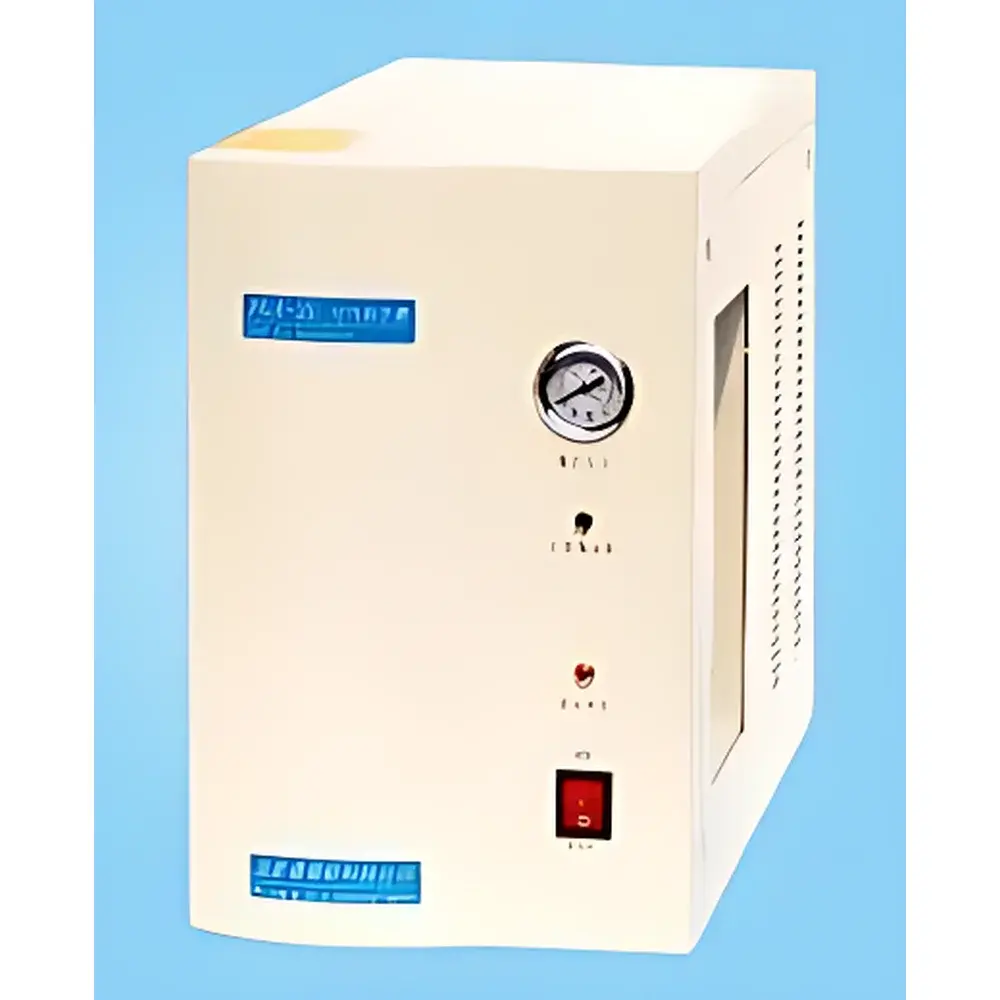
Beifen Sanpu BF-5 Air Generator with 0–5 L/min Flow Rate
| Brand | Beifen Sanpu |
|---|---|
| Model | BF-5 |
| Origin | Hebei, China |
| Manufacturer Type | Direct Manufacturer |
| Output Flow | 0–5 L/min (0–5000 mL/min) |
| Output Pressure | 0.4 MPa (standard for GC air supply) / 0.5 MPa (for air input to nitrogen generators) |
| Hydrocarbon Content | <0.1 ppm (HC) |
| Dew Point | –60 °C |
| Filtration Stages | Triple-stage purification (particulate, coalescing, catalytic hydrocarbon removal) |
| Pressure Regulation | Dual-stage precision pressure regulation |
| Safety Features | Over-pressure protection, automatic condensate drain valve |
| Noise Level | ≤42 dB(A) |
| Power Supply | AC 220 V, 50 Hz |
| Rated Power | 180 W |
| Weight | 24 kg |
| Dimensions (L×W×H) | 490 × 240 × 380 mm |
| Operating Temperature | 15–40 °C |
| Relative Humidity | <70% RH |
| Ambient Requirements | Low-dust, non-corrosive environment |
Overview
The Beifen Sanpu BF-5 Air Generator is an engineered solution for laboratories requiring continuous, on-demand supply of high-purity compressed air for analytical instrumentation—including gas chromatography (GC), GC–MS, flame ionization detectors (FID), nitrogen–phosphorus detectors (NPD), and other air-dependent detectors. Unlike conventional compressed air cylinders, the BF-5 eliminates storage hazards, logistical constraints, and purity variability by generating clean, dry, hydrocarbon-free air directly from ambient air via a robust, integrated compression and purification architecture. Its core process comprises oil-free diaphragm compression, followed by three-stage purification: particulate filtration, coalescing moisture removal, and high-temperature catalytic oxidation of residual hydrocarbons (≥350 °C). The resulting air meets stringent instrumental requirements—<0.1 ppm total hydrocarbons and a dew point of –60 °C—ensuring baseline stability, detector longevity, and method reproducibility across regulated and research environments.
Key Features
- Oil-free diaphragm compressor ensures zero lubricant contamination—critical for trace-level analysis and detector sensitivity.
- Triple-stage purification system: pre-filter (3 µm), coalescing filter (0.01 µm), and high-efficiency catalytic converter (HC <0.1 ppm).
- Dual-stage precision pressure regulation delivers stable output at either 0.4 MPa (standard for GC detector air supply) or 0.5 MPa (compatible with inlet requirements of membrane-based nitrogen generators).
- Integrated over-pressure safety cutoff and manual/auto condensate drain valve enhance operational reliability and reduce maintenance intervals.
- Ultra-quiet operation (≤42 dB[A]) enables deployment in shared lab spaces without acoustic interference.
- Compact footprint (490 × 240 × 380 mm) optimizes benchtop utilization—ideal for space-constrained QC labs and multi-instrument setups.
- Intuitive single-button start/stop interface with LED status indicators simplifies daily operation; no routine calibration or consumable replacement required beyond scheduled filter changes.
Sample Compatibility & Compliance
The BF-5 is designed for use with all major GC and GC–MS platforms requiring instrument-grade air, including but not limited to Agilent, Thermo Fisher Scientific, Shimadzu, PerkinElmer, and Waters systems. It complies with ISO 8573-1:2010 Class 1.2.1 (compressed air purity for instrumentation), and its hydrocarbon specification aligns with ASTM D6245 and USP guidance for carrier and detector gases. While not certified to FDA 21 CFR Part 11 out-of-the-box, its stable, auditable output supports GLP/GMP workflows when paired with laboratory documentation protocols and periodic verification (e.g., annual HC and dew point validation per internal SOPs).
Software & Data Management
The BF-5 operates as a standalone hardware system with no embedded software or network interface. All operational parameters—including runtime, pressure status, and fault alerts—are conveyed via front-panel LEDs and tactile feedback. For laboratories requiring integration into electronic lab notebooks (ELN) or preventive maintenance tracking, optional analog voltage outputs (0–5 V or 4–20 mA) can be configured to monitor pressure and flow continuity. Maintenance logs—including filter service dates and condensate drain frequency—are recommended to be recorded manually per ISO/IEC 17025 Clause 6.4.7 (equipment management) and retained for audit readiness.
Applications
- Primary air supply for FID, NPD, and photoionization detectors (PID) in environmental, pharmaceutical, and petrochemical testing labs.
- Air source for zero-air generation systems used in ambient air monitoring and calibration gas preparation.
- Instrument air for pneumatic actuators, auto-samplers, and purge-and-trap concentrators requiring consistent low-hydrocarbon air.
- Backup or primary air feed for nitrogen generators utilizing air-as-feedstock membrane or PSA technology.
- Replacement for high-pressure air cylinders in ISO 17025-accredited laboratories seeking improved gas traceability, reduced cylinder handling risk, and elimination of third-party gas certification dependencies.
FAQ
What is the maximum continuous operating time for the BF-5?
The BF-5 is rated for indefinite continuous operation under specified ambient conditions (15–40 °C, <70% RH), provided routine maintenance (e.g., filter replacement every 6–12 months depending on usage and ambient dust load) is performed.
Can the BF-5 be used with a mass spectrometer’s auxiliary air supply?
Yes—provided the MS manufacturer specifies air purity requirements compatible with <0.1 ppm HC and –60 °C dew point; verify compatibility with your instrument’s technical manual prior to integration.
Is the output air truly oil-free?
Yes—the unit employs an oil-free diaphragm compressor and contains no lubricated moving parts in the air path; all purification stages are inert and non-leaching.
How often must the filters be replaced?
Pre-filters should be inspected quarterly and replaced every 6 months under typical lab conditions; catalytic cartridges require replacement every 12–18 months based on cumulative runtime and ambient hydrocarbon exposure.
Does the BF-5 meet GLP or GMP requirements?
It supports GLP/GMP compliance through stable, documented performance—but formal qualification (IQ/OQ/PQ) must be executed by the end user per internal validation protocols and applicable regulatory expectations (e.g., EU Annex 15, FDA Guidance for Industry).



