
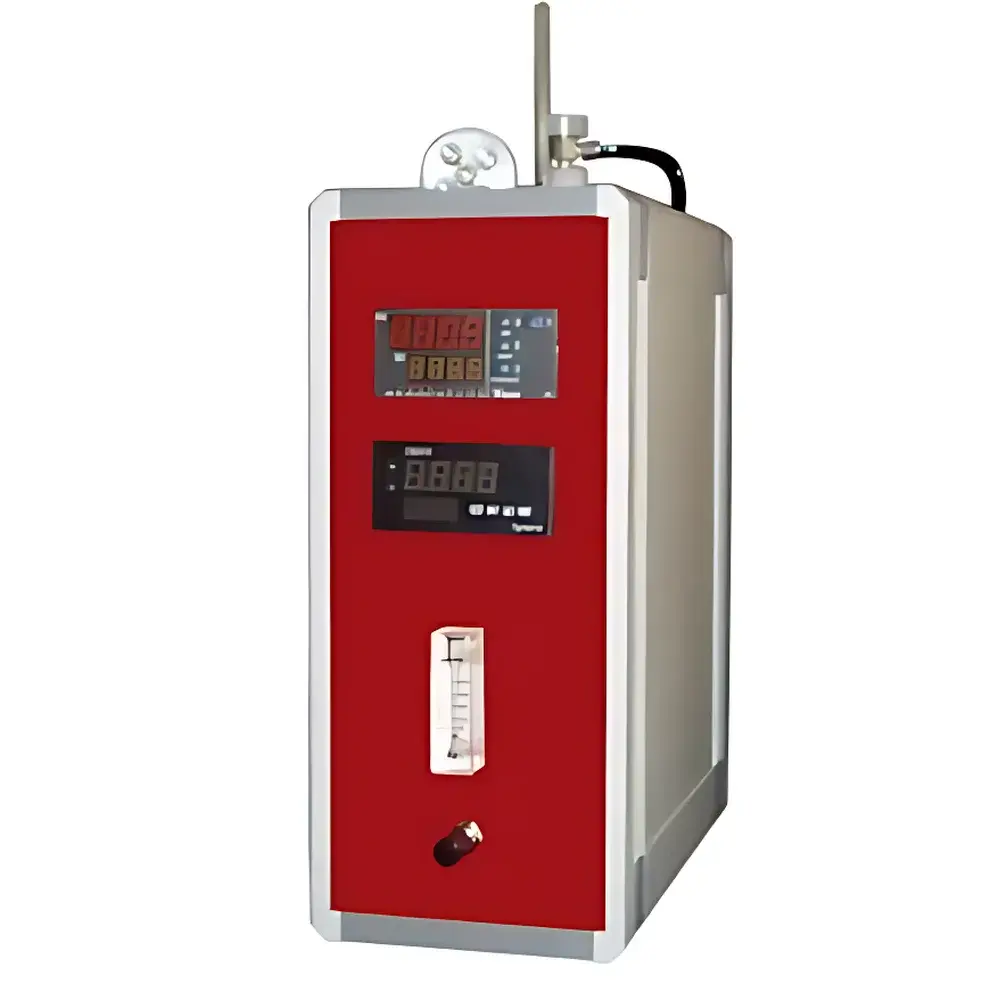
Beifen Sanpu TDS-3410 Integrated Thermal Desorption Tube Activator and Standard Sample Simulation Sampler
| Brand | Beifen Sanpu |
|---|---|
| Origin | Beijing, China |
| Manufacturer Type | Direct Manufacturer |
| Model | TDS-3410 |
| Temperature Control Range | Ambient to 400 °C |
| Nitrogen Flow Rate | 0–200 mL/min (adjustable) |
| Tube Capacity | 6 tubes |
| Timer Range | 0–655 min |
| Power Consumption | <500 W |
| Dimensions | 340 × 165 × 395 mm |
| Weight | ~8 kg |
Overview
The Beifen Sanpu TDS-3410 Integrated Thermal Desorption Tube Activator and Standard Sample Simulation Sampler is a laboratory-grade benchtop instrument engineered for precision conditioning of sorbent-packed thermal desorption (TD) tubes and reproducible generation of certified reference standards for gas chromatography–mass spectrometry (GC–MS) and GC–flame ionization detection (GC–FID) analysis. It operates on two independent yet co-located functional modules: (1) a programmable tube activation system that thermally regenerates spent or virgin adsorption tubes via controlled inert gas purging at elevated temperatures, and (2) a calibrated standard simulation module capable of introducing trace-level volatile organic compounds (VOCs)—including benzene, toluene, ethylbenzene, xylenes (BTEX), and total volatile organic compounds (TVOC)—into clean carrier gas streams. This dual-function architecture eliminates inter-instrument variability and reduces method development time in environmental air monitoring, indoor air quality (IAQ) assessment, and occupational hygiene laboratories.
Key Features
- Integrated dual-mode operation: simultaneous or sequential activation of up to six 6-mm OD (¼-inch) sorbent tubes and quantitative spiking of certified gaseous or liquid-phase standards under temperature-controlled conditions
- Precise thermal control: PID-regulated furnace with ambient-to-400 °C range, 1 °C resolution, and ±0.5% stability over full operating span
- Calibrated inert gas delivery: digitally adjustable nitrogen flow from 0 to 200 mL/min, enabling optimization of desorption efficiency and breakthrough prevention during tube conditioning
- Deep-gas purification system: integrated high-efficiency hydrocarbon and moisture trap upstream of the sampling manifold to minimize background interference in low-concentration VOC calibration
- Automated timing protocol: programmable timer (0–655 minutes) supporting unattended overnight regeneration cycles and synchronized standard generation sequences
- Compact footprint and energy-efficient design: 340 × 165 × 395 mm chassis with <500 W peak power draw—suitable for shared analytical workspaces and ISO/IEC 17025-accredited laboratories
Sample Compatibility & Compliance
The TDS-3410 accommodates standard 6-mm outer diameter stainless steel or glass thermal desorption tubes of arbitrary length, compatible with common sorbents including Tenax TA, Carbopack B/C, Carboxen, and graphitized carbon black media. Its modular architecture supports both ambient-pressure gas standard introduction (e.g., certified permeation tubes or dynamic dilution systems) and heated liquid standard injection (e.g., syringe-based spiking into a vaporization chamber). The instrument meets essential functional requirements outlined in ASTM D6196-22 (Standard Practice for Selecting Air Monitoring Methods for Volatile Organic Compounds), EPA TO-17 (Determination of Volatile Organic Compounds in Ambient Air Using Active Sampling Onto Sorbent Tubes), and ISO 16000-6 (Indoor Air – Part 6: Determination of Volatile Organic Compounds in Indoor and Test Chamber Air by Active Sampling on Tenax TA Sorbent, Thermal Desorption and Gas Chromatographic Analysis). While not inherently 21 CFR Part 11-compliant, its timer logs and manual operational records support GLP-aligned documentation practices when integrated into validated laboratory workflows.
Software & Data Management
The TDS-3410 is a microprocessor-controlled standalone unit with no embedded software or network interface. All parameters—including target temperature, dwell time, flow rate, and cycle count—are set via front-panel rotary encoder and LED display. No proprietary drivers, firmware updates, or cloud connectivity are required. This design ensures long-term operational consistency, eliminates cybersecurity exposure, and simplifies audit readiness in regulated environments where deterministic hardware behavior is prioritized over digital feature sets. Users maintain full traceability through handwritten or LIMS-integrated logbooks documenting activation batch IDs, standard lot numbers, purge durations, and post-activation blank checks per ISO/IEC 17025 Clause 7.7.
Applications
- Regeneration of used TD tubes prior to reuse in compliance with EPA Method TO-17 quality control protocols
- Pre-conditioning of virgin tubes to remove residual volatiles and establish baseline cleanliness for low-ppt analysis
- Preparation of matrix-matched calibration standards for BTEX, aldehydes, halogenated VOCs, and semi-volatile compounds (SVOCs)
- Verification of TD-GC system performance via recovery testing using spiked tube challenges
- Method validation studies requiring precise control over tube heating profiles, purge gas composition, and thermal history
- Training and proficiency testing in accredited environmental testing laboratories conducting ISO 16000-series analyses
FAQ
What tube dimensions does the TDS-3410 support?
It accepts standard 6-mm outer diameter (¼-inch) thermal desorption tubes of any length; tube holders are mechanically adjustable to accommodate variations in manufacturer specifications.
Can the instrument be used with helium or synthetic air instead of nitrogen?
Yes—provided the gas source meets purity specifications (>99.999% for trace VOC work) and flow controller calibration is verified for the selected gas species.
Is remote monitoring or data export possible?
No—the TDS-3410 is an analog-digital hybrid controller without USB, Ethernet, or Bluetooth interfaces; all operational data must be manually recorded.
Does it meet FDA or EU GMP requirements for pharmaceutical environmental monitoring?
While not certified for GMP, its robust thermal stability, repeatable timing, and documented maintenance procedures enable qualification per ICH Q9 principles when incorporated into a site-specific validation protocol.
How often should the gas purifier cartridge be replaced?
Replacement frequency depends on usage intensity and ambient humidity; typical service intervals range from 3 to 6 months under continuous lab operation—monitor pressure drop across the trap as the primary indicator.



