
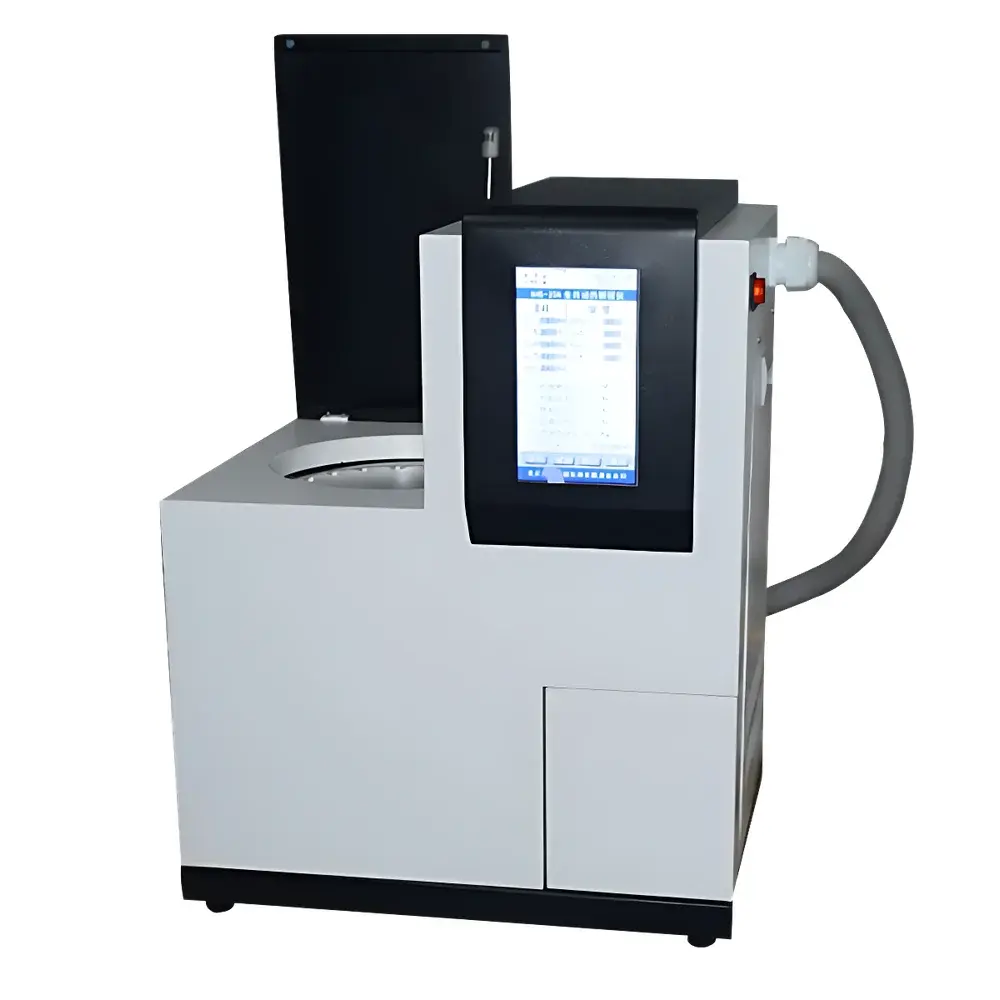
Beifen Sanpu ATDS-20A Fully Automated Two-Stage Thermal Desorber
| Brand | Beifen Sanpu |
|---|---|
| Origin | Beijing, China |
| Manufacturer Type | Direct Manufacturer |
| Product Category | Domestic (China-made) |
| Model | ATDS-20A |
| Instrument Type | Two-stage Thermal Desorber |
| Primary Desorption Temperature Range | Ambient to 450 °C |
| Secondary Desorption Temperature Range | 100–450 °C |
| Cold Trap Temperature Range | −35 °C to Ambient |
| Desorption Recovery Rate | >99% (compound-dependent) |
| Sample Capacity | 20 positions |
| Cold Trap Cooling Method | Electronic Refrigeration |
| Temperature Control Accuracy | ±0.5 °C |
| RSD | ≤2.5% (for 0.05 μg benzene in methanol) |
| Sample Tube Specification | 1/4″ OD × 3.5″ length (ASTM D6196-compliant) |
Overview
The Beifen Sanpu ATDS-20A Fully Automated Two-Stage Thermal Desorber is an engineered solution for trace-level volatile organic compound (VOC) and semi-volatile organic compound (SVOC) analysis in environmental, occupational health, and building materials testing laboratories. It operates on the principle of two-stage thermal desorption—first releasing analytes from sorbent tubes under controlled heating and inert gas flow, then refocusing them onto a cryogenically cooled trap before rapid, narrow-band thermal injection into a gas chromatograph (GC) or GC–MS system. This architecture ensures high analyte integrity, minimal band broadening, and optimal sensitivity for compounds with boiling points up to 350 °C. Designed to meet the procedural rigor of modern regulatory methods—including HJ 644–2013, HJ 583–2010, HJ 734–2014, and GB/T 18883–2002—the ATDS-20A delivers reproducible, auditable performance in compliance-critical workflows.
Key Features
- Fully automated 20-position sample processing with unattended overnight operation and intelligent self-diagnostic routines including automatic sample tray calibration and fault logging.
- Independent four-zone temperature control: primary desorption oven, secondary desorption chamber, transfer line, and six-port valve—all heated separately with 1 °C resolution and stability better than ±0.5 °C.
- Electronically refrigerated cold trap capable of reaching −35 °C, enabling efficient analyte focusing and sharp, symmetrical peak shapes—even for early-eluting VOCs such as formaldehyde and acetaldehyde.
- Programmable multi-step sequence: primary desorption → inert gas purge → cold trap focusing → secondary flash desorption → GC injection → post-run trap and transfer line back-flush (0–100 mL/min, continuously adjustable).
- Dual-mode secondary desorption configuration: supports both ambient-temperature and low-temperature secondary desorption modules, configurable per method requirements.
- Integrated sample tube activation protocol with programmable heating and purging cycles, eliminating manual off-line conditioning.
- Standardized 1/4″ OD × 3.5″ sorbent tube interface compliant with ASTM D6196 and ISO 16017-1; optional fused silica transfer lines available for active compound analysis.
- Motor-driven six-port valve with precise timing control; compatible with all major GC and GC–MS inlet types via application-specific mechanical and electrical adapters.
Sample Compatibility & Compliance
The ATDS-20A accommodates standard stainless steel or glass sorbent tubes packed with single- or multi-bed media (e.g., Tenax TA, Carbopack B/C, Carboxen 1000), supporting sampling volumes from 10 mL to 5 L at flow rates up to 160 mL/min (simulated sampling mode). Its hardware and software architecture align with GLP/GMP data integrity expectations: all method parameters, run logs, temperature profiles, and error events are time-stamped and stored locally. While not pre-certified to FDA 21 CFR Part 11, the system supports audit-trail-enabled third-party LIMS integration and is routinely deployed in laboratories undergoing CNAS (China National Accreditation Service) and CMA (China Metrology Accreditation) assessments. It fulfills technical requirements specified in HJ/T 400–2007 (in-vehicle VOCs), GB 50325–2020 (civil engineering indoor air), and ISO 16017-1 (indoor air VOC determination).
Software & Data Management
Controlled via a 7-inch capacitive touchscreen interface, the embedded microprocessor runs deterministic real-time firmware—not Windows-based software—ensuring deterministic timing for critical thermal events. Method files store complete thermal profiles, valve actuation sequences, gas flow setpoints, and GC synchronization triggers. All run metadata—including start/stop timestamps, temperature deviations, and alarm history—is exported in CSV format for traceability. The system supports external triggering via TTL or dry-contact signals, enabling seamless integration with GC autosamplers or centralized lab automation systems. No proprietary drivers or runtime dependencies are required for data export or remote monitoring via Ethernet.
Applications
The ATDS-20A is routinely applied in accredited environmental testing labs for: quantification of BTEX, aldehydes, and halogenated VOCs in ambient and indoor air; screening of residual solvents in polymer composites and adhesives per GB/T 2912.1; assessment of off-gassing from carpets, furniture, and insulation materials; and monitoring of fugitive emissions from industrial stacks per HJ 734–2014. Its robustness and repeatability make it suitable for long-term trend analysis in regulatory monitoring networks, where inter-laboratory comparability and method ruggedness are essential.
FAQ
What sorbent tube formats does the ATDS-20A support?
It accepts standard 1/4″ OD × 3.5″ stainless steel or glass tubes compliant with ASTM D6196 and ISO 16017-1 specifications.
Can the instrument be integrated with third-party GC data systems?
Yes—via hardware trigger signals (TTL or relay) and synchronized method export; no proprietary software layer is required.
Is the cold trap cooling system maintenance-free?
The solid-state electronic refrigeration module requires no cryogens or compressors and has no scheduled service intervals beyond routine cleaning of ventilation grilles.
Does the ATDS-20A meet US EPA Method TO-17 requirements?
While not EPA-certified, its thermal performance, recovery rates (>99%), and RSD (<2.5%) satisfy the instrumental criteria outlined in TO-17 for laboratory qualification and method validation.
How is carryover prevented between samples?
Through programmable high-flow inert gas back-flush of the transfer line and six-port valve after each injection—configurable from 0–100 mL/min.
Related Products





