
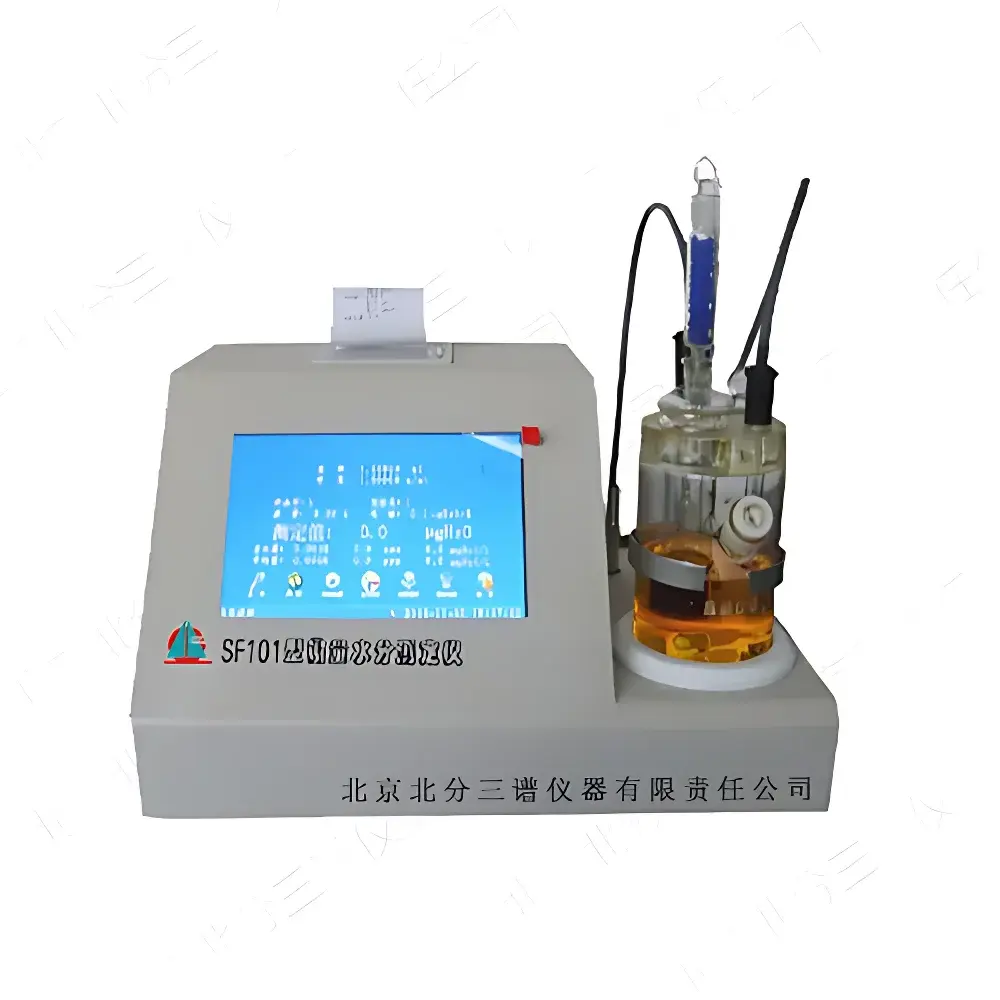
Beifen Sanpu SF101 Coulometric Karl Fischer Moisture Analyzer
| Brand | Beifen Sanpu |
|---|---|
| Origin | Hebei, China |
| Manufacturer Type | Direct Manufacturer |
| Country of Origin | China |
| Model | SF101 |
| Application | Multi-purpose coulometric moisture determination for liquids, gases, and solids |
| Measurement Principle | Coulometric Karl Fischer titration (电量法) |
| Display | 7-inch color TFT LCD touchscreen with Chinese UI |
| Electrolysis Current Range | 0–400 mA (auto-controlled) |
| Measurement Range | 0.1 µg – 200 mg H₂O (equivalent to 0.1 ppm – 100% w/w) |
| Resolution | 0.1 µg H₂O (0.1 ppm) |
| Accuracy | ≤ ±0.2% for samples ≥1 mg H₂O |
| Data Storage | 256 test records |
| Sample Introduction Modes | Volumetric injection, gravimetric weighing, and dilution-based injection |
| Automatic Unit Conversion | µg H₂O, ppm, % w/w, mg H₂O/L, and mean values |
| Printer | High-speed thermal micro-printer |
| Power Consumption | 60 W |
| Operating Temperature | 5–45 °C |
| Relative Humidity Limit | ≤80% RH |
| Dimensions (W×D×H) | 350 × 230 × 180 mm |
| Weight | 8 kg |
Overview
The Beifen Sanpu SF101 Coulometric Karl Fischer Moisture Analyzer is a precision laboratory instrument engineered for trace-level water quantification in diverse chemical matrices using the coulometric variant of the Karl Fischer (KF) titration method. Unlike volumetric KF systems, this analyzer generates iodine electrochemically at the anode via controlled current (0–400 mA), enabling direct stoichiometric quantification of water based on Faraday’s law. This principle ensures high reproducibility and eliminates reagent standardization errors—critical for compliance-driven environments such as pharmaceutical QC, petrochemical quality control, and battery electrolyte certification. Designed for regulatory alignment, the SF101 supports full traceability in accordance with ISO/IEC 17025, ASTM E203, and multiple Chinese national standards (e.g., GB/T 7600, GB 6283, SH/T 0246), making it suitable for GLP- and GMP-aligned workflows where audit-ready documentation is mandatory.
Key Features
- True coulometric detection with auto-adjusting electrolysis current for optimal sensitivity across the full dynamic range (0.1 µg–200 mg H₂O)
- 7-inch high-resolution color TFT touchscreen with intuitive Chinese-language interface and real-time graphical feedback during titration
- Triple-mode sample introduction: volumetric syringe injection, analytical balance-coupled gravimetric dosing, and programmable dilution calculation for viscous or high-moisture samples
- Onboard data management: stores up to 256 complete test records—including date/time stamp, sample ID, method parameters, raw titration curves, and final results in µg H₂O, ppm, % w/w, and mg H₂O/L
- Integrated thermal printer for immediate hard-copy output compliant with 21 CFR Part 11 requirements when paired with validated software protocols
- Self-diagnostic firmware that continuously monitors cell status, electrode integrity, reagent saturation, and ambient humidity interference
- Compact benchtop architecture (350 × 230 × 180 mm; 8 kg) optimized for space-constrained QC labs and production line deployment
Sample Compatibility & Compliance
The SF101 demonstrates broad compatibility across liquid, gaseous, and solid-phase samples without requiring method redevelopment. It routinely analyzes transformer oils (per GB/T 7600), fluorinated refrigerants (GB 10670), lithium battery electrolytes, polymer precursors (GB/T 12008.6), surfactants (GB/T 7380), ethanol fuels (GB/T 8350, GB/T 8351), and active pharmaceutical ingredients (Chinese Pharmacopoeia Vol. IV, General Chapter 0832). Its coulometric design inherently minimizes drift and blank contribution—key advantages for low-water matrices (<10 ppm) such as solvents, monomers, and electronic-grade gases. All measurement protocols align with internationally recognized validation frameworks, including ICH Q2(R2) for analytical procedure verification and USP for moisture content determination.
Software & Data Management
While the SF101 operates autonomously via embedded firmware, its data export capability (via USB port) enables integration into LIMS or ELN platforms. Each stored record includes timestamped metadata: operator ID, sample weight/volume, titration curve integral, endpoint confirmation flag, and calculated uncertainty per ISO/IEC 17025 Clause 7.7. The system supports configurable pass/fail limits and batch summary reports. For regulated environments, optional PC-based software (sold separately) provides full 21 CFR Part 11 compliance—including electronic signatures, audit trails, user role permissions, and secure data archiving—without modifying core instrument firmware.
Applications
- Petrochemicals: Water content in crude oil (GB/T 11146), lubricants (SH/T 0255), jet fuel (ASTM D6304), and LNG feedstocks (GB/T 18619.1)
- Pharmaceuticals: Residual moisture in APIs, excipients, and lyophilized formulations per Chinese Pharmacopoeia and ICH guidelines
- Electronics: Quantification of trace H₂O in semiconductor-grade solvents, photoresists, and Li-ion battery electrolytes (e.g., LiPF₆ in EC/DMC)
- Agrochemicals: Moisture in pesticide emulsifiers (GB/T 3727) and technical-grade actives (GB/T 1600)
- Polymers & Coatings: Water in polyols (GB/T 12008.6), acrylic monomers, and architectural coatings (GB 18582, GB 18583)
- Food & Biofuels: Ethanol purity verification (GB/T 8350), biodiesel (EN 14104), and glycerin feedstock analysis
FAQ
What is the fundamental difference between coulometric and volumetric Karl Fischer titration?
Coulometric KF generates iodine electrochemically in situ, allowing absolute quantification of water based on charge passed (Faraday’s law); volumetric KF uses pre-standardized iodine-containing titrant, requiring periodic recalibration and introducing volumetric uncertainty.
Can the SF101 analyze solid samples directly?
Yes—using gravimetric sample introduction with an external analytical balance; the instrument automatically calculates water content based on entered sample mass and performs stoichiometric conversion without manual intervention.
Does the SF101 support method validation per ICH Q2(R2)?
Its documented accuracy, repeatability, linearity, and robustness—validated against certified reference materials—provide foundational evidence for method qualification; full validation requires lab-specific protocol execution per Q2(R2) principles.
Is the instrument compatible with non-aqueous solvents like chloroform or xylene?
Yes—the dual-platinum electrode cell and optimized KF reagent formulation ensure stable endpoint detection in common anhydrous media used for hydrophobic sample dissolution.
How does the SF101 handle high-humidity laboratory environments?
Built-in environmental monitoring triggers alerts when ambient RH exceeds 80%; combined with sealed reagent bottles and desiccant-equipped sample ports, it maintains measurement integrity under typical QC lab conditions.





