
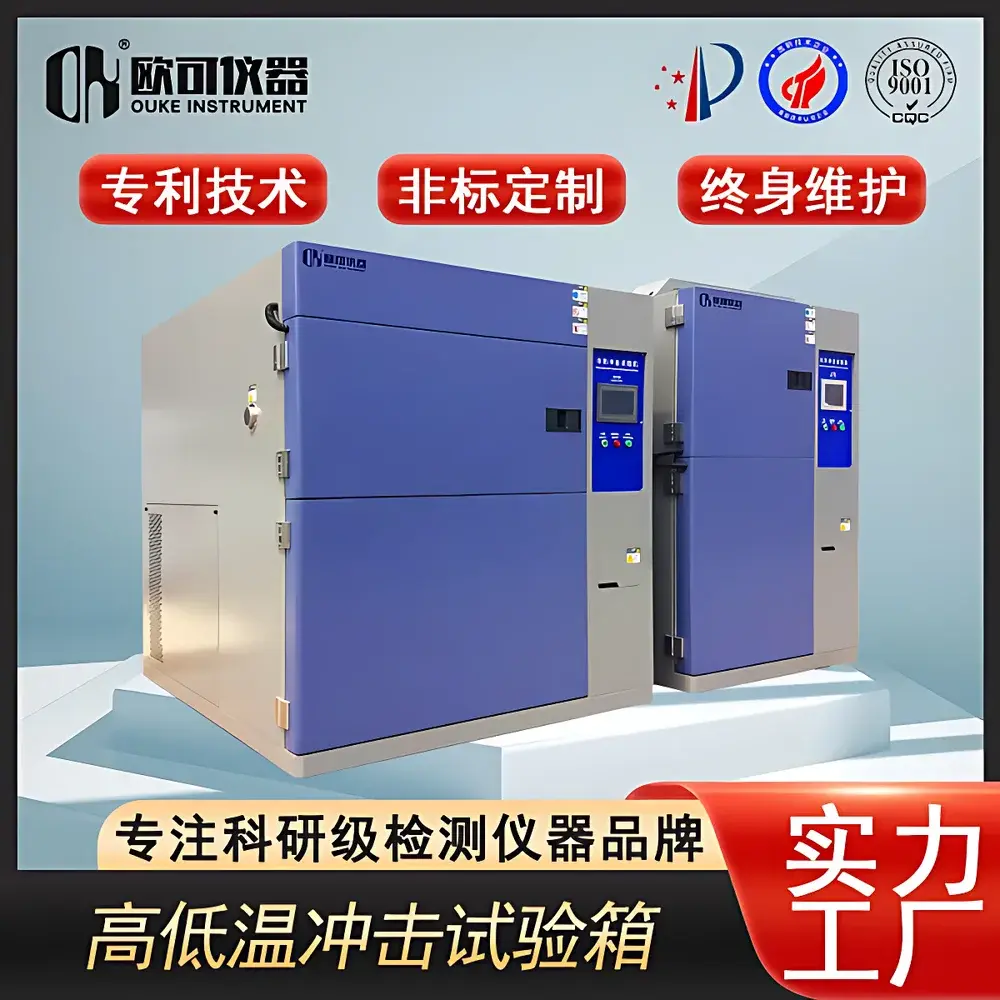
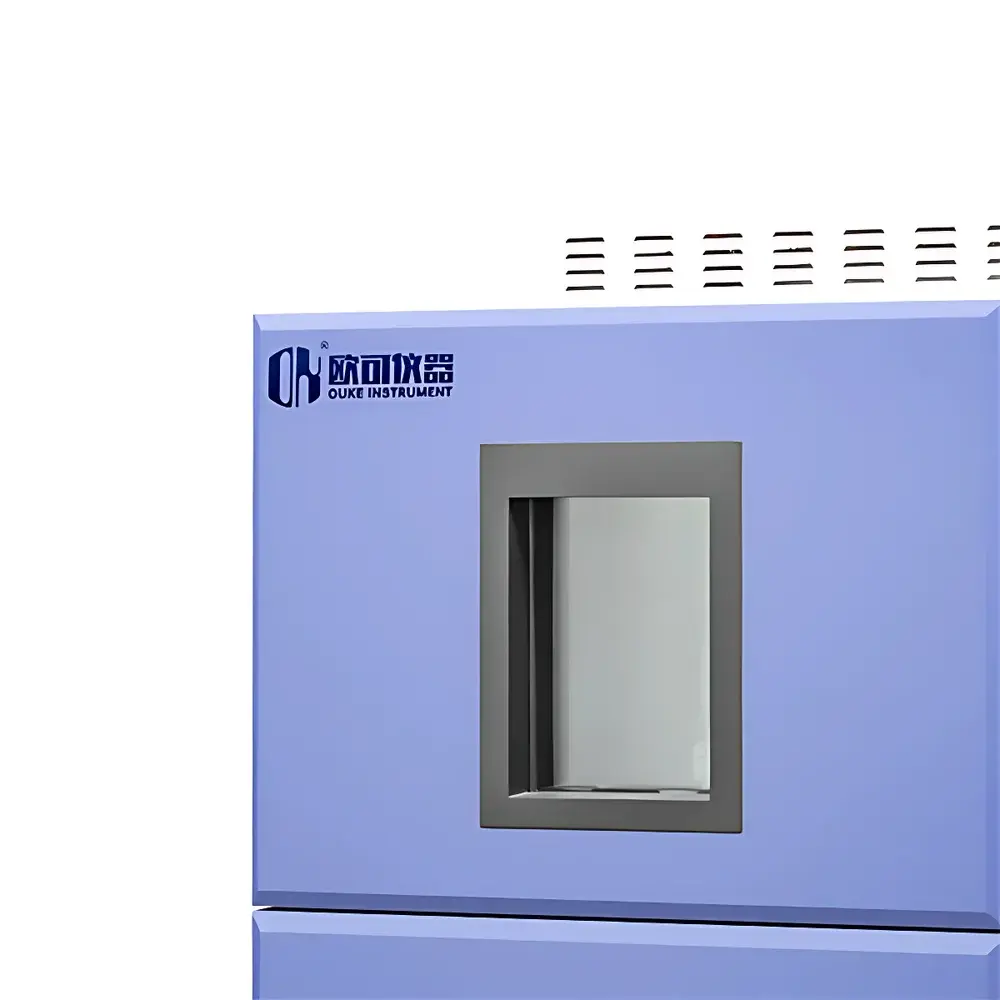
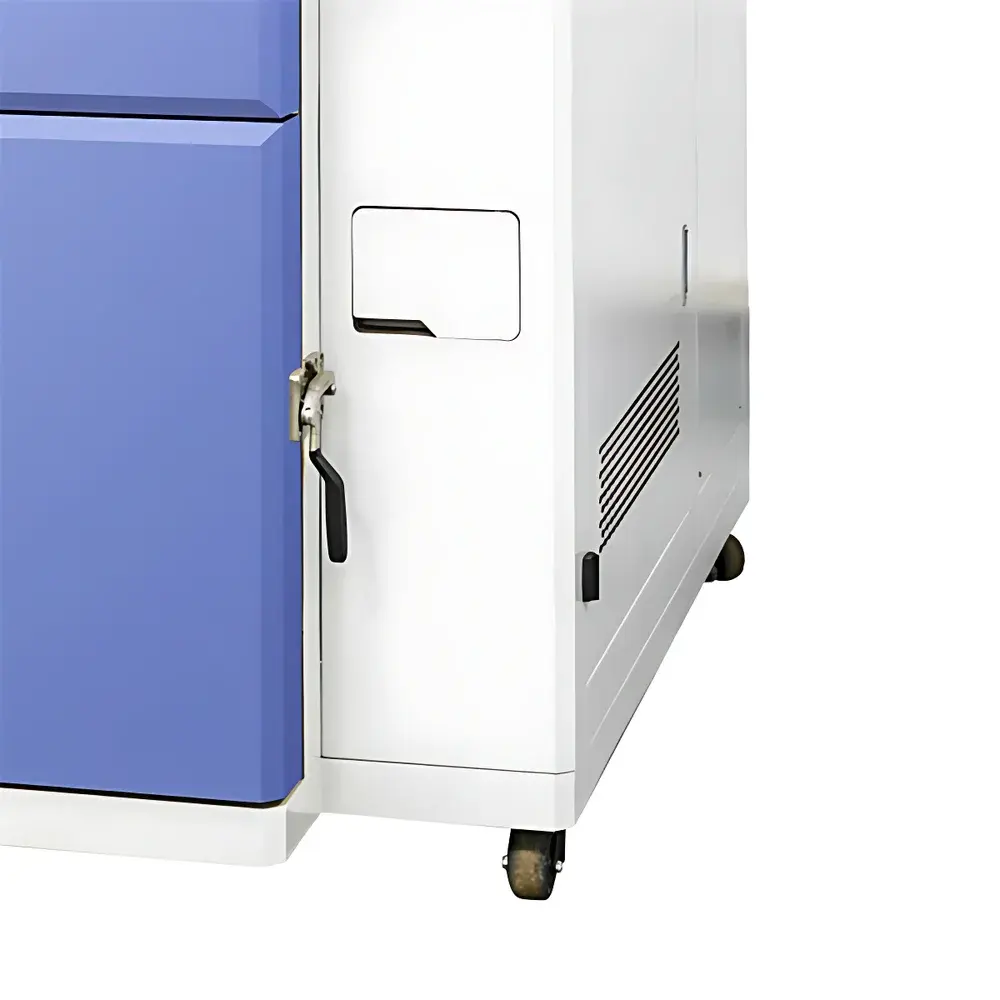
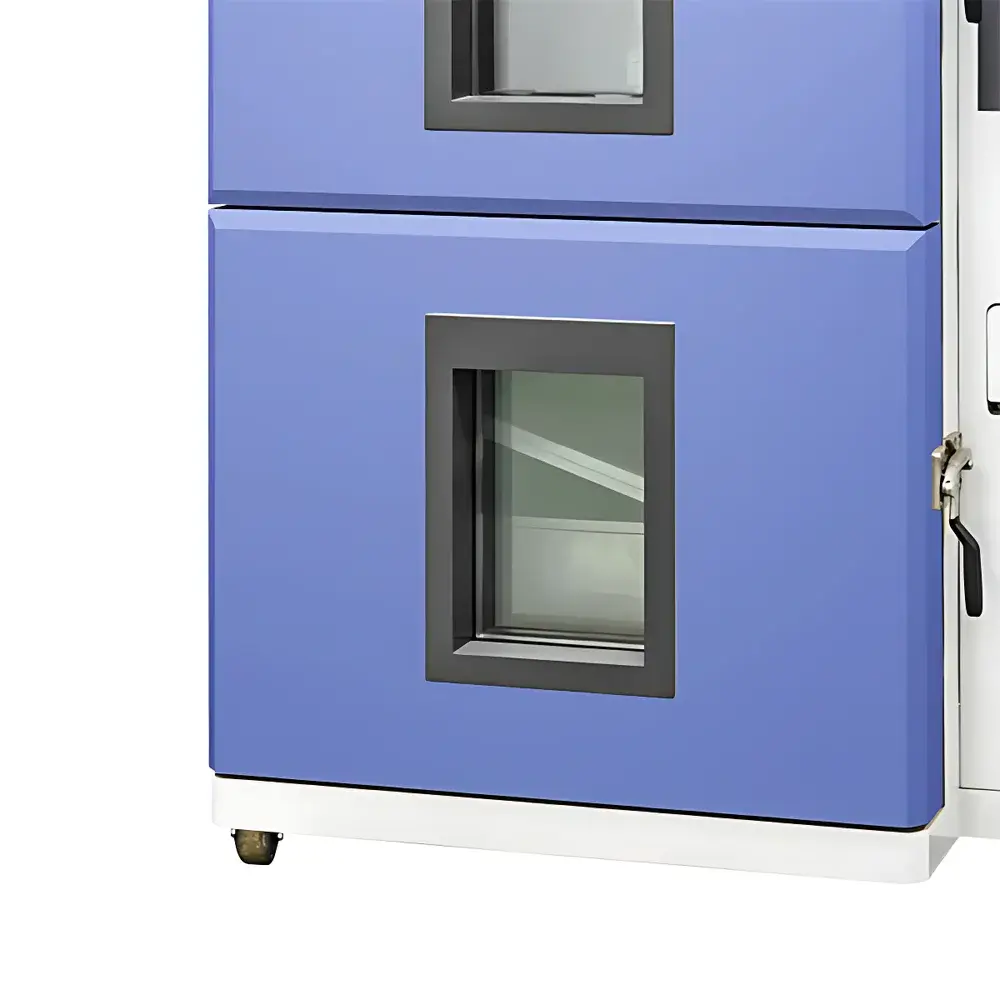
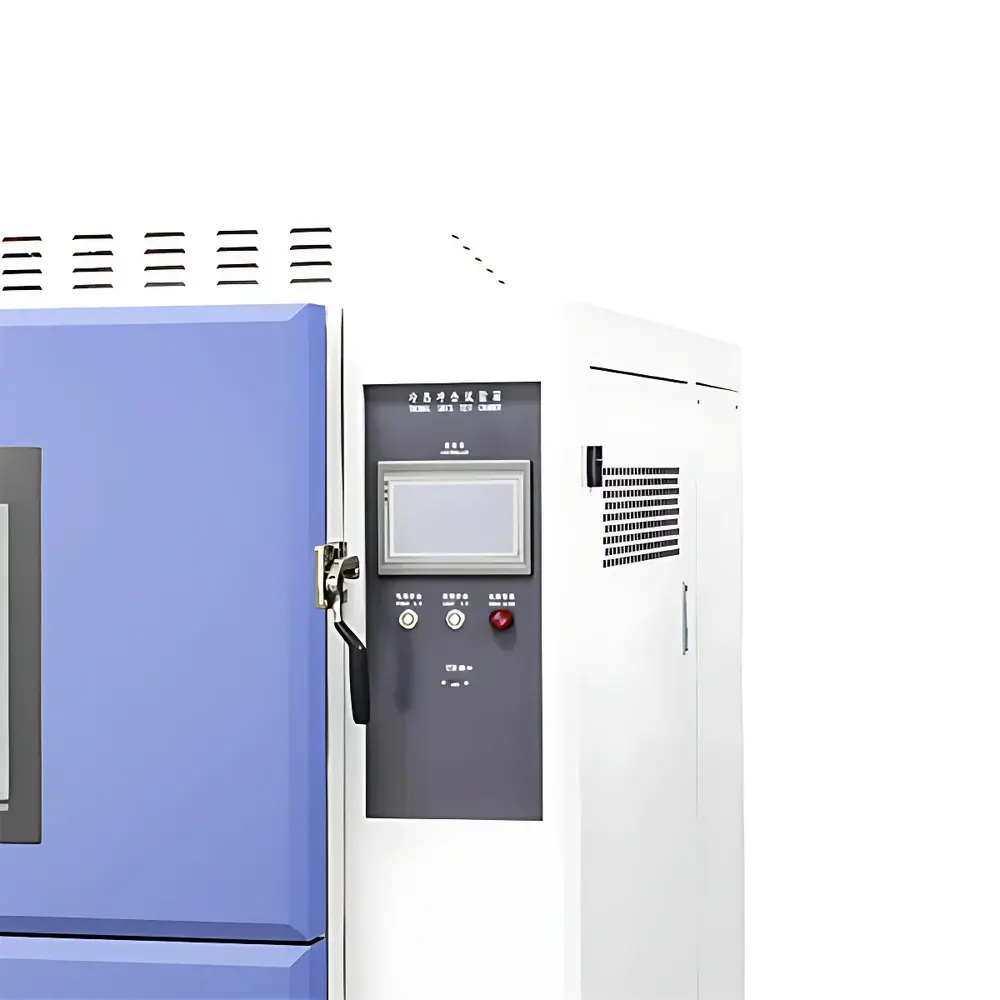
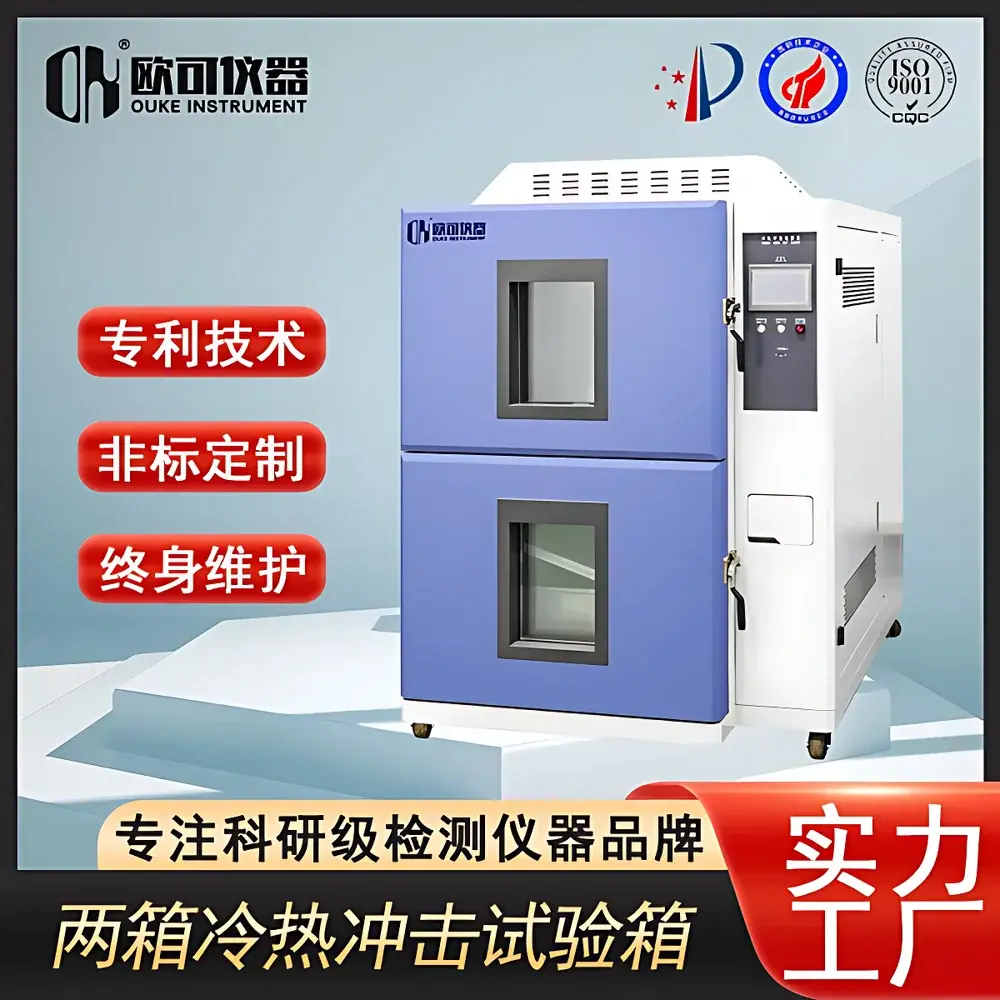
OK Thermal Shock Test Chamber OK-TS-80.02
| Brand | OK Instruments |
|---|---|
| Origin | Guangdong, China |
| Manufacturer Type | Direct Manufacturer |
| Model | OK-TS-80.02 |
| High Temp Range | +150 °C |
| Low Temp Range | −60 °C |
| Thermal Shock Range | −60 °C to +150 °C |
| Temperature Stability | ±2 °C |
| Transition Time | ≤10 s (typical) |
| Heating/Cooling Rate (chamber air) | 5 °C/s (air temperature change in test zone during transition) |
Overview
The OK Thermal Shock Test Chamber OK-TS-80.02 is an engineered solution for accelerated reliability validation under extreme thermal transients. Unlike environmental chambers designed for gradual temperature cycling or steady-state conditioning, this dual-zone (two-chamber) thermal shock system operates on the principle of rapid physical relocation of test specimens between independently maintained high- and low-temperature environments. By mechanically transferring the sample carrier—via pneumatic lift-and-transfer mechanism—between a +150 °C hot zone and a −60 °C cold zone in ≤10 seconds, the chamber subjects devices to abrupt thermal gradients that induce mechanical stress through differential expansion/contraction of heterogeneous materials. This methodology directly replicates field-relevant failure modes such as solder joint fracture, delamination at interface boundaries, hermetic seal rupture, and interconnect discontinuity—failures that remain undetected under slow-ramp thermal cycling protocols.
Key Features
- Dual-zone architecture with independent high-temperature (+150 °C) and low-temperature (−60 °C) chambers, each equipped with precision PID-controlled heating and cryogenic refrigeration systems
- Pneumatically actuated specimen transfer basket enabling ≤10-second transition time between thermal extremes—meeting critical timing requirements of MIL-STD-883 Method 1011, IEC 60068-2-14 (equivalent to GB/T 2423.22), and JESD22-A104
- Temperature stability maintained at ±2 °C across both zones during dwell phases, ensuring repeatability and compliance with test standard tolerances
- Robust stainless-steel construction with insulated double-wall panels and silicone-sealed access doors to minimize thermal leakage and cross-contamination
- Integrated safety interlocks including over-temperature cutoff, door-open freeze protection, and emergency stop circuitry compliant with IEC 61000-6-2 and UL 61010-1
- Programmable controller supporting up to 999 cycles, multi-step dwell times, and automatic logging of chamber temperatures and transition timestamps
Sample Compatibility & Compliance
The OK-TS-80.02 accommodates specimens up to standard industrial dimensions suitable for PCB assemblies, automotive ECUs, military-grade connectors, and optoelectronic modules. Its two-chamber configuration is optimized for medium-sized, rigid, and transportable units—particularly those requiring mechanical integrity verification without external instrumentation interference. The system supports full traceability per GLP/GMP requirements, with audit-ready data export (CSV/Excel) and optional 21 CFR Part 11–compliant user authentication and electronic signature modules. All operational parameters—including actual transition duration, dwell deviation, and thermal overshoot—are recorded with millisecond resolution and synchronized to internal real-time clock. Calibration certificates are traceable to NIM (National Institute of Metrology, China) standards and may be extended to ISO/IEC 17025-accredited third-party labs upon request.
Software & Data Management
The embedded controller features a 7-inch TFT touchscreen HMI with intuitive workflow navigation and multilingual UI (English, Simplified Chinese, Spanish). Test programs are defined using a hierarchical structure: test profile → cycle sequence → step parameters (dwell time, target temp, transition mode). Real-time graphs display live temperature curves for both zones and the basket thermocouple channel. Data is stored internally (≥10,000 cycle records) and exportable via USB or Ethernet. Optional PC-based OK-TestSuite software provides advanced analysis tools—including transition time histogramming, statistical process control (SPC) charts, and comparative overlay of multiple test runs—to support root-cause analysis and qualification reporting. Raw logs include ISO 8601 timestamps, operator ID, and firmware version for full regulatory audit trail.
Applications
- Qualification testing of aerospace avionics against MIL-STD-883H, Method 1011.12 (Thermal Shock)
- Reliability screening of semiconductor packages (QFN, BGA, CSP) per JESD22-A104E
- Validation of automotive ADAS sensors exposed to rapid cabin-to-outdoor thermal transitions
- Failure analysis of medical device enclosures subjected to sterilization-cooling cycles
- Material compatibility assessment for adhesive bonds, conformal coatings, and MEMS packaging under thermal gradient stress
- Design verification of battery management systems (BMS) and power electronics modules operating across wide ambient envelopes
FAQ
What distinguishes thermal shock testing from temperature cycling or rapid temperature change (RTC) testing?
Thermal shock relies on discrete, near-instantaneous exposure to opposing thermal extremes—achieved via physical relocation or airflow redirection—to provoke immediate mechanical failure. In contrast, temperature cycling applies linear ramp rates (e.g., 5–15 °C/min) over prolonged durations to assess cumulative fatigue. Standards specify different metrics: shock tests mandate maximum transition time (e.g., ≤10 s); cycling tests define minimum ramp rate.
Does the OK-TS-80.02 support three-zone (static-sample) configuration?
No—the OK-TS-80.02 implements a two-chamber, moving-basket architecture optimized for high-fidelity mechanical shock replication. For static-sample applications requiring zero vibration or continuous electrical monitoring, OK offers the OK-TS-V series (vertical three-zone design) as a separate platform.
Can liquid nitrogen be integrated for enhanced cooling performance?
The base model uses mechanical cascade refrigeration capable of sustaining −60 °C without auxiliary cryogens. Optional LN₂ assist is available for sub-60 °C operation or reduced recovery time between cycles—but requires site-specific infrastructure review and additional safety certification.
Is calibration documentation provided with shipment?
Yes—each unit ships with a factory calibration report covering temperature uniformity (±1.5 °C), stability (±2 °C), and transition timing (≤10 s verified at mid-load), all referenced to NIM-traceable standards. On-site IQ/OQ protocol support is available upon request.
How is thermal uniformity validated across the test basket?
Uniformity mapping is performed per IEC 60068-3-5 using nine calibrated PT100 sensors positioned at standardized locations (center + eight corners). Results confirm ≤±2 °C spatial deviation at both extreme setpoints during dwell phases.



