
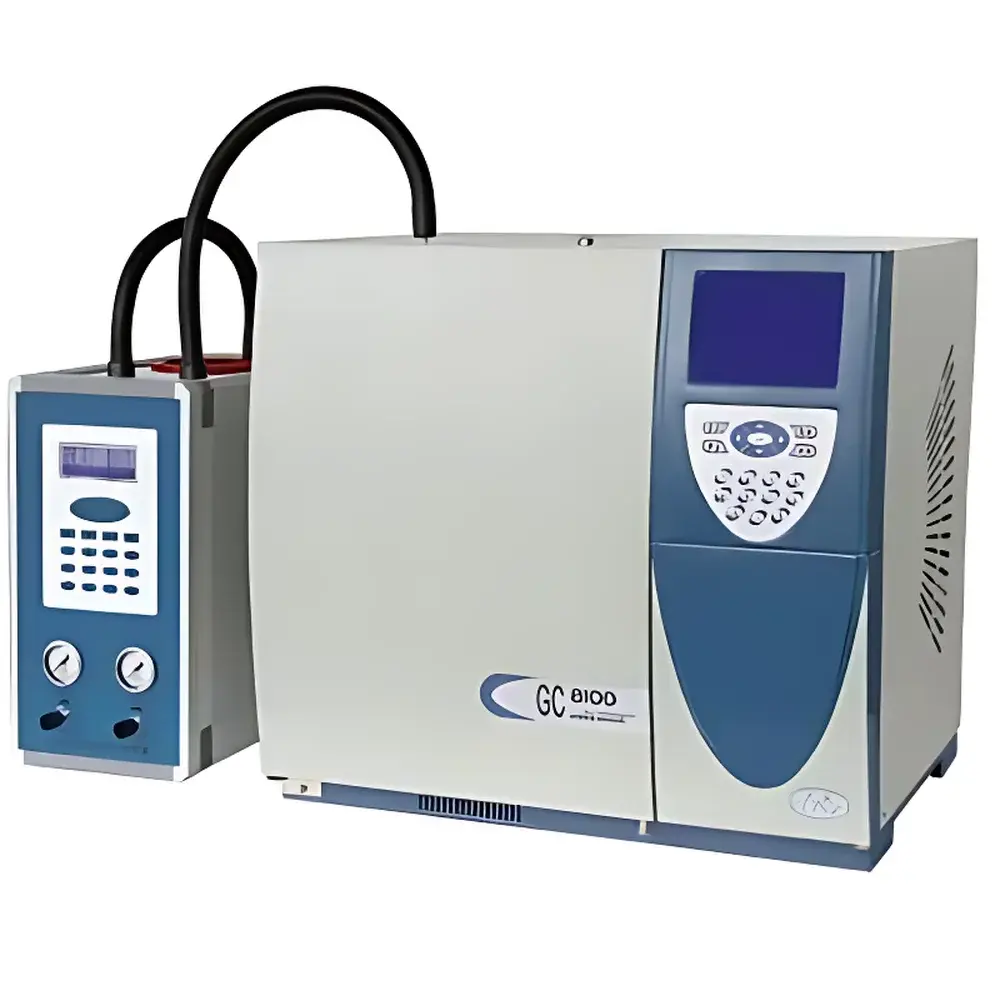
North Branch Sanpu GC-8000 Dedicated Gas Chromatograph for Residual Organic Solvent Analysis in Tobacco, Printing Inks, and Packaging Materials
| Brand | North Branch Sanpu |
|---|---|
| Origin | Beijing, China |
| Manufacturer Type | Original Equipment Manufacturer (OEM) |
| Regional Classification | Domestic (PRC) |
| Model | GC-8000 |
| Pricing | Available Upon Request |
Overview
The North Branch Sanpu GC-8000 is a dedicated gas chromatograph engineered for precise quantification of residual organic solvents in regulated industrial matrices—specifically tobacco products, printing inks, and flexible packaging materials. It operates on the fundamental principle of capillary gas chromatography with flame ionization detection (GC-FID), enabling selective separation, retention time alignment, and sensitive detection of volatile and semi-volatile organic compounds—including ethanol, isopropanol, n-butanol, propanol, methyl ethyl ketone (MEK), ethyl acetate, butyl acetate, toluene, and xylene—as defined in national and industry-specific testing protocols (e.g., YC/T 207–2014 for tobacco, GB/T 10004–2008 for plastic packaging, and ISO 11843-2 for detection limit validation). The system integrates a robust dual-inlet architecture supporting both direct liquid injection and automated headspace sampling, with thermally controlled syringe and backflush-capable headspace module to minimize carryover and ensure analytical integrity across high-throughput QC environments.
Key Features
- 5.7-inch high-resolution LCD display (320 × 240 pixels) with real-time Chinese interface for simultaneous monitoring of six independent temperature zones—including split/splitless inlet, capillary inlet, oven, detector, and auxiliary heaters
- Six-channel independent temperature control with ±0.1 °C stability (at 200 °C), supporting complex thermal programming requirements for multi-analyte resolution
- Five-stage programmable temperature ramping: zero-to-999 min hold times per stage, 0.1 °C increment resolution, and variable heating rates (up to 40 °C/min below 200 °C; up to 20 °C/min above)
- Intelligent self-diagnostic system with contextual Chinese fault messaging—including error codes, root-cause descriptions, and recommended remediation steps—reducing instrument downtime and technician dependency
- Overtemperature protection circuitry: automatic power cutoff and audible alarm if any zone exceeds user-defined setpoint
- Dynamic rear-door temperature regulation via fuzzy logic algorithm, maintaining oven thermal homogeneity even at ambient-proximal operating temperatures (e.g., 40–60 °C)
- Heated syringe (up to 150 °C) and pressurized headspace vial transfer line to prevent analyte condensation and ensure quantitative transfer fidelity
Sample Compatibility & Compliance
The GC-8000 is validated for use with solid, semi-solid, and liquid samples requiring headspace equilibration or direct injection. It complies with core regulatory expectations for residual solvent analysis under Chinese national standards (e.g., GB 9685–2016 for food-contact materials, YC/T 207 for cigarette paper), and supports method development aligned with ISO/IEC 17025:2017 laboratory accreditation requirements. Its FID detector delivers a minimum detectable mass of ≤1 × 10⁻¹¹ g/s (benzene), with baseline noise <0.03 mV, satisfying sensitivity thresholds for Class II and III residual solvents per ICH Q3C(R8). While not pre-certified for 21 CFR Part 11, the system’s hardware architecture—including non-volatile event logging and user-accessible audit trail generation—enables straightforward configuration for GLP/GMP-compliant operation when paired with validated third-party data systems.
Software & Data Management
The instrument operates via embedded firmware with local method storage (≥100 methods), peak integration using tangent skim and valley-to-valley algorithms, and customizable reporting templates (PDF/CSV export). Raw data files adhere to ASTM E1947-compliant structure for chromatographic metadata exchange. For enterprise integration, optional RS-232/USB/Ethernet connectivity supports bidirectional communication with LIMS platforms. All temperature events, detector status changes, and user logins are timestamped and stored in internal memory for traceability—facilitating internal audits and quality system reviews without reliance on external software modules.
Applications
- Quantitative determination of residual alcohols (ethanol, IPA), ketones (MEK, acetone), esters (ethyl acetate, butyl acetate), and aromatic hydrocarbons (toluene, xylenes) in gravure and flexographic printing inks
- Compliance testing of solvent migration from laminated pouches, aluminum foil composites, and BOPP films into simulated food simulants (e.g., 10% ethanol, olive oil)
- Batch release testing of cigarette paper, filter tow, and reconstituted tobacco sheet for VOC residuals per tobacco industry specifications
- Stability-indicating method development for accelerated aging studies assessing solvent evaporation kinetics in coated packaging substrates
- Method transfer support for laboratories migrating from legacy GC platforms to standardized, serviceable instrumentation
FAQ
Does the GC-8000 support compliance with ISO 17025 method validation requirements?
Yes—the system provides stable temperature control, reproducible retention times (105) necessary for full validation per ISO/IEC 17025 Annex A.2.
Can the headspace module be used for aqueous samples such as water-based inks?
Yes—equilibration temperature and time are fully programmable; the heated transfer line prevents condensation of polar solvents like ethanol or acetone during vapor-phase injection.
Is remote monitoring or networked data export supported out-of-the-box?
Basic Ethernet connectivity is included; full LIMS integration requires configuration of TCP/IP parameters and mapping of exported CSV fields to site-specific schema.
What maintenance intervals are recommended for the FID detector?
We recommend quarterly jet cleaning and annual ceramic igniter inspection under standard usage (≤8 h/day); detector gas flow calibration should be verified before each analytical batch.
Are reference standards and certified reference materials (CRMs) supplied with the instrument?
No—CRMs must be procured separately per application (e.g., NIST SRM 1648a for urban particulate matter, or custom-mixed solvent standards traceable to NIM).




