
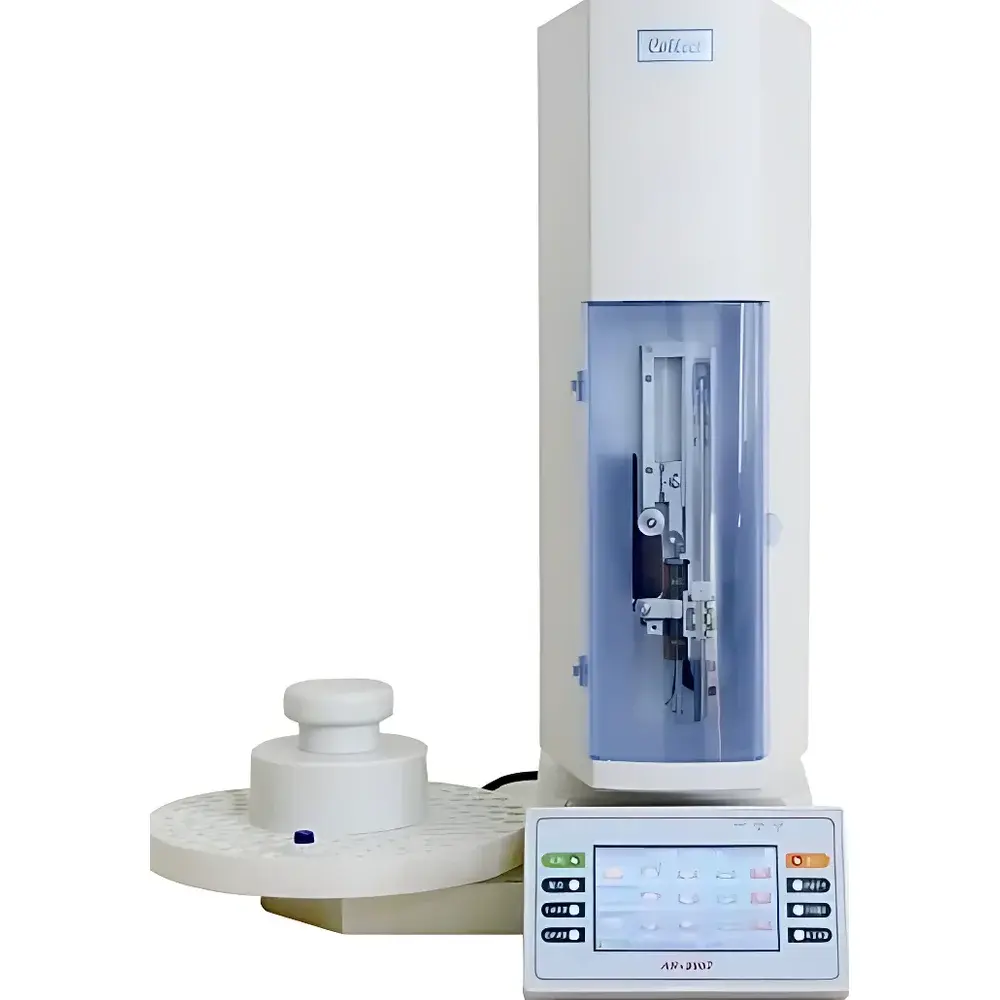
Sanpu AS-2902 Multifunctional Gas Chromatography Autosampler
| Brand | Sanpu |
|---|---|
| Origin | Beijing, China |
| Manufacturer Type | Original Equipment Manufacturer (OEM) |
| Product Origin | Domestic (China) |
| Model | AS-2902 |
| Pricing | Upon Request |
| Syringe Volumes | 1 µL, 5 µL, 10 µL, 25 µL, 50 µL, 100 µL, 250 µL, 500 µL |
| Sample Tray Capacity | 15-position and 110-position trays |
| Injection Repetition | 1–99 times per sample |
| Injection Interval | 0–65,535 s |
| Method Storage | 20 methods |
| Minimum Injection Volume | 0.1 µL |
| Maximum Injection Volume | 500 µL |
| Maximum Inlet Ports Supported | 2 |
| Maximum Injection Cycles per Sequence | 20 |
| Rinse Cycles | 1–15 |
| Viscosity Delay | 0–120 s |
| Pre-/Post-Injection Dwell Time | 0–300 s |
| PTV-Compatible Interval | 0–7200 s |
| Injection Speed Modes | Fast, Medium, Slow, User-Defined |
| Sampling Accuracy | ±0.01 µL |
| Injection Precision (RSD) | ≤0.2% |
Overview
The Sanpu AS-2902 Multifunctional Gas Chromatography Autosampler is an OEM-engineered, dual-inlet compatible liquid autosampling system designed for precise, reproducible, and unattended sample introduction into gas chromatographs (GC). It operates on a dual-turret mechanical architecture—enabling independent, time-synchronized injections into two separate GC inlets without physical reconfiguration or port occupation. This design eliminates the need for duplicate autosamplers in multi-inlet or method-comparison workflows, while preserving manual injection capability at either inlet. The system employs closed-loop stepper motor control with real-time encoder feedback across all motion axes—including syringe plunger actuation, carousel rotation, and needle positioning—ensuring positional repeatability and volumetric fidelity under variable environmental conditions. Its hardware-level compatibility with analog trigger signals (TTL/5V), digital handshake protocols, and software-controllable start commands ensures seamless integration with GC systems from Agilent, Thermo Fisher, Shimadzu, PerkinElmer, and domestic platforms—regardless of manufacturer-specific communication stacks.
Key Features
- Dual-inlet autonomous operation: Simultaneous or staggered injection sequences to two independent GC inlets, each with dedicated trigger output and timing control.
- Bilingual operator interface: Fully switchable Chinese/English GUI on a high-resolution capacitive touchscreen—no firmware reload or hardware modification required.
- Modular tray support: Interchangeable 15-position and 110-position vial trays; backward-compatible with standard 12 × 32 mm and 12 × 75 mm screw-cap or crimp-top vials.
- High-fidelity liquid handling: Syringe volume range from 0.1 µL to 500 µL with ±0.01 µL volumetric accuracy and ≤0.2% RSD (n = 10, 10 µL aqueous standard).
- Programmable fluidics logic: Adjustable rinse cycles (1–15), viscosity delay (0–120 s), pre-/post-dwell (0–300 s), and PTV-compatible injection intervals (up to 7200 s).
- Multi-speed injection profiling: Four preset plunger velocity modes (fast/medium/slow) plus user-defined ramp profiles for optimal peak shape in volatile, viscous, or thermally labile analytes.
- Integrated maintenance routines: Automated needle wash (solvent selection configurable), blank injection, and internal calibration verification via reference standards.
Sample Compatibility & Compliance
The AS-2902 accommodates liquid samples across a broad polarity and viscosity spectrum—from hexane-diluted pesticides to glycerol-based pharmaceutical formulations—without requiring hardware modification. Its sealed syringe path and inert needle materials (stainless steel with optional fused silica coating) minimize carryover and adsorption. From a regulatory standpoint, the system supports audit-ready operation: all method parameters, sequence logs, and execution timestamps are stored locally with write-protection and export capability (CSV/Excel). While not certified as standalone 21 CFR Part 11 compliant, its deterministic I/O behavior, traceable parameter versioning, and deterministic execution model enable full validation within GLP/GMP environments when deployed alongside validated chromatography data systems (CDS). It meets ISO/IEC 17025 requirements for instrument control traceability when used in accredited testing laboratories.
Software & Data Management
Control is executed via embedded real-time OS with local method storage (20 methods), sequence queuing, and event-triggered execution. Communication interfaces include RS-232, USB virtual COM, and opto-isolated TTL trigger I/O—allowing direct synchronization with GC oven start, detector enable, or external event markers. Raw acquisition metadata—including actual injection time, syringe position error, rinse cycle count, and ambient temperature drift compensation values—is logged per injection and exportable for QA review. Optional PC-based configuration software provides drag-and-drop sequence builder, method cloning, and batch report generation aligned with LIMS ingestion templates (ASTM E1384, ISO 15197). No cloud dependency or proprietary runtime is required; all operations execute deterministically on-device.
Applications
The AS-2902 is routinely deployed in environmental labs for EPA Method 8260/8270 compliance testing (VOCs/SVOCs in water and soil extracts), in food safety labs for pesticide residue screening (AOAC 2007.01), and in pharmaceutical QC for residual solvent analysis per ICH Q2(R2) guidelines. Its dual-inlet capability enables parallel method development—e.g., comparing split vs. splitless injection efficiency on the same sample set—or simultaneous analysis of complementary detectors (FID + ECD) without sample re-injection. In academic research, its programmable dwell times and viscosity delay support method optimization for high-boiling-point compounds (e.g., PAHs, phthalates) and polymer additives where needle rinsing kinetics critically impact reproducibility.
FAQ
Does the AS-2902 require vendor-specific GC software to operate?
No. It functions autonomously using hardware-triggered start signals (TTL/5V) or serial command sets compatible with standard terminal emulators. GC vendor software integration is optional—not mandatory—for basic operation.
Can it be validated for GMP-regulated environments?
Yes. Its deterministic behavior, parameter versioning, and full execution logging meet core ALCOA+ principles. Full 21 CFR Part 11 compliance requires integration with a validated CDS platform for electronic signatures and audit trail management.
What maintenance is required for long-term precision?
Monthly syringe lubrication with GC-grade silicone grease and quarterly needle alignment verification using NIST-traceable depth gauges are recommended. Encoder calibration is factory-performed and does not require field adjustment.
Is remote monitoring supported?
Local USB/RS-232 telemetry allows integration with SCADA or LabView-based supervisory systems. Ethernet or Wi-Fi connectivity is not natively supported but can be added via external industrial protocol converters (e.g., Modbus TCP gateways).






