
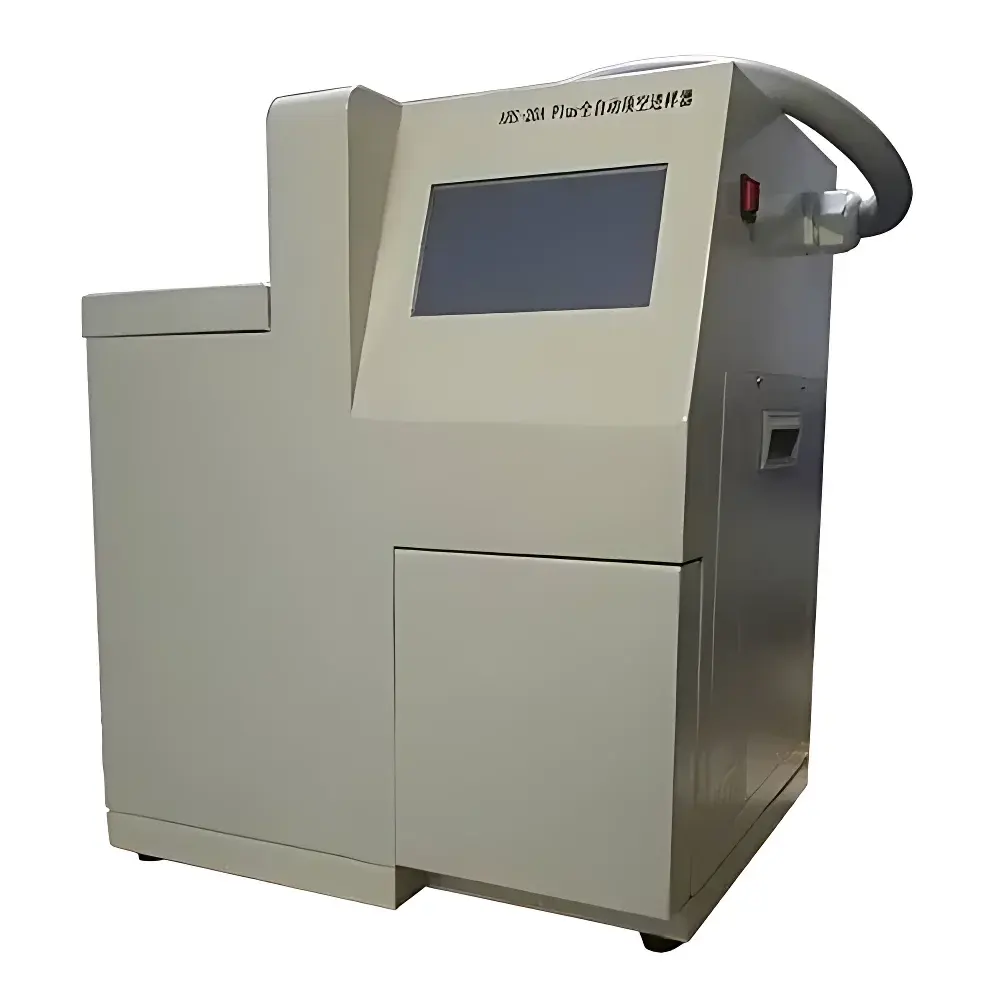
Beifen Sanpu AHSA-20A Plus Fully Automated Headspace Sampler
| Brand | Beifen Sanpu |
|---|---|
| Model | AHSA-20A Plus |
| Origin | Beijing, China |
| Manufacturer Type | Direct Manufacturer |
| Sample Positions | 20 |
| Sample Vial Capacity | 10 mL or 20 mL (customizable up to 100 mL) |
| Quantitative Loop Volume | 1 mL (optional: 0.5 / 2 / 5 mL) |
| Sample Heating Range | 40–220 °C (extendable to 300 °C) |
| Valve & Transfer Line Heating Range | 40–220 °C (extendable to 300 °C) |
| Temperature Accuracy | ±0.5 °C |
| Temperature Stability | < ±0.5 °C |
| Pressurization Time | 0–999 s |
| Sampling Time | 0–30 min |
| Injection Time | 0–999 s |
| Bake-out/Flush Time | 0–30 min |
| Minimum Time Resolution | 1 ms |
| Pressurization Pressure | 0–0.25 MPa (continuously adjustable) |
| Carrier Gas Flow Control | EPC optional |
| RSD | < 1.0% (for 100 ppm ethanol in water) |
| Backflush Flow Rate | 0–100 mL/min (adjustable) |
| Interface | USB |
| Sample Handling | Liquid and solid matrices |
| Inert Flow Path | Deactivated fused-silica tubing and high-inertness valve components |
| Drive Mechanism | Motor-driven (no external gas required) |
| Compliance | Designed for GLP/GMP-aligned workflows |
Overview
The Beifen Sanpu AHSA-20A Plus Fully Automated Headspace Sampler is an engineered solution for reproducible, unattended volatile organic compound (VOC) analysis in compliance-critical laboratory environments. It operates on the principle of equilibrium headspace sampling—where a sealed sample vial is heated to establish vapor-phase equilibrium between the non-volatile matrix (liquid or solid) and its headspace gas phase. The instrument then introduces this equilibrated headspace gas into a gas chromatograph (GC) via pressurized transfer, eliminating solvent interference and minimizing matrix effects. Designed for routine QC/QA labs, environmental testing facilities, pharmaceutical stability studies, and forensic toxicology units, the AHSA-20A Plus delivers robust automation without compromising analytical integrity. Its motor-driven actuation system, fully inert flow path, and precise thermal control architecture ensure long-term repeatability and low carryover—key requirements for regulated applications under FDA 21 CFR Part 11, EU Annex 11, and ISO/IEC 17025 accreditation scopes.
Key Features
- 20-position autosampler tray with automatic vial detection and collision-avoidance logic—skips empty slots and halts motion upon positional anomaly
- Triple-zone independent temperature control: sample oven (40–220 °C), six-port valve (40–220 °C), and transfer line (40–220 °C), all extendable to 300 °C per application-specific validation needs
- High-precision thermal regulation: ±0.5 °C accuracy and < ±0.5 °C stability over 8-hour continuous operation
- Deactivated fused-silica quantitative loop (standard 1 mL) and inertized stainless-steel transfer lines minimize adsorption and memory effects
- Zero-dead-volume six-port valve configuration housed entirely within the heated zone—eliminates cold spots and preserves analyte integrity during transfer
- Positive-pressure sampling mode ensures compatibility with aqueous, viscous, and heterogeneous solid samples; baseline stability maintained under constant carrier flow
- Full USB-based computer control with bidirectional GC triggering: initiates GC run sequence and acquires timing signals from external instruments
- Onboard 7-inch graphical LCD interface with animated workflow guidance—enables standalone operation without PC dependency
- Configurable sampling protocols: single vial/multiple injections, single vial/single injection, or sequential multi-vial analysis
- Integrated self-diagnostic suite: power-on hardware verification, real-time motor position feedback, thermal sensor validation, and fault logging with event timestamps
Sample Compatibility & Compliance
The AHSA-20A Plus accommodates standard 10 mL and 20 mL crimp-top headspace vials (with optional support for 50 mL and 100 mL formats). It accepts liquid samples—including aqueous solutions, organic solvents, and emulsions—as well as solid matrices such as polymers, soils, pharmaceutical tablets, and food products. All wetted surfaces employ SilcoNert®- or Sulfinert®-treated materials to prevent catalytic degradation or adsorption of polar VOCs (e.g., aldehydes, ketones, low-molecular-weight acids). The system meets functional requirements for pharmacopeial methods including USP Residual Solvents and EP 2.4.24, supports ASTM D6866 biobased content determination, and aligns with ISO 11843-3 for limit-of-detection estimation in headspace-GC workflows. Audit trail generation, electronic signatures, and parameter change logging are enabled when integrated with compliant chromatography data systems (CDS) supporting 21 CFR Part 11 Annex 11 configurations.
Software & Data Management
Instrument control is managed through Beifen Sanpu’s proprietary Headspace Control Suite (v3.2+), which provides full parameter configuration—including heating ramp profiles, pressurization dwell times, loop fill volumes, and backflush durations. All method parameters are stored with versioned timestamps and user attribution. The software exports raw acquisition logs in CSV format, compatible with LIMS integration via ODBC or RESTful API adapters. When paired with third-party CDS platforms (e.g., Thermo Chromeleon, Agilent OpenLab, Shimadzu LabSolutions), the AHSA-20A Plus synchronizes injection events using TTL or Ethernet-based GC trigger protocols. Electronic record retention complies with ALCOA+ principles: attributable, legible, contemporaneous, original, accurate, complete, consistent, enduring, and available.
Applications
- Pharmaceutical residual solvent quantification (ICH Q3C guidelines)
- Environmental analysis of VOCs in groundwater, soil extracts, and landfill leachates
- Food and beverage quality control: ethanol in beverages, off-flavor compounds in dairy, packaging migration testing
- Forensic toxicology: blood alcohol concentration (BAC), volatile drug metabolites
- Polymers and coatings: monomer release, curing byproduct monitoring
- Chemical manufacturing: batch release testing for trace volatiles in intermediates and APIs
FAQ
What sample vial sizes does the AHSA-20A Plus support?
Standard configurations include 10 mL and 20 mL crimp-top vials; custom trays for 50 mL and 100 mL formats are available upon request.
Is EPC (Electronic Pressure Control) included as standard equipment?
EPC is an optional upgrade—standard configuration uses mechanical pressure regulation with 0–0.25 MPa continuous adjustability.
Can the system be validated for GxP environments?
Yes—the hardware design, firmware logging architecture, and software audit trail capabilities support IQ/OQ/PQ execution per ASTM E2500 and WHO TRS 996 Annex 6 requirements.
How is carryover minimized between injections?
Through programmable backflush cycles (0–30 min), high-purity inert gas purge, and thermally stabilized transfer pathways with zero cold spots.
Does the instrument require external compressed air or nitrogen for operation?
No—all positioning, valve actuation, and pressurization functions are motor-driven; only carrier gas (helium, hydrogen, or nitrogen) is required for GC interfacing.





