
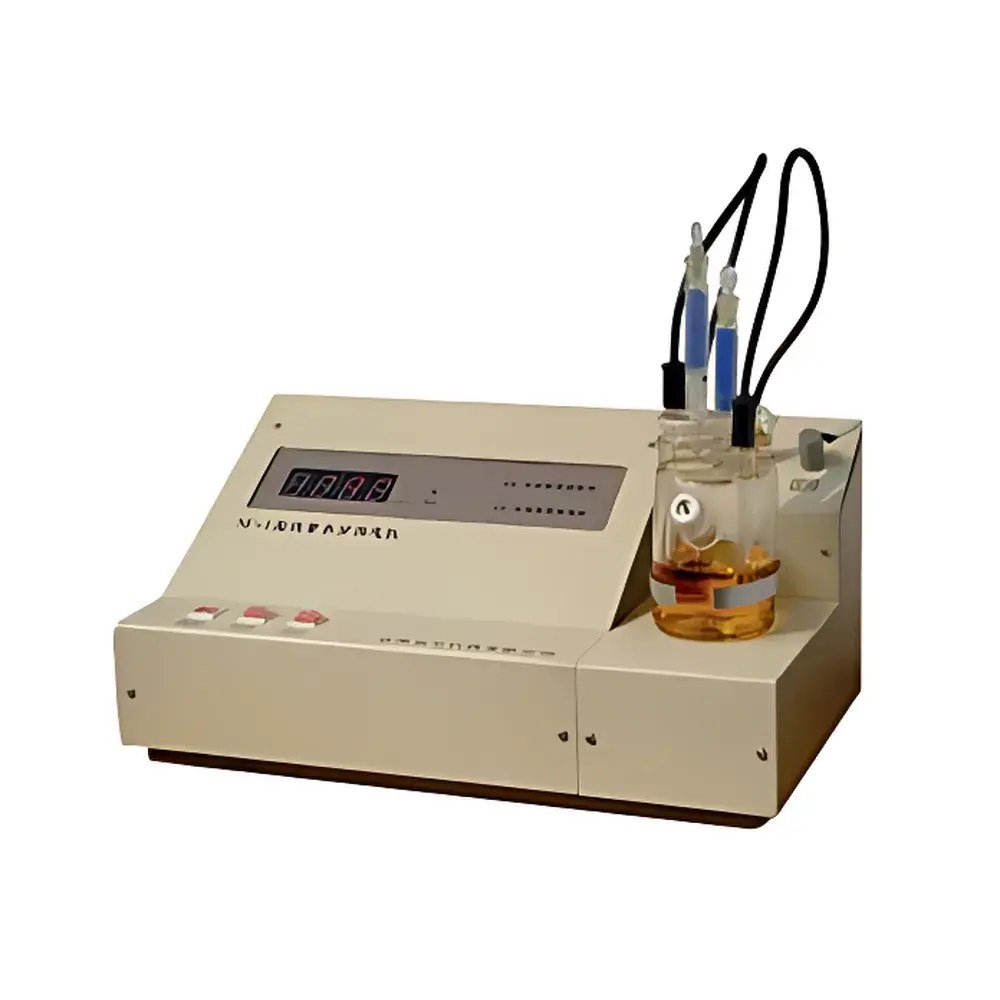
North Branch Sanpu SF-1 Coulometric Karl Fischer Moisture Analyzer
| Brand | North Branch Sanpu |
|---|---|
| Origin | Hebei, China |
| Manufacturer Type | Direct Manufacturer |
| Model | SF-1 |
| Measurement Principle | Coulometric Karl Fischer (KF) Titration |
| Detection Range | 3 µg – 100 mg H₂O |
| Resolution | 1 µg H₂O |
| Accuracy | ±3 µg H₂O (≤1 mg), ±0.3% of reading (>1 mg) |
| Electrolysis Current | 0–300 mA, auto-controlled |
| Display | 4-digit high-brightness LED |
| Endpoint Indication | Audible alert + visual LED indicator |
| Drift Compensation | Microprocessor-based automatic compensation |
| Stirring | Continuously variable speed control |
| Power | AC 220 V ±11 V, 50 Hz ±2.5 Hz |
| Dimensions | 320 mm × 260 mm × 90 mm |
| Weight | Approx. 4.2 kg |
| Operating Temperature | 5–45 °C |
| Relative Humidity | ≤80% RH (non-condensing) |
Overview
The North Branch Sanpu SF-1 Coulometric Karl Fischer Moisture Analyzer is a precision laboratory instrument engineered for trace-level water quantification in diverse industrial and research matrices. It operates on the fundamental electrochemical principle of coulometric Karl Fischer titration—where iodine is generated *in situ* via controlled electrolysis of an iodide-containing reagent, and stoichiometrically reacts with water according to the classic Karlsruhe reaction: H₂O + I₂ + SO₂ + 3RN + CH₃OH → 2RN·HI + RN·HSO₄CH₃. The total charge passed during electrolysis (Q, in coulombs) is directly proportional to the moles of water consumed (n = Q / (2F), where F is Faraday’s constant), enabling absolute quantification without volumetric calibration. Designed for applications demanding high sensitivity and reproducibility—particularly in petroleum refining, lubricant formulation, pharmaceutical excipient testing, and battery electrolyte quality control—the SF-1 delivers sub-microgram detection capability with robust baseline stability and minimal reagent consumption.
Key Features
- Coulometric KF methodology compliant with ASTM D6304, ISO 10337, and USP , ensuring metrological traceability and regulatory acceptability.
- High-resolution 1 µg H₂O detection limit and linear dynamic range spanning 3 µg to 100 mg H₂O—covering concentrations from 3 ppm to 100% w/w in compatible samples.
- Microprocessor-driven drift compensation algorithm continuously monitors and corrects for background current fluctuations, enhancing measurement repeatability under variable ambient conditions.
- Digitally regulated electrolysis current (0–300 mA) with real-time feedback control ensures optimal iodine generation rate across sample types—from low-water hydrocarbons to hygroscopic solvents.
- Four-digit high-brightness LED display provides unambiguous readout of water mass (µg), calculated concentration (% or ppm), titration time, and system status indicators.
- Integrated endpoint detection combines dual-mode signaling: audible beep and dedicated LED illumination, minimizing operator dependency and reducing analysis cycle time.
- Compact benchtop footprint (320 × 260 × 90 mm) and low power consumption (40 W) support deployment in constrained QC laboratories or mobile analytical units.
Sample Compatibility & Compliance
The SF-1 accommodates a broad spectrum of liquid, gaseous, and solid-phase samples following appropriate pretreatment (e.g., dissolution in KF-compatible solvents such as methanol, chloroform, or specialized anhydrous media). It is validated for use with petroleum fractions (crude oil, naphtha, jet fuel), transformer oils (per GB/T 7600 and IEC 60814), fluorocarbons (GB/T 7376, GB 10670), ethanol fuels (GB/T 8350, GB/T 8351), polymers (GB/T 12008.6), agrochemicals (GB/T 12008.6, GB/T 3727), and pharmaceutical intermediates (Chinese Pharmacopoeia Vol. IV, General Chapter 0832). All operational parameters adhere to Good Laboratory Practice (GLP) requirements, including full audit trail logging capability when paired with optional data export interfaces. Instrument design meets electromagnetic compatibility (EMC) standards per GB/T 18268.1 and electrical safety requirements per GB 4793.1.
Software & Data Management
While the SF-1 operates as a standalone analyzer with embedded firmware, it supports RS-232 serial output for integration into centralized LIMS or ELN environments. Exported data includes timestamped result records (sample ID, water mass, concentration, %RSD, analyst ID, method version), titration curve metadata (peak current, endpoint time, drift value), and system diagnostics (electrolysis voltage, cell temperature, reagent expiry status). When used in regulated settings—including FDA 21 CFR Part 11-compliant facilities—the instrument can be configured with user-access controls, electronic signature prompts, and immutable data archiving protocols via external middleware. Firmware updates are delivered via secure USB interface, maintaining version traceability per ISO/IEC 17025 clause 5.9.
Applications
- Quantitative moisture verification in insulating oils prior to transformer commissioning (per GB/T 7600 and IEEE C57.106).
- Batch release testing of lithium-ion battery electrolytes (LiPF₆ in carbonate blends) where residual H₂O >20 ppm degrades SEI formation.
- Stability-indicating assay of hygroscopic APIs and excipients under accelerated storage conditions (ICH Q5C).
- In-process monitoring of dehydration efficiency in petrochemical fractionation columns and molecular sieve regeneration cycles.
- Quality control of fluorinated refrigerants (R-134a, R-125) per GB/T 18826 and AHRI Standard 700.
- Compliance testing of adhesives and architectural coatings against VOC and moisture-related blistering limits (GB 18582, GB 18583).
FAQ
What sample types require special handling prior to analysis?
Viscous oils, waxy solids, or highly reactive substances (e.g., acid chlorides) must be dissolved in dry methanol or proprietary KF solvents; gas-phase analysis necessitates carrier gas sparging through a dedicated vaporizer module.
Is the SF-1 suitable for routine GMP manufacturing environments?
Yes—when operated with documented SOPs, calibrated electrodes, and integrated into a validated data management workflow, it satisfies core requirements of EU Annex 11 and FDA guidance on analytical instrument qualification.
How often should the KF reagent be replaced?
Reagent lifetime depends on cumulative water load and exposure to ambient humidity; typical replacement interval ranges from 50–200 analyses, indicated by rising baseline drift or extended titration times.
Can the instrument differentiate between free and bound water?
No—coulometric KF measures total reactive water content; speciation requires complementary techniques such as thermogravimetric analysis (TGA) or NMR spectroscopy.
Does the SF-1 support multi-point calibration verification?
While inherently absolute (no calibration standards required), daily system suitability testing using certified water standards (e.g., 1.00 ± 0.02 mg H₂O in ampoules per ISO 10337) is recommended for audit readiness.
Related Products




