
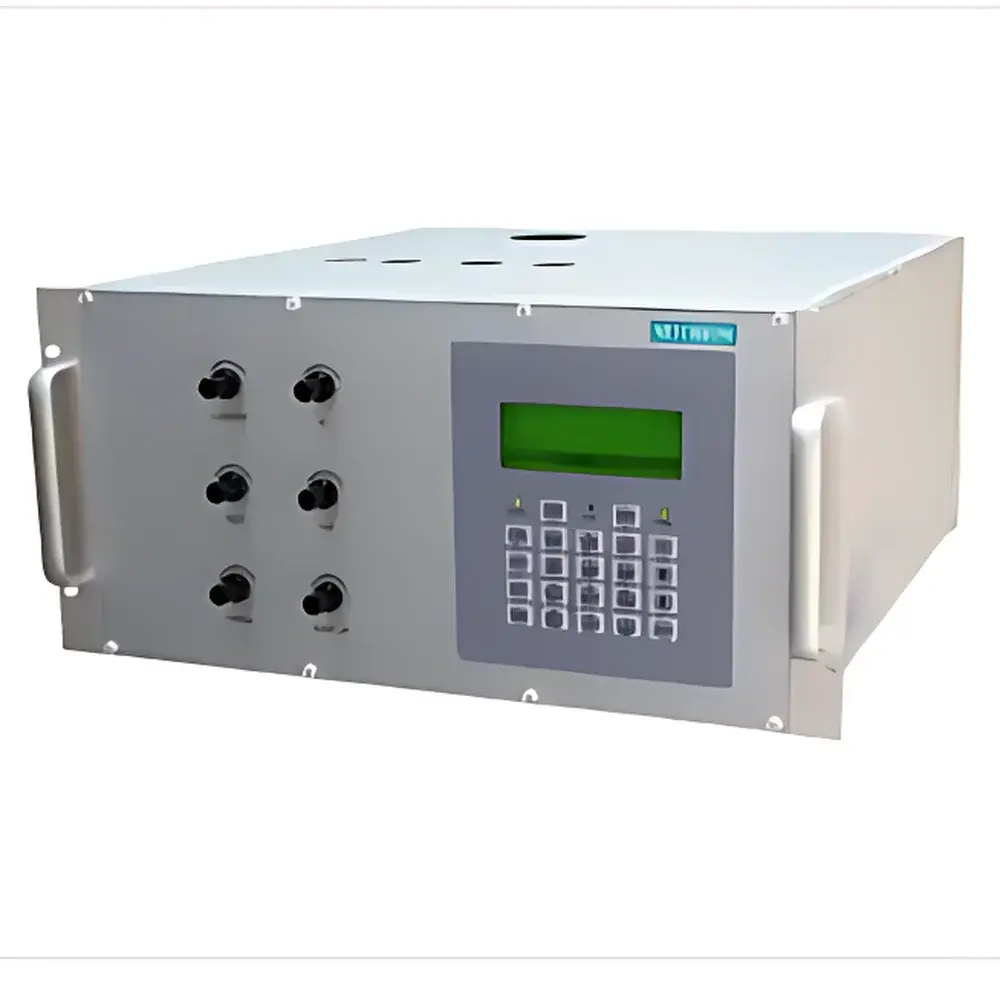
Beifen Sanpu GC9860-5U Online Gas Chromatograph
| Brand | Beifen Sanpu |
|---|---|
| Origin | Beijing, China |
| Manufacturer Type | Direct Manufacturer |
| Instrument Type | Online Gas Chromatograph |
| Model | GC9860-5U |
| Price Range | USD 4,200 – 7,000 (FOB Beijing) |
| Temperature Control Range | 4 °C to 450 °C |
| Oven Ramp Rate | 0.1–39 °C/min |
| Cool-down Time | ~6 min (450 °C → 50 °C) |
| Carrier Gas Flow Range & Control | 0–1200 mL/min |
| Carrier Gas Pressure Range & Control | 0–0.6 MPa |
| Injector Max Operating Temperature | 450 °C |
| Injector Pressure Setting Range | 0–970 kPa |
| Injector Total Flow Setting Range | 0–1200 mL/min |
| Temperature Zones | 6 independently controlled |
| Programmed Temperature Ramping | Up to 16 steps |
| EPC/EFC Capabilities | Dual-mode (constant pressure / constant flow), supports N₂, H₂, Air, He, Ar |
| Pressure Accuracy | ±0.01 kPa |
| Flow Accuracy | ±0.01 sccm |
| Detector Options | FID, TCD, ECD, NPD (up to 3 simultaneously) |
| Data Interface | Ethernet (IEEE 802.3) |
| Display | 192×64 dot-matrix LCD or optional 7-inch industrial tablet |
Overview
The Beifen Sanpu GC9860-5U Online Gas Chromatograph is a compact, rack-mountable (19-inch, 5U height) analytical platform engineered for continuous, unattended operation in industrial process monitoring, environmental emission tracking, and mobile laboratory applications. Designed around electronic pressure and flow control (EPC/EFC) architecture, the system delivers high reproducibility and long-term stability required for regulatory-compliant online analysis. Its core separation principle relies on partitioning of volatile and semi-volatile compounds between a gaseous mobile phase (carrier gas) and a stationary phase coated inside fused-silica capillary or packed columns. Retention time profiling, coupled with selective detection—primarily via flame ionization (FID)—enables quantitative determination of hydrocarbons, solvents, residual monomers, and trace contaminants across petrochemical, pharmaceutical, and environmental sectors.
Key Features
- Rack-optimized 5U chassis (220 mm H × 483 mm W × 500 mm D) minimizes footprint for installation in control rooms, vehicle-mounted labs, explosion-proof enclosures, and university teaching facilities.
- Six independently programmable temperature zones—including oven, up to three injectors, and up to three detectors—support complex multi-method workflows and column switching configurations.
- High-precision EPC/EFC modules regulate carrier, makeup, and detector gases across five supported gases (N₂, H₂, Air, He, Ar), with pressure control resolution of ±0.01 kPa and flow resolution of ±0.01 sccm.
- Thermal management enables rapid cooling from 450 °C to 50 °C in approximately six minutes, reducing cycle time without compromising column integrity or baseline stability.
- Fully Ethernet-enabled architecture (IEEE 802.3) facilitates integration into SCADA, DCS, and LIMS environments; supports remote configuration, real-time chromatogram streaming, and alarm-triggered data export.
- Modular detector support: simultaneous installation of up to three detectors (FID, TCD, ECD, or NPD), each with independent temperature and gas parameter control.
Sample Compatibility & Compliance
The GC9860-5U accommodates diverse sample introduction methods—including split/splitless capillary injection, packed-column injection, six-port gas sampling valves, and micro-volume liquid injection—ensuring compatibility with gaseous process streams, liquefied petroleum gas (LPG), ambient air, stack emissions, and purified solvent batches. All hardware and firmware comply with IEC 61000-6-2/6-4 electromagnetic compatibility standards. The system supports audit-trail-enabled data acquisition when paired with validated chromatography data systems (CDS), meeting foundational requirements for GLP and GMP environments. While not pre-certified for ATEX or IECEx, its modular design permits integration into Class I, Div 2 or Zone 2 hazardous area enclosures when configured per client-specified safety protocols.
Software & Data Management
Data acquisition and instrument control are managed through an embedded Linux-based firmware interface accessible via local LCD or remotely via web browser or dedicated CDS client. Raw signal data (voltage vs. time) and processed peak tables are stored in vendor-neutral formats (e.g., .CDF-compatible binary files). The system logs all method changes, calibration events, maintenance alerts, and EPC fault conditions with timestamps and operator IDs—providing traceability aligned with FDA 21 CFR Part 11 principles when deployed with appropriate access controls and electronic signature workflows. Optional 7-inch industrial tablet integration adds touchscreen method editing, real-time overlay of multiple chromatograms, and configurable alarm dashboards.
Applications
- Continuous monitoring of refinery off-gas composition (C₁–C₅ hydrocarbons, H₂S, CO) in compliance with EPA Method 18 and ISO 10156.
- Automated quality control of polymer-grade ethylene and propylene feedstocks per ASTM D2505 and GB/T 13290.
- Fixed-site ambient air monitoring for VOCs (e.g., benzene, toluene, xylene) under EN 14662 and US EPA TO-17 protocols.
- On-vehicle deployment for roadside emission testing or emergency response chemical identification.
- Teaching laboratories requiring robust, networked GC platforms for method development, retention indexing, and detector response characterization.
FAQ
Is the GC9860-5U certified for use in hazardous locations?
No intrinsic safety or explosion-proof certification is provided by default; however, the unit may be installed within externally certified enclosures rated for Class I, Division 2 or Zone 2 environments when configured with appropriate purge systems and gas routing.
Can the system operate without a PC connected locally?
Yes—the instrument runs autonomously using its embedded controller. Method scheduling, data logging, and alarm handling occur onboard; Ethernet connectivity is required only for remote supervision or CDS integration.
What is the minimum detectable concentration for benzene using the FID configuration?
Under standard operating conditions (capillary column, 1 µL injection, H₂ carrier), the typical limit of detection (LOD) for benzene is ≤0.05 ppm (v/v) in air matrix, based on signal-to-noise ratio ≥3.
Does the GC9860-5U support ASTM D1945 or ISO 6974-1 gas analysis methods out-of-the-box?
Preloaded method templates for these standards are available upon request; full compliance requires column selection, calibration gas traceability, and periodic system suitability verification per the respective standard’s annexes.
How is firmware updated and validated?
Firmware updates are delivered as signed binary packages via secure FTP or USB; version history, checksums, and change logs are maintained in the system audit trail to support regulatory review.
Related Products






