
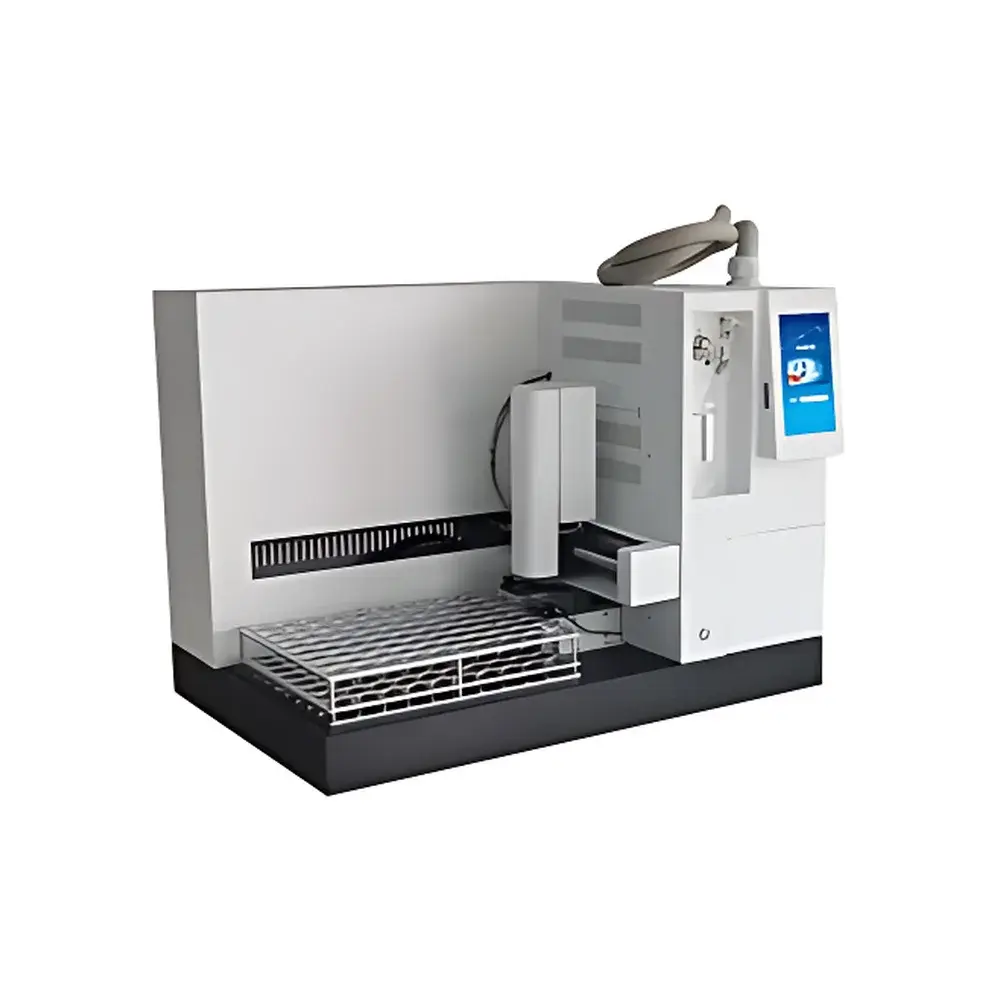
Beifen Sanpu PT-80A Fully Automated Water-and-Soil Integrated Purge and Trap Concentrator
| Brand | Beifen Sanpu |
|---|---|
| Origin | Hebei, China |
| Manufacturer Type | OEM Manufacturer |
| Instrument Category | Domestic |
| Model | PT-80A |
| Sample Tray Capacity | 80 positions (40 mL VOA vials) |
| Injection Precision | RSD ≤ 3% |
| Trap Desorption Temperature Range | Ambient to 380 °C |
| Cooling | 250 °C → 35 °C in ≤ 90 s |
| Purge Heater Temperature | Ambient to 95 °C |
| Sample Chiller Temperature | Ambient |
| Cold Trap Temperature Range | –40 °C to ambient (Peltier + air cooling) |
| Purge Flow Rate | 0–150 mL/min |
| Tube Heating Zone | Ambient to 220 °C |
| Water Removal Trap | Ambient to 400 °C |
| Rinse Water Temperature | Ambient to 90 °C |
| Solid Sample Heating | Ambient to 100 °C |
| Trap Dimensions | Quartz, Φ4 mm × 80 mm × 1 mm wall thickness |
| Timing Resolution | 0.1 s |
| Max Duration | 100 min |
| Timing Accuracy | < 0.1 s |
| Pneumatic Pressure Rating | ≤ 0.6 MPa |
| Power Supply | AC 220 V, 50 Hz |
| Power Consumption | 800 W |
| Dimensions (W×D×H) | 750 × 500 × 550 mm |
| Weight | ~50 kg |
Overview
The Beifen Sanpu PT-80A is a fully automated, water-and-soil integrated purge and trap concentrator engineered for trace-level volatile organic compound (VOC) analysis in environmental, regulatory, and food safety laboratories. It operates on the principle of dynamic headspace extraction: inert gas purges VOCs from aqueous or solid-phase samples into a cryogenically cooled trap, where analytes are adsorbed and subsequently thermally desorbed in a narrow band for direct transfer to a gas chromatograph (GC) or GC–mass spectrometer (GC–MS). Unlike liquid nitrogen–dependent systems, the PT-80A employs a dual-stage Peltier cooler with forced-air assist to achieve stable cold trap temperatures down to –40 °C at ambient room conditions (20 °C), eliminating logistical constraints associated with cryogenic supply chains. Its modular thermal architecture—featuring independently controlled zones for purge tube, transfer lines, water removal trap, and desorption trap—ensures minimal analyte loss, reduced memory effects, and high reproducibility across complex matrices.
Key Features
- 80-position autosampler compatible with standard 40 mL VOA vials; supports both liquid and solid sample formats without hardware modification
- Direct-resistance heated quartz trap (Φ4 mm × 80 mm) enabling ultra-rapid thermal desorption (>2000 °C/min) and precise cooling (250 °C → 35 °C in ≤90 s) for sharp peak focusing
- Peltier-based cold trap with active air cooling achieves –40 °C operation without liquid nitrogen—reducing operational cost and safety risk
- Integrated foam sensor detects foaming during aqueous purging, automatically pausing the sequence to prevent cross-contamination and system carryover
- Independent temperature control for purge heater (ambient–95 °C), solid-sample vial heater (ambient–100 °C), transfer lines (ambient–220 °C), water removal trap (ambient–400 °C), and rinse water bath (ambient–90 °C)
- PEEK-lined and silanized stainless-steel fluidic path minimizes surface adsorption and ensures compatibility with polar and reactive VOCs
- Separate backflush gas routing isolates desorbed analytes from the purge tube path, preventing re-deposition and inter-sample carryover
- Two programmable TTL synchronization outputs (1–2 s delay) enable precise triggering of GC oven start, valve actuation, or data acquisition software
- Hot-water rinse capability (up to 90 °C) for effective decontamination of purge tubes and internal lines between runs
Sample Compatibility & Compliance
The PT-80A accommodates diverse sample types including drinking water, groundwater, wastewater, soil, sediment, and food extracts. Solid-phase analysis is enabled via in-situ aqueous slurry preparation: 5 mL distilled water is added directly to the sample vial, followed by programmable vortex mixing and heated purge (up to 100 °C). The instrument complies with multiple U.S. EPA and Chinese environmental method requirements—including EPA Method 524.4, EPA Method 8260D, HJ 605–2011 (Soil VOCs), HJ 639–2012 (Water VOCs), and HJ 686–2014—supporting GLP-compliant workflows. All thermal zones and timing parameters are logged with timestamps in audit-trail-capable software, meeting basic FDA 21 CFR Part 11 readiness criteria when deployed with validated electronic signatures and user access controls.
Software & Data Management
Control and method development are performed via Windows-based PC software with intuitive graphical interface. Users define multi-step methods—including purge duration, trap conditioning, dry purge, desorption ramp profiles, and backflush parameters—with full parameter validation and error logging. The software supports remote monitoring, real-time status display, and automatic report generation compliant with ISO/IEC 17025 documentation standards. Method files include embedded metadata (operator ID, date/time, instrument serial number), and all system events (temperature deviations, pressure faults, sensor triggers) are time-stamped and stored locally. Export options include CSV, PDF, and XML formats suitable for LIMS integration.
Applications
- Regulatory compliance testing per Chinese national standards (HJ series) for VOCs in drinking water, soil, and sediment
- Analysis of volatile halogenated hydrocarbons (e.g., chloroform, carbon tetrachloride, vinyl chloride) in environmental matrices
- Determination of acrylonitrile and other priority pollutants in wastewater effluents
- Screening of residual solvents and off-flavor compounds in food and beverage products
- Method development and validation studies requiring high precision (RSD ≤ 3%) and low detection limits (sub-ng/L range achievable with GC–MS detection)
- High-throughput environmental monitoring labs processing >50 samples/day with minimal manual intervention
FAQ
Is the PT-80A compatible with third-party GC and GC–MS systems?
Yes—the instrument features universal pneumatic and electrical interfaces, including two TTL synchronization outputs and analog signal inputs, allowing seamless integration with Agilent, Thermo Fisher, Shimadzu, and PerkinElmer platforms.
Does the system require liquid nitrogen or other cryogens?
No—cold trapping is achieved solely via Peltier elements augmented by forced-air cooling, delivering stable –40 °C performance without consumables or infrastructure dependencies.
How is carryover minimized between solid and liquid samples?
Through physical separation of purge and backflush gas paths, hot-water rinsing of purge tubes, programmable needle wash cycles, and independent thermal zoning to eliminate cold spots in transfer lines.
Can the software generate audit trails for regulatory submissions?
Yes—software logs all method changes, run sequences, temperature/pressure events, and operator actions with immutable timestamps, supporting GLP/GMP documentation requirements when paired with appropriate network authentication protocols.
What maintenance is required for long-term reliability?
Routine maintenance includes quarterly inspection of Peltier modules, annual replacement of O-rings and septa, biannual calibration of temperature sensors using NIST-traceable references, and periodic verification of purge flow accuracy with certified mass flow meters.




