
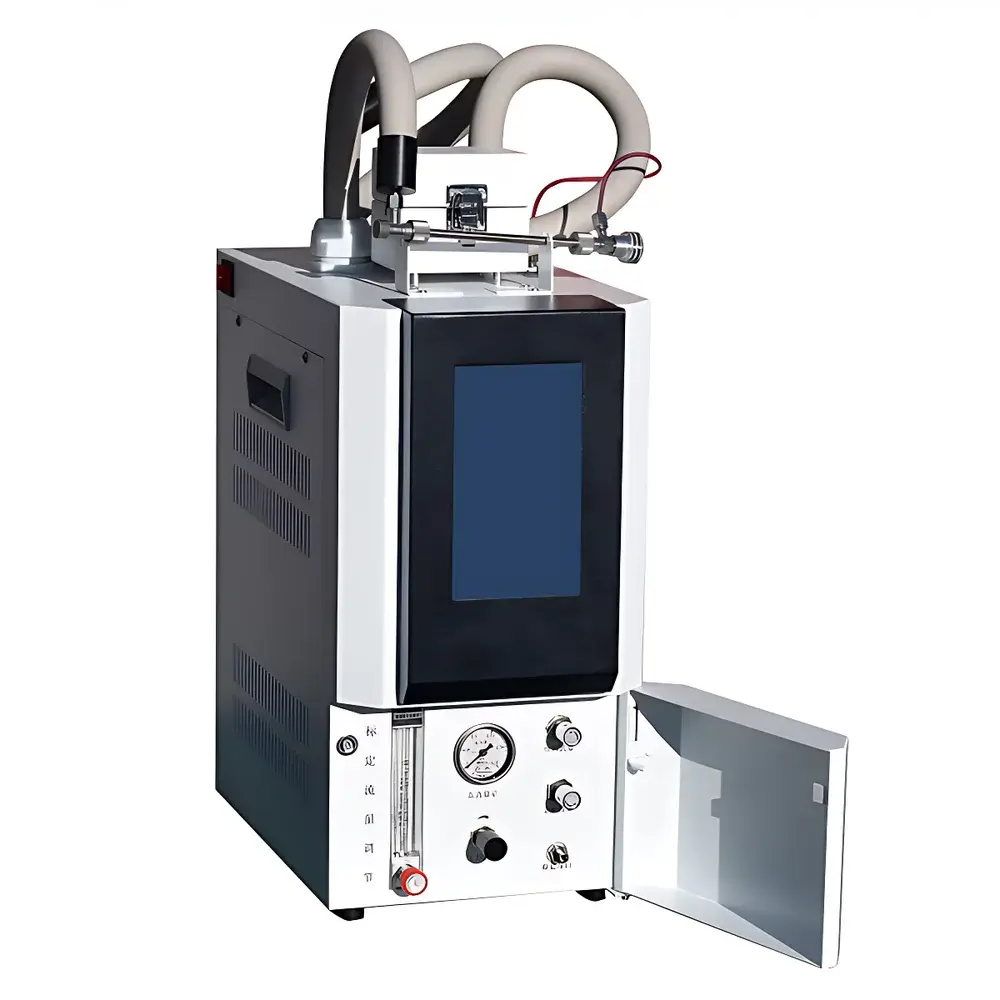
Beifen Sanpu A2TDS-3430 Dual-Stage Automated Thermal Desorber
| Brand | Beifen Sanpu |
|---|---|
| Origin | Beijing, China |
| Manufacturer Type | Direct Manufacturer |
| Region of Origin | Domestic (China) |
| Model | A2TDS-3430 |
| Instrument Type | Dual-Stage Thermal Desorber |
| Desorption Temperature Range | Ambient to 450 °C |
| Cold Trap Temperature Range | −35 °C to Ambient |
| Desorption Recovery Rate | >99% (compound-dependent) |
| Sample Position Capacity | 1 tube |
Overview
The Beifen Sanpu A2TDS-3430 is a dual-stage automated thermal desorber engineered for precise, reproducible quantification of volatile organic compounds (VOCs) in indoor air matrices. It operates on the principle of two-step thermal desorption: first, analytes adsorbed onto sorbent tubes (e.g., Tenax-TA or activated charcoal) are thermally released under inert gas flow; second, the evolved vapors are cryogenically focused in a cooled trap before rapid injection into a gas chromatograph (GC). This architecture minimizes band broadening and maximizes sensitivity—critical for trace-level compliance testing against stringent regulatory thresholds defined in GB 50325–2020. Designed specifically for routine analysis of formaldehyde (via derivatization), benzene, and total volatile organic compounds (TVOC) in residential, commercial, and institutional indoor environments, the A2TDS-3430 integrates seamlessly with standard GC systems equipped with flame ionization detection (FID) or mass spectrometric detection (MS).
Key Features
- Dual-stage thermal desorption architecture with independent temperature control for primary desorption oven and cryogenic cold trap
- Precise desorption temperature regulation from ambient to 450 °C (±0.5 °C stability), enabling complete elution of high-boiling VOCs including naphthalene, styrene, and C10–C16 alkanes
- Cold trap temperature range from −35 °C to ambient (±0.3 °C), ensuring efficient analyte focusing and sharp chromatographic peaks
- Automated sample handling for single-tube operation, compatible with standard 6 mm OD stainless steel or quartz sorbent tubes (e.g., Tenax-TA, Carbopack B/C, Carboxen 1000)
- Integrated carrier gas flow control with real-time pressure monitoring and leak-tolerant pneumatic design
- Robust thermal insulation and low-thermal-mass construction to ensure inter-run reproducibility and minimize carryover (<0.1% for benzene after standard cleaning protocol)
Sample Compatibility & Compliance
The A2TDS-3430 supports standardized sampling protocols aligned with Chinese national standards, particularly GB 50325–2020 “Standard for Indoor Environmental Pollution Control of Civil Building Engineering.” It accommodates both activated carbon tubes (for benzene analysis) and Tenax-TA tubes (for TVOC determination), with validated performance across humidity ranges up to 80% RH and sampling volumes from 1–20 L at flow rates of 0.1–1.0 L/min. Recovery rates exceed 99% for target analytes—including benzene, toluene, ethylbenzene, xylenes (BTEX), and C9–C12 alkylbenzenes—when operated within specified thermal profiles. While not certified to ISO/IEC 17025 or accredited per CNAS requirements out-of-the-box, the instrument’s hardware design and operational repeatability support laboratory validation per GLP principles and internal QC procedures required for regulatory reporting.
Software & Data Management
The A2TDS-3430 operates via embedded firmware with front-panel keypad navigation and LED status indicators. Method parameters—including desorption ramp rates, hold times, cold trap cool-down/flash temperatures, and valve timing sequences—are programmable and stored in non-volatile memory. No proprietary PC software is bundled; instead, instrument control and data logging are synchronized through external GC acquisition software (e.g., GC-9860 native platform or third-party chromatography data systems supporting ASCII-based method import). All thermal and pneumatic events are timestamped and logged internally for audit trail reconstruction. For laboratories operating under FDA 21 CFR Part 11 or similar electronic record regulations, integration with validated CDS platforms enables secure user access control, electronic signatures, and full audit trail generation for method execution and calibration history.
Applications
- Routine compliance testing of indoor air in newly constructed or renovated civil buildings per GB 50325–2020
- Quantitative analysis of benzene in residential and office environments using activated carbon sampling and FID detection
- TVOC profiling via Tenax-TA thermal desorption coupled with capillary GC–FID, reporting sum concentrations of ≥16 priority VOCs
- Method development and validation studies for alternative sorbents, multi-bed traps, or extended desorption protocols
- Quality assurance in HVAC system commissioning and post-remediation verification
- Research applications involving low-concentration VOC emission characterization from building materials and furnishings
FAQ
What sorbent tubes are compatible with the A2TDS-3430?
Standard 6 mm OD stainless steel or quartz tubes packed with Tenax-TA, Carbopack B/C, or activated carbon are fully supported. Tube conditioning and blank validation protocols must follow GB 50325–2020 Annex D.
Is the A2TDS-3430 suitable for formaldehyde analysis?
No—formaldehyde requires derivatization with DNPH followed by HPLC–UV analysis per GB/T 18204.26–2000; thermal desorption is not applicable due to formaldehyde’s high polarity and thermal lability.
Can the cold trap temperature reach −40 °C?
The specified operational range is −35 °C to ambient; sustained operation below −35 °C is not supported and may compromise refrigeration module longevity.
Does the system include autosampler capability?
No—the A2TDS-3430 is a single-position unit. For unattended batch processing, integration with an external robotic autosampler or use of the ATDS-20A model is recommended.
How is carryover addressed between runs?
Built-in bake-out cycles (up to 450 °C for trap and lines) and optional inert gas purge steps are programmable; typical carryover for BTEX is <0.1% when following manufacturer-recommended cleaning protocols.





