
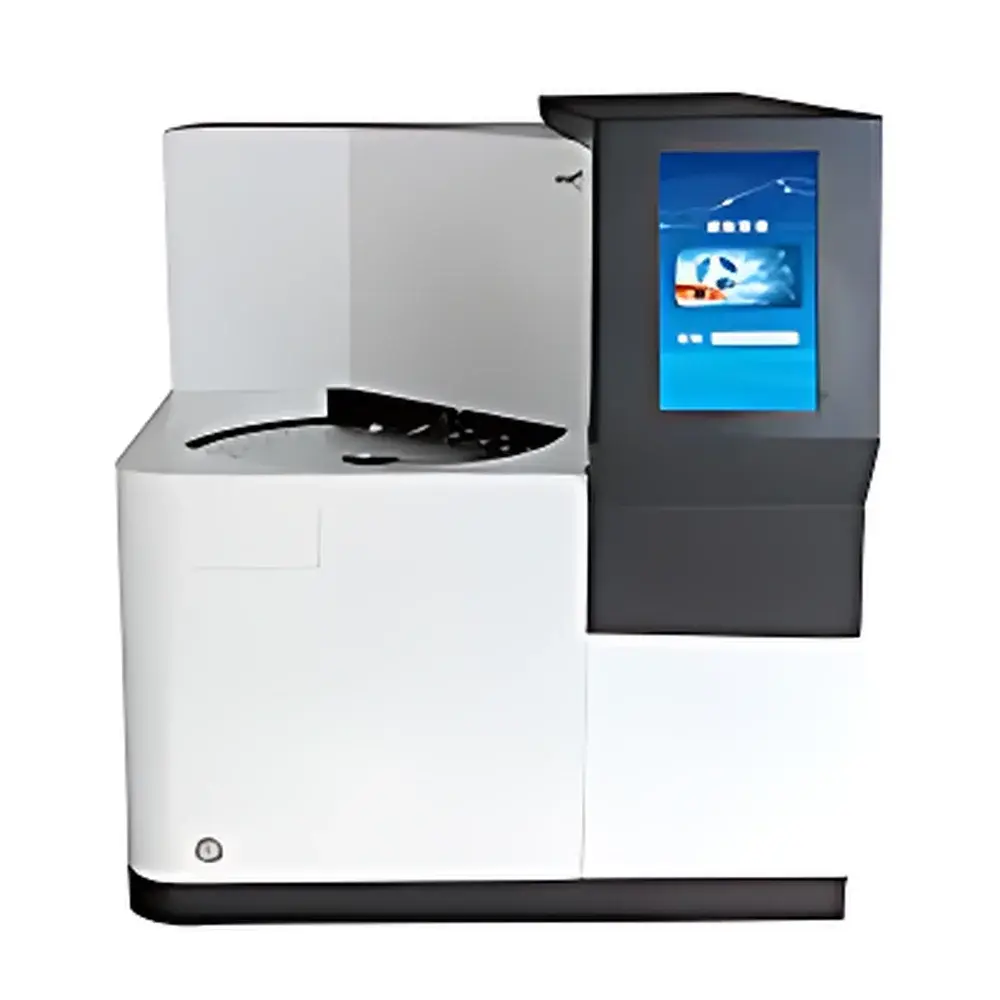
Beifen Sanpu ATDS-20A Fully Automated Two-Stage Thermal Desorber with Cryogenic Trap
| Brand | Beifen Sanpu |
|---|---|
| Origin | Beijing, China |
| Manufacturer Type | Direct Manufacturer |
| Instrument Type | Two-Stage Thermal Desorber |
| Automation Level | Fully Automated |
| Primary Desorption Temp Range | Ambient to 450 °C |
| Secondary Desorption Temp Range | 100–450 °C |
| Cryo-Trap Temp Range | −35 °C to Ambient |
| Desorption Recovery Rate | >99% (compound-dependent) |
| Sample Capacity | 20 positions |
| Temperature Control Accuracy | ±0.5 °C |
| RSD | ≤2.5% (benzene at 0.05 μg) |
| Enrichment Time | 0–60 min |
| Injection Time | 0–60 min |
| Sample Tube Format | 1/4″ OD × 3.5″ (ASTM D6196-compliant) |
| Valve Actuation | Motor-driven 6-port switching valve |
| Dimensions (L×W×H) | 350 × 450 × 510 mm |
| Weight | ~40 kg |
Overview
The Beifen Sanpu ATDS-20A is a fully automated two-stage thermal desorber engineered for high-fidelity, quantitative analysis of volatile and semi-volatile organic compounds (VOCs and SVOCs) in ambient air, indoor air, building materials, automotive cabin emissions, and industrial stack gases. It operates on the principle of sequential thermal desorption: first-stage desorption releases analytes from sorbent tubes under controlled inert gas flow; second-stage desorption—conducted within a cryogenically cooled trap—focuses and re-concentrates volatiles before rapid thermal injection into a gas chromatograph (GC) or GC-MS system. The integrated Peltier-based cryogenic trap achieves stable operation down to −35 °C, enabling sharp, symmetrical peak shapes and enhanced sensitivity for low-concentration target compounds (e.g., benzene, toluene, ethylbenzene, xylenes, C2–C12 alkanes, carbonyls, and halogenated VOCs). Designed to meet stringent regulatory requirements, the ATDS-20A delivers robust performance compliant with U.S. EPA TO-17, ISO 16017-1, ASTM D6196, and major Chinese environmental standards including HJ 644–2013, HJ 583–2010, HJ 734–2014, and GB/T 18883–2002. Its modular architecture supports seamless integration with all major GC and GC-MS platforms via standardized pneumatic and electronic interfaces.
Key Features
- Fully automated 20-position sample carousel with self-calibrating positioning algorithm and power-on diagnostic routine
- Independent four-zone temperature control: primary desorption oven, secondary desorption zone, transfer line, and six-port valve—all adjustable in 1 °C increments (range: ambient to 450 °C)
- High-efficiency Peltier cryo-trap with precise −35 °C to ambient control, ensuring narrow band focusing and minimized thermal degradation
- Programmable multi-step sequence: primary desorption → trap cold trapping → secondary desorption → GC injection → trap and transfer line bake-out → valve back-flush (0–100 mL/min, continuously adjustable)
- Integrated tube activation module for automated post-desorption reconditioning of Tenax®, Carbopack™, and other sorbent tubes
- Simulated sampling mode with programmable flow (0–160 mL/min) for direct calibration curve generation without external flow controllers
- Motor-driven 6-port valve with fail-safe position feedback and inert gas-purged sealing for long-term reliability
- Low-voltage (24 V DC) heating for transfer line, enhancing electrical safety and thermal stability
- Optional quartz-lined transfer tubing for analysis of reactive or polar compounds (e.g., formaldehyde, acetaldehyde)
- Front-panel 7-inch capacitive touchscreen with intuitive GUI, real-time status animation, and method storage (≥100 user-defined methods)
Sample Compatibility & Compliance
The ATDS-20A accepts standard 1/4″ OD × 3.5″ stainless steel or glass sorbent tubes conforming to ASTM D6196 and ISO 16017-1 dimensional specifications. It supports single-bed and multi-bed sorbents—including Tenax TA, Carbopack B/C, Carboxen 1000, and graphitized carbon blacks—for broad compound coverage across boiling points up to 350 °C. All thermal zones maintain temperature uniformity within ±0.5 °C, ensuring method reproducibility required for GLP/GMP-aligned laboratories. System validation includes documented temperature mapping, carryover testing (<0.1% for benzene), and recovery verification per EPA TO-17 Appendix A. Data integrity complies with 21 CFR Part 11 when operated with validated LIMS or chromatography data systems (CDS), supporting full audit trails, electronic signatures, and method version control.
Software & Data Management
Instrument control is managed via embedded firmware with USB and Ethernet connectivity. Method parameters—including temperature ramps, timing sequences, flow rates, and GC trigger logic—are configured through the onboard interface or exported/imported as XML files. The system supports synchronized start commands for GC and data acquisition software (e.g., Chromeleon, OpenLab, Empower) via TTL or RS-232 handshake protocols. Raw thermal desorption event logs—including actual vs. setpoint temperatures, valve actuation timestamps, and pressure transients—are recorded at 1 Hz resolution and stored internally (≥10,000 runs) with optional export to CSV. No proprietary desktop software is required; integration into enterprise-wide QA/QC workflows follows standard instrument driver protocols (e.g., Agilent GC Driver, Thermo Xcalibur SDK).
Applications
The ATDS-20A is routinely deployed in environmental monitoring labs for compliance testing under HJ 644–2013 (ambient VOCs), HJ 734–2014 (stationary source emissions), and GB 50325–2020 (indoor formaldehyde and TVOC screening). It is also applied in product safety evaluation—such as VOC emission profiling of automotive interiors (per HJ/T 400–2007), furniture composites, and polymer coatings—and in occupational hygiene for workplace air assessment. Research applications include breath analysis method development, odorant profiling in food packaging, and forensic fire debris analysis. Its consistent recovery (>99% for BTEX, <2.5% RSD) and trace-level detection capability (sub-ppt in air, with appropriate tube capacity and GC-MS detection) make it suitable for Tier 1 accredited laboratories performing ISO/IEC 17025 audits.
FAQ
What sorbent tube formats are supported?
Standard 1/4″ OD × 3.5″ tubes (ASTM D6196); custom-length tubes require mechanical adapter verification.
Does the system support method validation documentation?
Yes—built-in diagnostics, temperature logging, and event timestamping support IQ/OQ/PQ protocol execution per ISO/IEC 17025.
Can the cryo-trap be replaced or serviced in-house?
The Peltier module is field-replaceable using standard tools; replacement parts and service manuals are supplied with extended warranty contracts.
Is remote monitoring possible?
Yes—via Ethernet-connected network; real-time status and alarm notifications can be routed to SCADA or lab infrastructure management systems.
How is carryover mitigated between samples?
Automated post-injection back-flush of the trap, transfer line, and valve with inert gas (programmable flow and duration) ensures <0.1% residual carryover for high-concentration matrices.



