
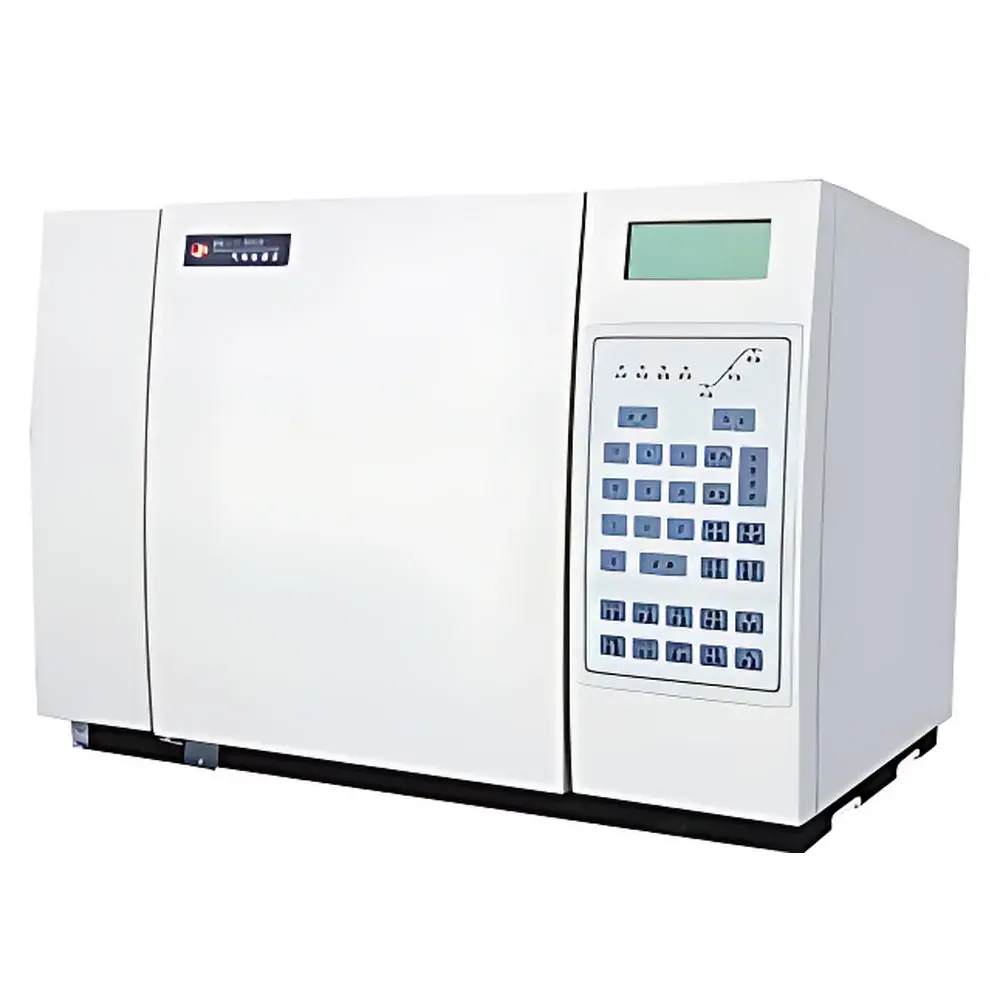
Beifen Sanpu GC-2010 Laboratory Gas Chromatograph
| Brand | Beifen Sanpu |
|---|---|
| Origin | Beijing, China |
| Manufacturer Type | Direct Manufacturer |
| Instrument Type | Laboratory Gas Chromatograph |
| Model | GC-2010 |
| Temperature Control Range | +8 °C to 400 °C |
| Oven Ramp Rate | 0.1–40 °C/min |
| Cooling Rate | ~6 min (400 °C → 50 °C) |
| Carrier Gas Flow Range | 0–1200 mL/min |
| Carrier Gas Pressure Range | 0–970 kPa |
| Injector Max Temp | 400 °C |
| Injector Pressure Setpoint Range | 0–970 kPa |
| Injector Total Flow Setpoint Range | 0–1200 mL/min |
| Temperature Accuracy | ±0.1 °C (≤200 °C), ±0.2 °C (>200 °C) |
| Programmed Temperature Ramping | 8-step linear |
| Minimum Temp Increment | 0.1 °C |
Overview
The Beifen Sanpu GC-2010 is a benchtop laboratory gas chromatograph engineered for precision, stability, and operational flexibility in routine and method-development environments. Based on the fundamental principle of differential partitioning of analytes between a mobile phase (inert carrier gas) and a stationary phase (capillary or packed column), the GC-2010 separates volatile and semi-volatile organic compounds with high resolution and reproducibility. Its modular architecture supports dual detection configurations—including simultaneous FID and TCD—and accommodates future expansion to ECD, FPD, and NPD detectors. Designed for compliance-critical workflows, the system maintains thermal stability across all heated zones (oven, injectors, detectors) with digital temperature control and real-time monitoring, meeting baseline requirements for GLP-aligned laboratories conducting environmental, petrochemical, pharmaceutical, and food safety analyses.
Key Features
- Eight-step linear programmed temperature ramping with adjustable rate (0.1–40 °C/min) and 0.1 °C increment resolution for precise method optimization.
- Dual independent injector systems: two packed-column vaporizers plus one dedicated split/splitless capillary inlet with integrated tail-purge flow control—compatible with narrow-bore (0.1–0.32 mm ID) and wide-bore (0.53 mm ID) fused-silica columns.
- Intelligent back-door cooling system with variable-frequency drive enables rapid oven cooldown (~6 minutes from 400 °C to 50 °C), supporting high-throughput analysis without thermal lag.
- Column oven employs tracking-heating mode to minimize thermal shock to detector components during rapid temperature transitions, reducing baseline drift and extending detector lifetime.
- Digital zero-baseline adjustment eliminates mechanical potentiometer drift, ensuring long-term signal stability—critical for quantitative applications requiring low detection limits.
- Microprocessor-controlled ignition for flame ionization detection (FID), eliminating manual pilot-light maintenance and improving startup repeatability.
- Comprehensive hardware-level safety: overtemperature cutoff (per zone), carrier gas failure detection with tungsten filament protection for TCD, and power surge immunity with non-volatile parameter retention.
Sample Compatibility & Compliance
The GC-2010 accepts liquid, gaseous, and headspace-derived samples via standard 10 µL syringes or optional autosampler interfaces. Its triple-gas-path design permits concurrent operation of multiple column types (packed, PLOT, and capillary) under independent pressure/flow control—enabling method transfer validation and multi-analyte screening in a single run. The instrument complies with foundational regulatory expectations for analytical instrumentation, including traceable temperature calibration (NIST-traceable reference standards recommended), audit-ready parameter logging, and deterministic fault reporting with human-readable Chinese-language diagnostics (configurable for English firmware localization). While not pre-certified for 21 CFR Part 11, its architecture supports integration into validated environments through external electronic lab notebook (ELN) or LIMS systems with full metadata capture.
Software & Data Management
Data acquisition and processing are performed using Beifen Sanpu’s proprietary GC Workstation software (Windows-based), which provides real-time chromatogram visualization, peak integration with customizable baselines and threshold logic, retention time locking, and export to CSV, TXT, and AIA (.cdf) formats. The software implements local user authentication, session logging, and editable audit trails—including operator ID, method name, injection time, and parameter revision history. Raw data files are stored with embedded instrument configuration metadata, facilitating method revalidation and cross-laboratory comparison. For enterprise deployment, the workstation supports OPC UA connectivity for integration into centralized process analytics platforms.
Applications
The GC-2010 serves as a general-purpose platform for qualitative and quantitative analysis across regulated and research settings. Typical use cases include residual solvent testing per ICH Q3C guidelines; hydrocarbon profiling in fuels (ASTM D1319, D5186); pesticide residue screening in agricultural commodities (AOAC 2007.01); volatile organic compound (VOC) analysis in indoor air (EPA TO-17); and fatty acid methyl ester (FAME) quantification in biodiesel (EN 14103). Its dual-FID expandability allows parallel analysis of different compound classes—for example, simultaneous detection of aldehydes (via derivatization/FID) and permanent gases (via TCD) in fermentation off-gas monitoring.
FAQ
Does the GC-2010 support method validation according to ISO/IEC 17025?
Yes—the instrument’s temperature accuracy (±0.1 °C ≤200 °C), reproducible ramp rates, and digital parameter logging enable documentation of critical method parameters required for accreditation.
Can the system be operated remotely via network connection?
Local Ethernet connectivity is supported for file transfer and remote desktop access; however, native web-based control is not implemented—integration requires third-party SCADA or LabVIEW drivers.
Is the firmware upgradeable in the field?
Yes—firmware updates are delivered via USB flash drive and applied through the onboard menu interface without requiring service engineer intervention.
What column dimensions are supported out-of-the-box?
Standard configurations accommodate 0.1–0.53 mm ID capillary columns up to 60 m length, and packed columns up to 4 mm ID × 3 m length, with adjustable gas flow compensation for optimal linear velocity.
How is detector sensitivity verified post-installation?
Sensitivity verification follows manufacturer-recommended test mixtures (e.g., n-decane for FID, methane for TCD) with documented signal-to-noise (S/N ≥ 3) and minimum detectable amount (MDA) calculations per ASTM E260 practice.






