
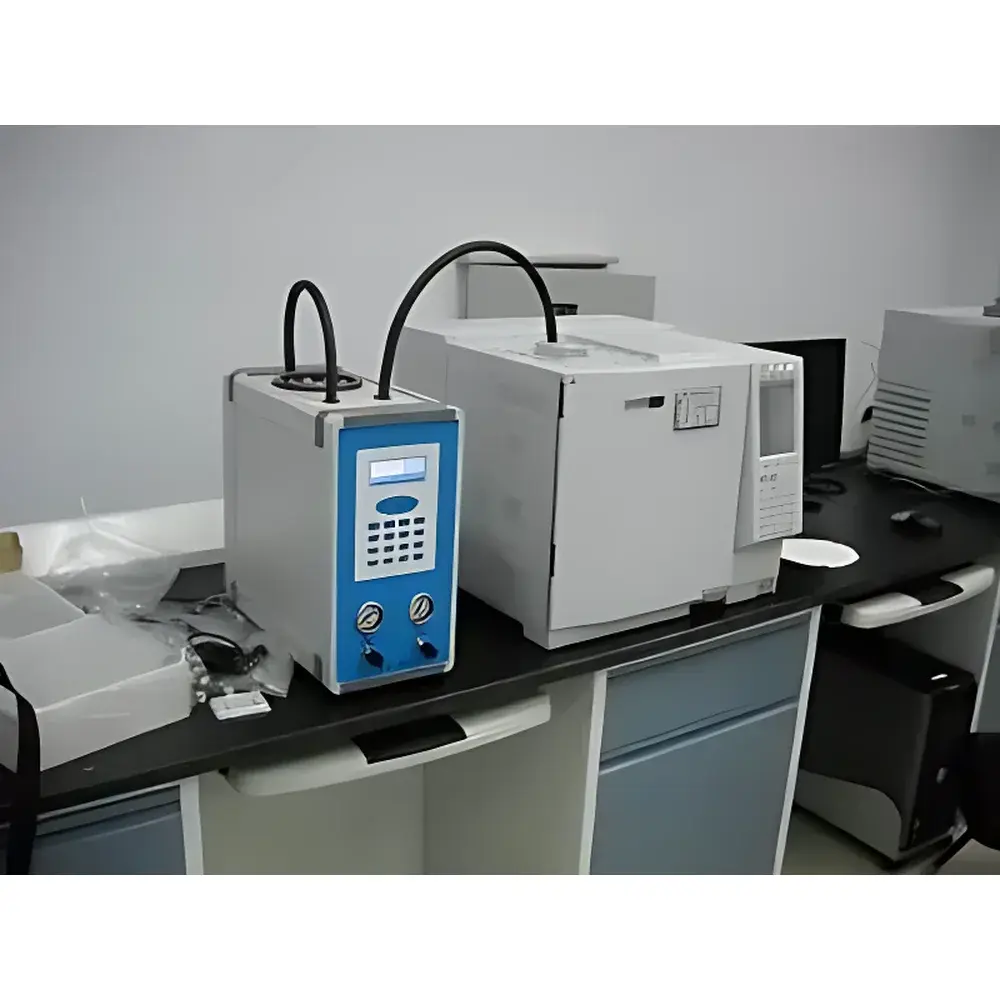
Beifen Sanpu AHS-610 Automated Static Headspace Sampler Coupled with Shimadzu GC-2010 Gas Chromatograph for Residual Ethylene Oxide Analysis in Pharmaceutical Excipients
| Brand | Beifen Sanpu |
|---|---|
| Origin | Beijing, China |
| Manufacturer Type | OEM Manufacturer |
| Product Category | Domestic |
| Model | AHS-610 + GC-2010 |
| Instrument Type | Static Headspace Sampler |
Overview
The Beifen Sanpu AHS-610 Automated Static Headspace Sampler is engineered for precise, reproducible quantification of volatile residual solvents—particularly ethylene oxide (EO)—in pharmaceutical dosage forms such as gelatin capsules, in full compliance with the Chinese Pharmacopoeia (2010 Edition). This system operates on the principle of static headspace equilibrium gas-phase extraction, followed by direct transfer of the equilibrated vapor phase into a Shimadzu GC-2010 gas chromatograph equipped with a capillary column and flame ionization detector (FID) or mass spectrometric detection (GC-MS). Ethylene oxide, classified as a Group 1 human carcinogen by IARC, is widely used for terminal sterilization of medical devices and pharmaceutical excipients; regulatory limits require residual EO concentrations ≤ 1 ppm in gelatin-based capsules. The AHS-610 achieves a validated method detection limit of 0.5 ppm under optimized thermal and timing parameters—exceeding the sensitivity threshold mandated by pharmacopoeial monographs.
Key Features
- Pressure-balanced static headspace injection architecture eliminates reliance on six-port valves or fixed-volume loop systems, minimizing carryover and improving quantitative accuracy.
- Triple-zone independent temperature control: heated sample vial block (±0.1 °C stability), transfer line (up to 220 °C), and injection needle (up to 250 °C), ensuring complete volatilization and preventing condensation artifacts.
- Microprocessor-controlled operation with LCD interface supporting Chinese/English bilingual display, real-time status monitoring, and timestamped method logging.
- Configurable 8-step time-programmable sequence including vial pressurization, equilibration, sampling, injection, and post-injection purge—fully automatable via external trigger signals from GC or data system.
- Integrated carrier gas regulation module enables seamless coupling with Shimadzu GC-2010 without hardware modification; compatible with both split/splitless inlet configurations.
- Supports multi-GC sharing: one AHS-610 unit can serve up to three GC instruments via programmable event scheduling and auxiliary valve routing.
- Automatic backflush functionality for both sampling needle and transfer tubing reduces cross-contamination between samples—critical for high-throughput QC laboratories.
- Optional 0.53 mm fused-silica transfer lines available for enhanced inertness when analyzing reactive analytes like EO or chloroethanol.
Sample Compatibility & Compliance
The AHS-610 accommodates standard 10–22 mL crimp-top headspace vials sealed with PTFE/silicone septa. It is validated for use with gelatin capsules, lyophilized powders, polymer-based drug delivery matrices, and sterilized medical device packaging materials. Method development adheres to ICH Q2(R2) guidelines for analytical procedure validation. System suitability testing meets USP and EP 2.2.46 requirements for headspace GC methods. Data integrity complies with FDA 21 CFR Part 11 when integrated with compliant chromatography data systems (CDS); audit trails, electronic signatures, and method version control are fully supported through synchronized GC-CDS workflows.
Software & Data Management
The AHS-610 supports bidirectional communication with Shimadzu LabSolutions GC software via RS-232 or Ethernet. Up to nine user-defined methods—including vial temperature, equilibration time, pressurization pressure, injection volume, and purge duration—can be stored onboard and recalled instantly. All method parameters, run timestamps, and instrument status logs are exportable in CSV format for LIMS integration. Optional GLP-compliant reporting modules generate PDF-certified reports containing calibration history, system suitability results, and raw chromatogram overlays—fully traceable to individual vial IDs and analyst credentials.
Applications
- Quantitative determination of residual ethylene oxide in pharmaceutical-grade gelatin capsules per ChP 2010, Section 0871.
- Simultaneous analysis of EO and 2-chloroethanol in capsule shells using dual-detection GC-FID/GC-MS workflows.
- Residual solvent profiling in API intermediates and final drug substances per ICH Q3C(R8).
- Leachables screening from sterilized plastic containers and elastomeric closures.
- Stability-indicating assays for EO degradation products (e.g., ethylene glycol, acetaldehyde) under accelerated storage conditions.
FAQ
What is the minimum detectable concentration of ethylene oxide achievable with this configuration?
Under optimized conditions (20 min equilibration at 85 °C, 1 mL headspace injection, DB-624 column, FID detection), the method detection limit is 0.5 ppm (w/w) in gelatin matrix.
Can the AHS-610 be used with non-Shimadzu GC systems?
Yes—the system features universal analog/digital triggering and adjustable pneumatic interfaces compatible with Agilent, Thermo Fisher, and PerkinElmer GC platforms.
Is method validation support documentation provided?
Beifen Sanpu supplies IQ/OQ protocols, system suitability test templates, and representative chromatograms aligned with ChP 2010 Annex VI requirements.
How is carryover minimized during high-concentration sample analysis?
Automatic needle and transfer line backflushing (programmable duration and flow rate), coupled with inert surface treatment of all wetted parts, ensures carryover < 0.1% across consecutive injections.
Does the system meet GMP environmental monitoring requirements?
When operated within ISO 14644-1 Class 7 cleanroom conditions and paired with calibrated reference standards, the AHS-610+GC-2010 configuration satisfies EU GMP Annex 1 and WHO TRS 992 Annex 5 criteria for residual solvent testing.




