
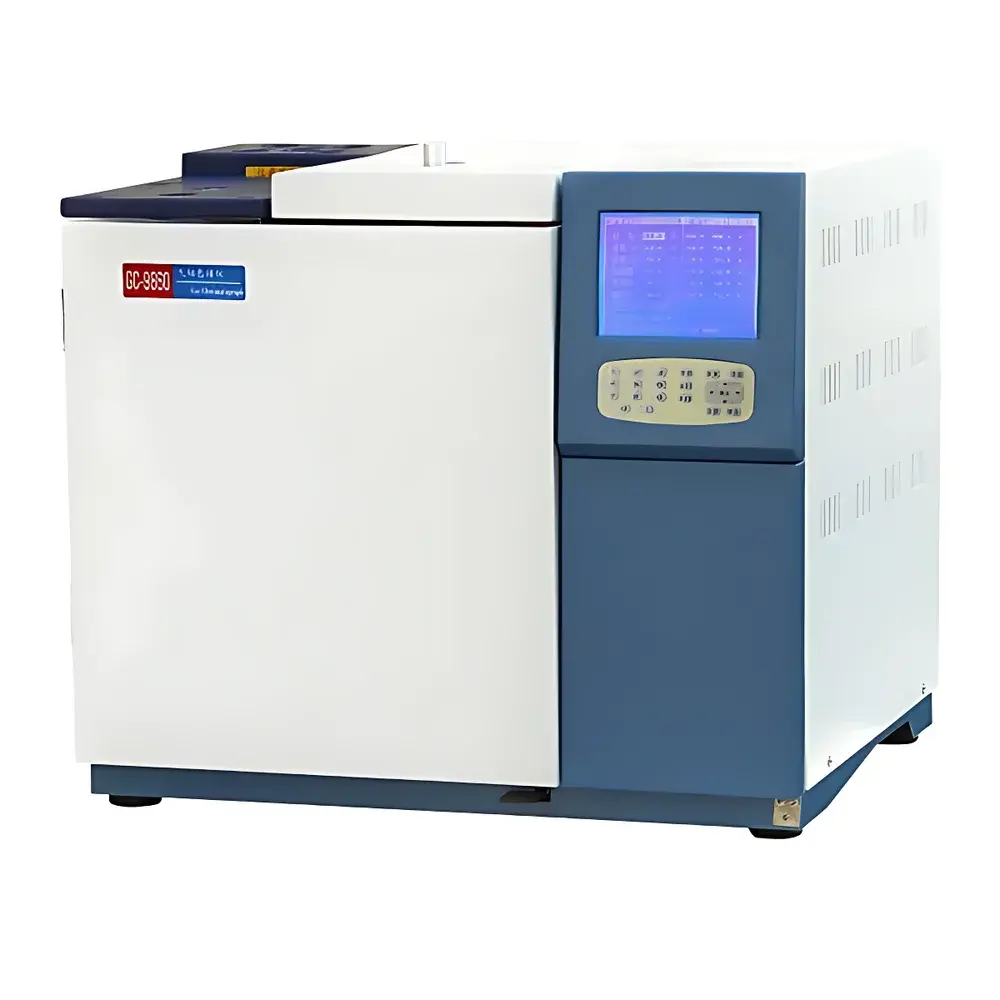
BFSAP BFGC-9860 High-Performance Gas Chromatograph with FID for Deltamethrin Residue Analysis in Cockroach Control Formulations
| Brand | BFSAP |
|---|---|
| Origin | Beijing, China |
| Manufacturer Type | Direct Manufacturer |
| Product Origin | Domestic (China) |
| Model | BFGC-9860 |
| Pricing | Upon Request |
Overview
The BFSAP BFGC-9860 is a high-stability, multi-detector-capable gas chromatograph engineered for precise quantification of deltamethrin—a synthetic pyrethroid insecticide—in commercial cockroach control products and environmental matrices. It operates on the principle of capillary or packed-column gas chromatography coupled with flame ionization detection (FID), delivering reliable separation and sensitive detection of deltamethrin at trace levels (sub-ppb to low-ppm range) in complex formulations such as emulsifiable concentrates (EC) and wettable powders (WP). The instrument integrates advanced thermal management, microcurrent amplification, and robust gas flow control to ensure reproducible retention times and peak area precision—critical for regulatory compliance in pesticide residue testing per ISO 17025-accredited laboratories. Its design supports routine analysis under GLP and GMP frameworks, with full traceability for method validation, calibration, and audit readiness.
Key Features
- Eight-stage linear programmable temperature ramping with ±0.1 °C column oven accuracy across a wide range (ambient +5 °C to 400 °C), enabling optimal resolution of deltamethrin from co-extracted matrix interferences.
- Dual independent back-oven doors with intelligent airflow regulation for true near-ambient cooling and rapid thermal equilibration—essential for high-throughput labs performing daily pesticide residue batches.
- FID with detection limit ≤2×10⁻¹² g/s (n-hexadecane), low noise (≤2×10⁻¹⁴ A), and ≥107 linear dynamic range—ensuring accurate calibration over three orders of magnitude without signal saturation or detector overload.
- Modular detector configuration: supports simultaneous installation of up to four detectors—including dual-FID, dual-TCD, or hybrid combinations (e.g., FID + ECD)—without hardware modification.
- Integrated flash memory system eliminating battery-dependent data retention; stores up to 20 complete chromatographic methods with full parameter logging and timestamped run history.
- Self-diagnostic firmware with real-time fault localization and Chinese/English bilingual interface (5.7″ LCD, 320×240 resolution) for intuitive operation by QC technicians and analytical chemists.
- Automatic FID ignition, pressure-controlled dual-gas supply (N2/H2/air), and leak-tolerant flow stabilization—minimizing downtime during routine maintenance or column changes.
Sample Compatibility & Compliance
The BFGC-9860 is validated for direct injection of solvent extracts (e.g., acetone, ethyl acetate, or acetonitrile) from treated surfaces, baits, or residual formulations following AOAC Official Method 2007.01 or EPA Method 8081B adaptations. It accommodates both packed columns (e.g., 3.2 mm × 1.1 m stainless steel OV-101/Chromosorb W AW DMCS, 180–250 µm) and fused-silica capillaries for enhanced resolution. Instrument performance meets ASTM D3699 (hydrocarbon solvents), ISO 10382 (pesticide residue GC), and USP chromatographic system suitability requirements. Built-in power failure recovery, gas cutoff protection, and platinum RTD-based overtemperature safeguards ensure uninterrupted operation in regulated environments subject to FDA 21 CFR Part 11 and ISO/IEC 17025 documentation standards.
Software & Data Management
The system interfaces with BFSAP’s GC-DataPro v3.2 workstation software, supporting fully compliant electronic records including audit trails, user access controls, electronic signatures, and raw-data integrity verification. All chromatograms are stored in vendor-neutral .cdf format compatible with third-party LIMS platforms. Calibration curves support weighted least-squares regression (1/x or 1/x²), peak integration via valley-to-valley or tangent skim algorithms, and automatic internal standard correction using dioctyl phthalate (DOP) or other reference compounds. Software modules include automated sequence scheduling, QC flagging (e.g., retention time drift >0.1 min, area RSD >5%), and PDF report generation aligned with CNAS-CL01 and GLP reporting templates.
Applications
- Quantitative determination of deltamethrin residues in commercial cockroach gel baits, dusts, and spray formulations per national registration guidelines (e.g., China NY/T 761–2008, EU SANCO/12571/2013).
- Stability-indicating assay development for shelf-life studies of pyrethroid-based biocidal products.
- Environmental monitoring of deltamethrin leachates in indoor surface wipes or air sampling cartridges (via thermal desorption-GC/FID).
- Method transfer and cross-validation between QC labs and contract research organizations (CROs) conducting GLP-compliant residue trials.
- Support for multi-residue screening when paired with optional ECD or NPD detectors for organochlorines or nitrogen-containing pesticides.
FAQ
What is the typical retention time for deltamethrin under standard BFGC-9860 operating conditions?
Under recommended settings (OV-101 packed column, 245 °C isothermal, 50 mL/min N2 carrier), deltamethrin elutes at approximately 3.2 minutes—with internal standard (e.g., dioctyl phthalate) appearing at ~2.13 minutes.
Can the BFGC-9860 be used for other pyrethroids beyond deltamethrin?
Yes—the platform supports validated methods for cypermethrin, permethrin, fenvalerate, and lambda-cyhalothrin using identical hardware and minor method adjustments (e.g., temperature ramp profiles or column selection).
Is the instrument compatible with third-party GC data systems like Chromeleon or OpenLab CDS?
While native software is BFSAP GC-DataPro, the instrument outputs standard .cdf files and supports ASCII export, enabling import into major chromatography data systems via vendor-supplied drivers or generic AIA file handling.
Does the BFGC-9860 meet requirements for ISO/IEC 17025 accreditation?
Yes—its hardware-level diagnostics, electronic signature capability, audit trail logging, and documented system suitability protocols fulfill key technical requirements for accredited pesticide residue testing laboratories.
What maintenance intervals are recommended for sustained FID performance?
We recommend quarterly cleaning of the jet and collector electrode, biannual replacement of the FID ceramic igniter, and annual recalibration of gas flow controllers and temperature sensors—per the included Maintenance Logbook and SOP templates.







