
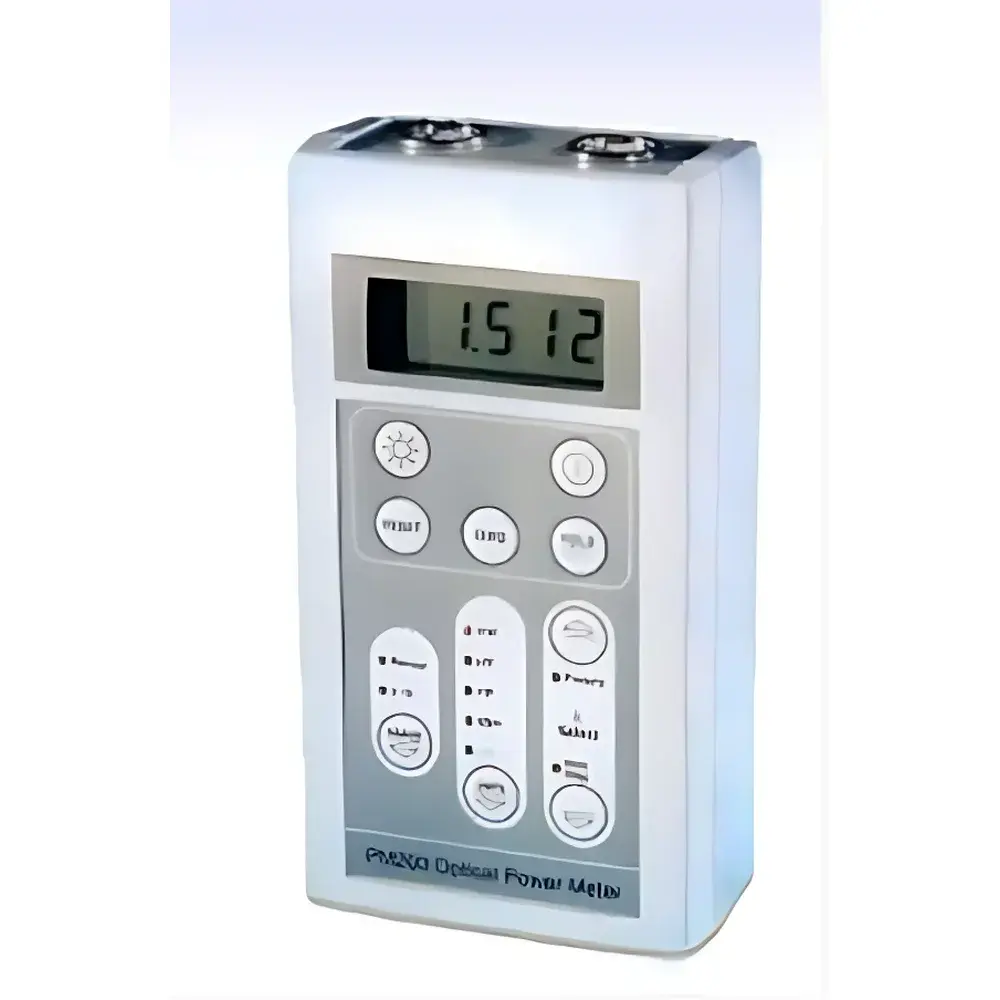
Macam Irradian PM203 Portable Optical Power Meter
| Brand | Macam |
|---|---|
| Origin | United Kingdom |
| Model | Irradian PM203 |
| Optical Detector | Silicon photodiode |
| Spectral Range | 200–1100 nm |
| Calibration Accuracy | ±5% (400–1100 nm), ±7.5% (240–400 nm) |
| Power Range (Standard) | 0.001 nW – 199.99 µW (5 auto-ranging scales) |
| Power Range (Extended Option) | 10 nW – 1.9999 mW |
| Resolution | 0.001 nW (standard), 0.01 nW (extended) |
| Display | 4½-digit LCD, 10 mm digit height, LED backlight |
| Interface | RS232 (3-wire, 4800 baud, no parity, 1 stop bit) |
| Integration Time | 0.33 s |
| Linearity Error | <1% |
| Operating Temperature | 0–40 °C, 80% RH |
| Dimensions (Display Unit) | 150 × 80 × 45 mm |
| Weight | ~350 g |
| Detector Housing | Black anodized aluminum, 1.125" × 20 TPI thread |
| Traceability | NIST-traceable calibration |
Overview
The Macam Irradian PM203 Portable Optical Power Meter is a precision-calibrated, microprocessor-controlled instrument engineered for quantitative measurement of radiant power in continuous-wave (CW) optical beams across the ultraviolet (UV), visible (VIS), and near-infrared (NIR) spectral regions (200–1100 nm). It operates on the principle of photovoltaic conversion using a 100 mm² silicon photodiode detector, whose responsivity is characterized and compensated via internal wavelength-specific calibration tables stored in non-volatile RAM. The PM203 delivers direct readings in absolute units—watts (W), milliwatts (mW), nanowatts (nW), decibel-milliwatt (dBm), or relative decibel (dBr)—eliminating manual unit conversion and minimizing operator-induced error. Its compact, ruggedized handheld design—featuring a sealed anodized aluminum detector housing and robust DIN-style connectors—ensures operational reliability in diverse environments including cleanroom laboratories, manufacturing floors, field-deployed photobiological safety assessments, and outdoor UV monitoring stations.
Key Features
- Microprocessor-based control architecture centered on an 80C51 8-bit CPU with 3.1684 MHz clock and onboard non-volatile RAM for persistent storage of calibration coefficients and user settings.
- Five standard auto-ranging measurement scales (0–19.999 nW to 0–199.99 µW) and optional extended range (up to 1.9999 mW), selectable via front-panel keys or remote command.
- High-resolution 4½-digit LCD display with 10 mm character height and user-activated LED backlight for low-ambient-light readability.
- Integrated multi-gain transimpedance amplifier (10⁴–10⁸ V/A) optimized for low-noise performance across six decades of input current, supporting linear response from 1 nW to 100 µW.
- RS232 serial interface compliant with standard COM port protocols (4800 baud, no parity, one stop bit) enabling remote instrument control, real-time data streaming, and automated calibration log export.
- Configurable wavelength selection: either fixed 10 nm step scanning across full spectral range or user-defined list of up to 16 preselected calibration wavelengths.
- Modular detector interface compatible with optical accessories including calibrated neutral-density attenuators, integrating spheres (for spatially non-uniform or divergent beams), and fiber-optic coupling adapters.
Sample Compatibility & Compliance
The PM203 is validated for use with collimated or moderately divergent CW light sources—including mercury vapor lamps, UV-LED arrays, halogen broadband emitters, and diode lasers—provided beam diameter remains within the active area of the 100 mm² silicon detector. When coupled with an NIST-traceable integrating sphere, it meets ASTM E275 and ISO/IEC 17025 requirements for radiometric measurement of diffuse or high-power laser output. Calibration certificates include uncertainty budgets referenced to UK National Physical Laboratory (NPL) standards. The instrument supports GLP-compliant data integrity through timestamped serial logging and retains configuration history in non-volatile memory—features aligned with FDA 21 CFR Part 11 expectations for audit-ready instrumentation in regulated phototherapy and photostability testing workflows.
Software & Data Management
No proprietary software is required for basic operation; however, the RS232 interface enables seamless integration with third-party platforms such as LabVIEW, MATLAB, or Python-based acquisition scripts using standard serial communication libraries. Raw ASCII-formatted data packets include measurement value, selected wavelength, active range, unit code, and timestamp. Internal memory does not store historical measurements, but external systems can implement continuous logging with full traceability. All calibration parameters are write-protected and can only be updated using authenticated firmware tools provided under Macam’s authorized service program—ensuring metrological continuity and preventing unauthorized drift correction.
Applications
- Radiometric validation of UV-A/UV-B irradiance in dermatological phototherapy systems and medical device sterilization cabinets.
- Process monitoring of mercury arc lamp output stability during semiconductor photolithography and PCB exposure systems.
- Accelerated photostability testing per ICH Q1B guidelines, where spectral irradiance profiles must be quantified at discrete UV-VIS bands.
- Plant phenotyping and photosynthetic photon flux density (PPFD) assessment in controlled-environment agriculture research.
- Calibration transfer between primary standards and field-deployable reference meters in environmental UV monitoring networks.
- Verification of optical attenuation in fiber-optic delivery systems used in laser surgery and dental curing applications.
FAQ
What spectral range is supported by the standard silicon photodiode detector?
The standard DET203PM detector covers 200–1100 nm, with specified calibration accuracy of ±5% from 400–1100 nm and ±7.5% from 240–400 nm.
Can the PM203 measure pulsed laser sources?
No—the instrument is designed exclusively for continuous-wave (CW) radiation. Its 0.33 s integration time and analog bandwidth (<0.5 MHz) preclude accurate peak power or pulse energy measurement.
Is the calibration traceable to international standards?
Yes—each unit ships with a certificate documenting NIST-traceable calibration against primary radiometric standards maintained by the UK’s National Physical Laboratory (NPL).
How is zero offset corrected during operation?
A manual zero function is accessible via front-panel key sequence; it samples dark current with detector aperture blocked and subtracts the baseline from subsequent readings.
What accessories are available for fiber-optic coupling?
Macam offers SMA-905 and FC/PC adapter kits, along with calibrated 10 dB and 20 dB ND filters certified to ISO 9050 for extended dynamic range applications.
Related Products







