
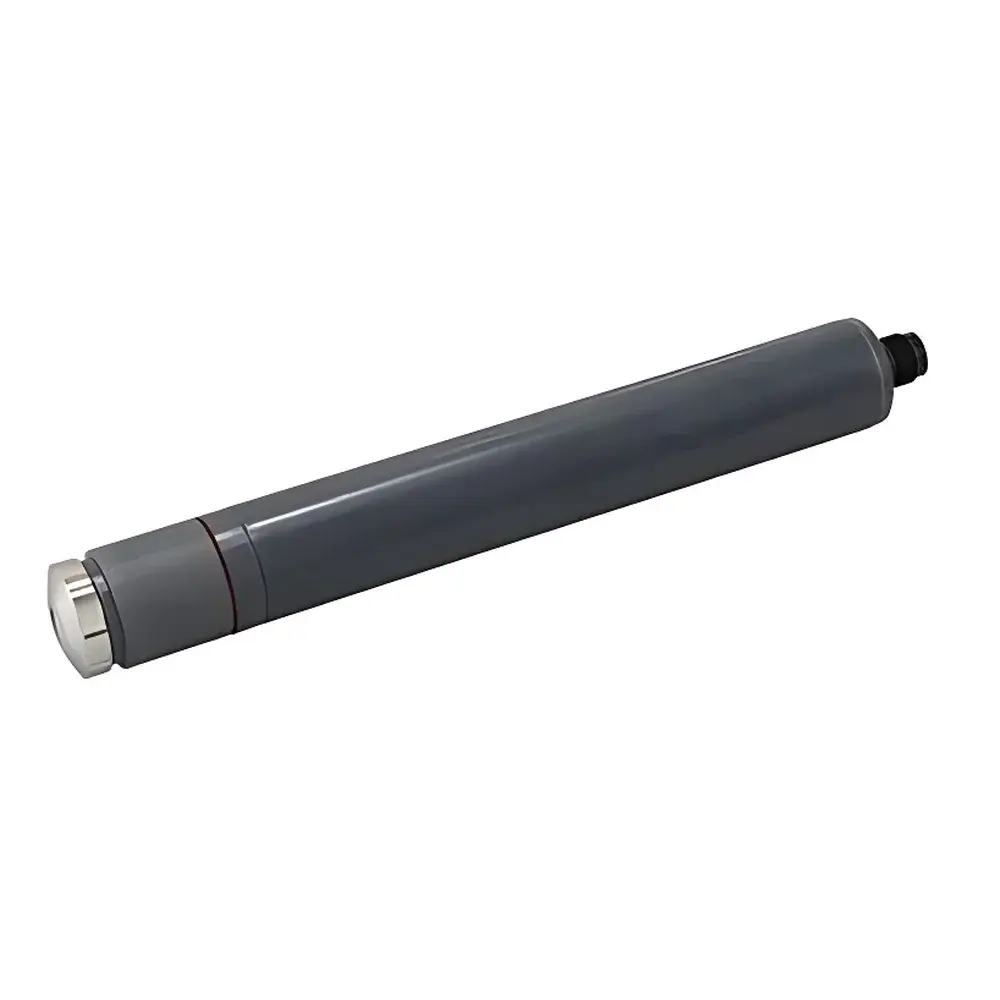
TriOS eCHEM Chlorine Dioxide Sensor
| Brand | TriOS |
|---|---|
| Origin | Germany |
| Model | eCHEM ClO₂ |
| Instrument Type | Portable |
| Measurement Principle | Electrochemical Amperometric (3-Electrode Potentiostatic) |
| Measurand | Chlorine Dioxide (ClO₂) |
| Range | 0–2 mg/L (ppm), optionally 0–20 mg/L |
| Accuracy | ±0.4 mg/L (0–2 mg/L range) |
| Temp. Compensation | Integrated Pt100 |
| Response Time (T90) | ~60 s |
| Housing Material | PVC-U & Stainless Steel 1.4571 |
| Dimensions | 205 mm × 25 mm |
| Weight | 0.12 kg |
| Output Interface | RS-485, Modbus RTU |
| Power Supply | 9–30 VDC, max. 56 mA |
| Connector | 8-pin M12 |
| IP Rating | IP68 |
| Operating Temp. | 0–50 °C (liquid, ice-free) |
| Pressure Rating | 1 bar (static, no shock/vibration) |
| pH Range | 1–12 |
| Conductivity Range | 10 µS/cm – 50 mS/cm |
| Cross-Sensitivity | Cl₂ — negligible interference |
| Membrane Lifetime & Maintenance | Weekly verification recommended |
| Flow Dependency | Yes (optimal flow in FLC-3 flow cell: 15–30 L/h) |
| Calibration Method | DPD-1 spectrophotometric reference for chlorine-equivalent validation |
Overview
The TriOS eCHEM Chlorine Dioxide Sensor is a precision electrochemical amperometric sensor engineered for continuous, real-time measurement of aqueous chlorine dioxide (ClO₂) concentration across demanding industrial water treatment environments. Based on a stable three-electrode potentiostatic system with a gas-permeable hydrophobic membrane, the sensor operates via controlled potential amperometry—where ClO₂ diffuses through the selective membrane and undergoes quantitative reduction at the working electrode, generating a current linearly proportional to analyte concentration. This principle ensures high specificity, low drift, and robust performance in complex matrices including process water, CIP (Clean-in-Place) rinse solutions, bottle washer effluents, and seawater. Its operational pH range (1–12) and broad conductivity tolerance (10 µS/cm to 50 mS/cm) enable reliable deployment where conventional colorimetric or iodometric methods fail due to turbidity, oxidant interferences, or rapid decay kinetics.
Key Features
- Triple-electrode potentiostatic architecture with integrated Pt100 temperature sensor for automatic thermal compensation
- Chemically resistant membrane system tolerant to surfactants, alkaline cleaners, and common CIP agents—no signal suppression from non-ionic or anionic detergents
- Proven ClO₂ selectivity: negligible cross-response to free chlorine (Cl₂); ozone (O₃) exhibits 25× higher sensitivity—a known characteristic requiring procedural awareness during multi-oxidant monitoring
- Compact, IP68-rated cylindrical housing (PVC-U body + 1.4571 stainless steel tip) optimized for immersion or inline flow-cell integration (e.g., TriOS FLC-3)
- RS-485 digital output with Modbus RTU protocol ensures seamless integration into SCADA, PLC, or centralized water quality management systems
- Low-power operation (0.6 W max) and wide supply range (9–30 VDC) support battery-powered portable use or fixed installation in hazardous-area-adjacent zones
Sample Compatibility & Compliance
The eCHEM ClO₂ sensor maintains metrological integrity across diverse aqueous media, including potable water, wastewater effluent, food-grade process streams, and marine environments. It complies with fundamental requirements of ISO 7027 (turbidity-insensitive detection), ASTM D1253 (residual oxidant measurement principles), and supports GLP/GMP-aligned data integrity when paired with TriOS TriBox3 or HS100 controllers featuring audit-trail-capable firmware. While not intrinsically certified for ATEX/IECEx Zones, its 1-bar static pressure rating and absence of internal ignition sources permit safe use in non-explosive, wet-process enclosures. Note: calcium carbonate or metal hydroxide precipitation (e.g., lime scaling) may occlude the membrane surface—application-specific pre-filtration or periodic mechanical cleaning is advised where hardness exceeds 200 mg/L as CaCO₃.
Software & Data Management
Data acquisition and configuration are managed via TriOS’ standardized Modbus RTU register map, compatible with industry-standard HMI platforms (Siemens WinCC, Rockwell FactoryTalk, Ignition). When connected to TriBox3 or TriBox Mini controllers, the sensor benefits from built-in zero/span calibration logging, temperature-compensated trend storage (≥30 days at 1-min intervals), and configurable alarm thresholds with relay outputs. All calibration events—including DPD-1 reference validation—are timestamped and stored with operator ID (if enabled), satisfying traceability requirements under FDA 21 CFR Part 11 when deployed in pharmaceutical or beverage manufacturing QA/QC workflows. Firmware updates preserve backward compatibility and include enhanced noise-filtering algorithms for high-conductivity seawater deployments.
Applications
- Real-time ClO₂ dosing control in municipal drinking water disinfection systems
- Verification of residual biocide levels in pharmaceutical purified water (PW) and water-for-injection (WFI) loops
- Monitoring ClO₂ stability during CIP cycle validation in dairy, brewery, and aseptic packaging lines
- Seawater antifouling system optimization in offshore cooling circuits and ballast water treatment units
- Research-grade kinetic studies of ClO₂ decay pathways under variable pH, temperature, and organic load conditions
FAQ
Does this sensor measure total chlorine or only chlorine dioxide?
No—it is specifically designed and calibrated for dissolved chlorine dioxide (ClO₂). Free chlorine (Cl₂) produces negligible current response due to membrane selectivity and electrode potential tuning.
Can it be used in seawater without fouling?
Yes—the sensor is validated for conductivity up to 50 mS/cm and includes corrosion-resistant 1.4571 stainless steel components. However, biofouling mitigation (e.g., periodic wiper cleaning or antifouling flow cells) is recommended for long-term submersion.
What is the recommended calibration frequency?
A weekly DPD-1 spectrophotometric check is standard practice. Membrane cap and electrolyte replacement intervals depend on exposure intensity; typical service life is 3–6 months in low-fouling applications and ≤8 weeks in aggressive CIP rinse streams.
Is flow rate critical for accuracy?
Yes—ClO₂ diffusion kinetics require defined hydrodynamic conditions. In TriOS FLC-3 flow cells, maintain 15–30 L/h. Static immersion yields unstable readings below 5 cm/s bulk velocity.
How does pH affect measurement stability?
The sensor functions reliably from pH 1 to 12. Below pH 1, membrane protonation may accelerate electrolyte leaching; above pH 12, ClO₂ disproportionation reduces measurable steady-state concentration—both extremes necessitate method validation per USP or ISO 15839.
Related Products







