
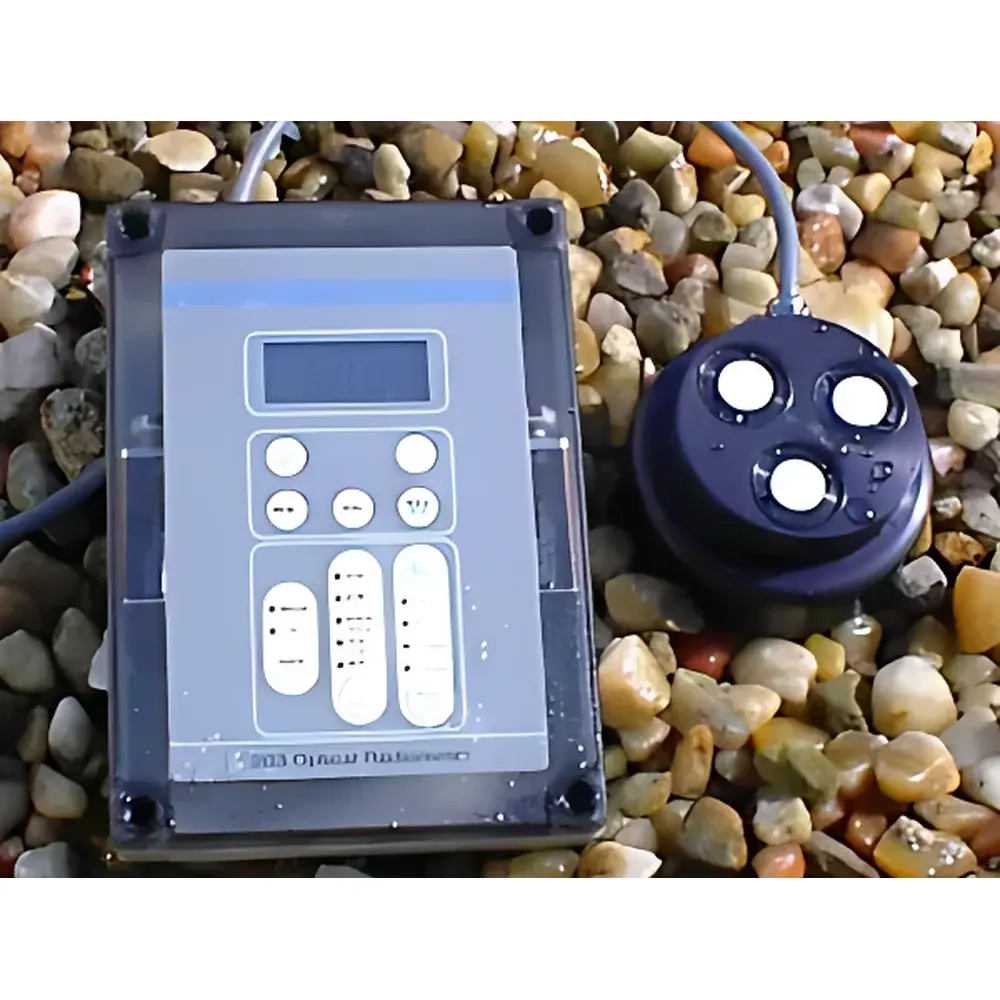
Macam UV203-3 Underwater UV Radiometer
| Brand | Macam |
|---|---|
| Origin | United Kingdom |
| Model | UV203-3 |
| Detector Configuration | Triple-channel (UVA, UVB2, RFF/Vis) |
| Submersible Depth Rating | 10 m |
| Display | 4½-digit LCD (10 mm digit height) |
| Microprocessor | 80C51-based, 3.1684 MHz clock |
| Memory | Onboard non-volatile RAM for calibration coefficients and settings |
| Gain Control | Auto/manual selectable per channel |
| Integration Time | 0.33 s |
| ADC Resolution | 17-bit |
| Accuracy | ±1 digit, linearity error < 1% |
| Cosine Response Error | ≤ ±3% (0–70° from normal incidence) |
| Operating Temperature | 0–40 °C, 80% RH |
| IP Rating | IP67 |
| Power | Two 9 V PP3 batteries (~150 h typical life, no RS232 active) |
| Interface | 3-wire RS232 (4800 baud, no parity, 1 stop bit) |
| Connectors | 8-pin circular screw-lock (detector), 5-pin (RS232), 3-pin (external power) |
| Weight | ~500 g |
| Dimensions | 180 × 130 × 60 mm |
Overview
The Macam UV203-3 Underwater UV Radiometer is a precision field-deployable instrument engineered for quantitative measurement of spectral irradiance in aquatic environments. It operates on the principle of photodiode-based radiometry, utilizing three spectrally selective, cosine-corrected detector channels—UVA (λpeak = 369 ± 2 nm, FWHM = 37 ± 2 nm), UVB2 (λpeak = 311 ± 1 nm, FWHM = 19 ± 2 nm), and RFF/Visible (400–700 nm)—to resolve biologically and photochemically relevant radiant fluxes beneath the water surface. Each detector integrates a high-stability silicon or GaAs photodiode with dedicated low-noise, high-gain transimpedance amplification and digital signal conditioning. The system employs an all-digital signal transmission architecture: analog photocurrents are converted to digital signals at the detector head, eliminating noise susceptibility over the 10 m submersible cable. This design ensures metrological integrity across variable conductivity, pressure, and temperature gradients encountered in marine, limnological, and coastal monitoring applications.
Key Features
- Fully submersible detector head rated to 10 m depth, constructed from anodized aluminum for corrosion resistance and mechanical robustness
- Triple-channel spectral separation via matched optical filter/diode assemblies, each with independent gain control and cosine correction compliant with Lambert’s cosine law (error ≤ ±3% up to 70° incidence)
- Microprocessor-controlled display unit featuring 4½-digit LCD (10 mm character height), auto-zero background subtraction, hold function, and min/max tracking during integration periods
- Onboard calculation of time-integrated irradiance (fluence) in units of mJ/m² or J/m², supporting dosimetric analysis for UV exposure studies
- 17-bit analog-to-digital conversion with 0.33 s fixed integration time, enabling stable, low-drift measurements under dynamic light conditions
- Three calibrated operating modes: standard monochromatic calibration (at peak wavelength), mercury-line calibration (aligned to Hg emission lines at 34 mm working distance), and spectral radiometric calibration traceable to NPL standards (±7.5% absolute uncertainty)
Sample Compatibility & Compliance
The UV203-3 is designed for direct immersion in natural and engineered water bodies—including seawater, freshwater lakes, aquaculture tanks, and UV disinfection reactors—without housing-induced spectral artifacts. Its detector head meets IP67 ingress protection and is compatible with ASTM E1319 (Standard Practice for Calibration of Spectroradiometers Used in Solar Radiation Measurements) and ISO 17166:2019 (Erythema reference action spectrum). While not inherently FDA 21 CFR Part 11-compliant as a standalone device, its RS232 interface supports integration into validated laboratory information management systems (LIMS) where audit trails, electronic signatures, and data integrity controls are implemented at the host software level. Calibration certificates include traceability statements to the UK’s National Physical Laboratory (NPL), satisfying GLP requirements for environmental photobiology studies.
Software & Data Management
Data acquisition is facilitated via a three-wire RS232 serial interface (4800 baud, no parity, one stop bit), enabling direct connection to PCs or data loggers. The instrument transmits ASCII-formatted irradiance values (in mW/m² or W/m²), integrated fluence (mJ/m²), and real-time min/max statistics. No proprietary driver is required; standard terminal emulation software (e.g., PuTTY, Tera Term) suffices for manual logging. For automated workflows, Macam provides documented command protocols allowing integration with Python, LabVIEW, or MATLAB scripts. All calibration coefficients—including spectral responsivity, cosine correction factors, and amplifier gain tables—are stored in non-volatile RAM and persist through battery replacement. The controller performs automatic gain selection based on signal magnitude, minimizing operator intervention while preserving resolution across six decades of dynamic range per channel.
Applications
- Marine and freshwater photobiology: quantifying UV penetration depth (Kd), assessing phytoplankton photoinhibition thresholds, and modeling UV-driven photochemical reactions (e.g., nitrate photolysis, DOM degradation)
- Aquaculture and coral reef research: monitoring UVR stress indices, validating shading structures, and correlating spectral irradiance with symbiont bleaching dynamics
- UV water treatment validation: verifying lamp output stability, mapping reactor fluence distribution, and verifying compliance with WHO/USEPA UV dose targets (e.g., 40 mJ/cm² for Cryptosporidium inactivation)
- Climate change monitoring: long-term deployment in buoy networks to track trends in surface UV transparency linked to dissolved organic carbon (DOC) and aerosol loading
- Instrument intercomparison campaigns: serving as a transfer standard in field calibrations against spectroradiometers and broadband sensors due to its NPL-traceable calibration and low angular dependence
FAQ
What is the maximum operational depth of the UV203-3 detector head?
The detector head is rated for continuous submersion to 10 meters depth under static pressure conditions. It is not rated for high-velocity flow or turbulent shear environments without supplemental mechanical protection.
Can the UV203-3 measure PAR (Photosynthetically Active Radiation)?
Yes—the RFF/Vis channel (400–700 nm) is optimized for photosynthetic photon flux density (PPFD) measurement when used with appropriate firmware scaling and calibration against a NIST-traceable PAR standard.
Is the instrument suitable for use in saltwater?
Yes. The anodized aluminum housing and sealed 8-pin circular connector meet ISO 9223 Class C5-I (very high salinity industrial) corrosion resistance requirements. Routine rinsing with deionized water after seawater exposure is recommended.
How often does the UV203-3 require recalibration?
Macam recommends annual recalibration against NPL-traceable sources. Field verification using a stable quartz-tungsten-halogen lamp with known spectral output is advised before critical deployments.
Does the display unit support external power?
Yes—an optional 3-pin circular screw-lock connector accepts regulated 9–12 V DC input, enabling extended operation during dockside data collection or integration into powered underwater observatories.







