
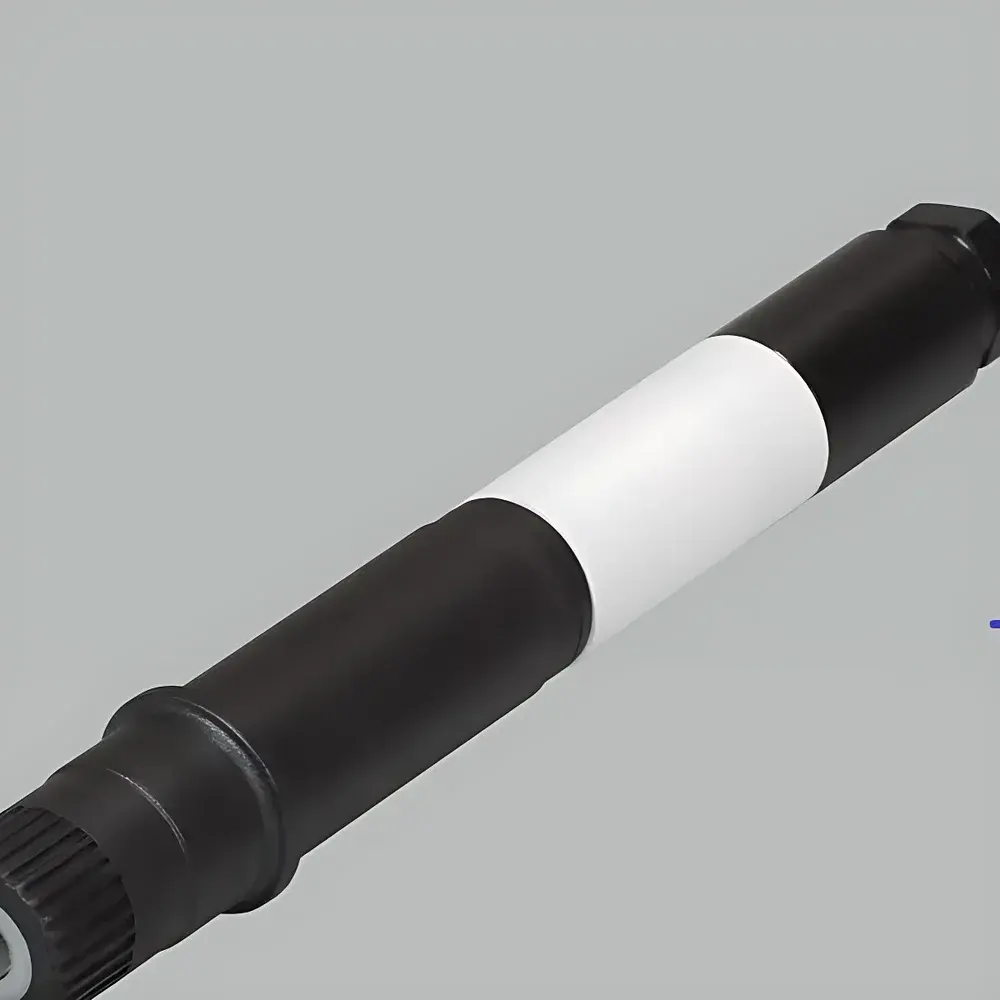
TriOS eCHEM Digital pH Sensor TpH
| Brand | TriOS |
|---|---|
| Origin | Germany |
| Model | TpH |
| Measurement Principle | Potentiometric Analysis |
| Measured Parameters | pH (0–14), Temperature (0–65 °C) |
| Accuracy | ±0.01 pH, ±0.1 °C |
| Resolution | ±0.06 pH, ±0.5 °C |
| Intrinsic Error (pH 1/7/13) | ±0.05 / ±0.05 / ±0.35 pH |
| Linearity Error | ±0.1 pH |
| Repeatability (pH 1/7/13) | ±0.1 / ±0.05 / ±0.1 pH |
| Signal Stability (pH 4/7) | ±0.05 / ±0.025 pH |
| Warm-up Time | < 5 min |
| Short-term Drift (24 h) | < 0.03 pH |
| Long-term Drift (1 week) | < 0.05 pH |
| Response Times (T10/T90/T100) | ≤2 s / ≤5 s / ~10 s |
| Temperature Compensation | Pt1000 |
| Output Interface | RS-485, Modbus RTU |
| Supply Voltage | 12–24 VDC (±10 %) |
| Power Consumption | 0.2 W |
| Housing Material | PPS / PET / NBR |
| Dimensions (L × Ø) | 180 × 27 mm |
| Weight | 110 g |
| Cable Options | 2 m, 10 m (standard) |
| IP Rating | IP68 |
| Max. Operating Pressure (free-flow) | 3 bar |
| Max. Flow Rate | 3 m/s |
| Sample Temp. Range | +2 to +40 °C |
| Ambient Temp. Range | −5 to +55 °C |
| Storage Temp. | 0 to +80 °C |
| Maintenance Interval | ≤0.5 h/month |
| Calibration Interval | 4 weeks |
| Flow Cell Compatibility | Yes (1 bar, 2–4 L/min) |
Overview
The TriOS eCHEM Digital pH Sensor TpH is a high-stability, industrial-grade potentiometric sensor engineered for continuous, real-time pH monitoring in demanding water and wastewater treatment environments. Unlike analog pH probes susceptible to signal degradation over distance or electromagnetic interference, the TpH employs digital signal transmission via RS-485 using the open Modbus RTU protocol—ensuring robust, noise-immune communication between sensor and controller (e.g., TriBox3, TriBox Mini, or HS100 DIN-rail modules). Its core sensing element features a dual-pore HDPE diaphragm combined with a polymer-based solid electrolyte gel, eliminating liquid junction drift and minimizing fouling in suspended-solids-rich matrices such as activated sludge, coagulation basins, and neutralization reactors. The integrated Pt1000 temperature sensor enables automatic, high-fidelity temperature compensation across the full operational range (0–65 °C), supporting accurate pH measurement under dynamic thermal conditions typical of biological treatment processes.
Key Features
- Digital RS-485 output with Modbus RTU protocol for deterministic, error-checked data transmission over distances up to 1,200 m without signal loss
- Robust dual-pore HDPE membrane electrode with polymer solid electrolyte—resistant to clogging, sulfide poisoning, and organic fouling in raw sewage and industrial effluents
- Fast electrochemical response: T90 ≤ 5 s at pH 7, enabling precise feedback control in rapid neutralization and dosing applications
- High intrinsic stability: short-term drift < 0.03 pH over 24 h; long-term drift < 0.05 pH per week—reducing recalibration frequency and operational overhead
- IP68-rated housing (PPS/PET/NBR composite) rated for continuous submersion and mechanical abrasion resistance in channel, pipe, or flow cell installations
- Low-power design (0.2 W) compatible with distributed 12–24 VDC power architectures common in SCADA and PLC-controlled treatment plants
- Modular cable interface (8-pin M12 connector) supports field-replaceable cables (2 m or 10 m standard; optional 0.3 m / 25 m) and simplifies maintenance logistics
Sample Compatibility & Compliance
The TpH sensor is validated for use in municipal and industrial wastewater streams, surface water, process water, and chemical dosing loops where particulate load, biofilm formation, or redox-active compounds challenge conventional glass electrodes. It meets IEC 60746-1 for electrochemical pH measurement and complies with EN ISO 10523 for routine water quality testing. When deployed with TriOS controllers supporting audit-trail logging and user-access controls, the system aligns with GLP and GMP documentation requirements for regulated facilities. Its Modbus RTU implementation supports integration into systems compliant with ISA-88 and ISA-95 automation standards. For flow-through applications, it is certified for use with TriOS-compatible flow cells operating at 1 bar pressure and 2–4 L/min flow rates—ensuring laminar, bubble-free sample presentation without pressure-induced calibration shift.
Software & Data Management
Data from the TpH is natively ingested by TriOS’ TriSoft configuration and visualization software, which provides real-time trend plotting, alarm thresholds (high/low pH, sensor fault, temperature deviation), and automated event-triggered data export (CSV, PDF). All measurements include embedded timestamps and sensor metadata (model, firmware version, serial number), satisfying traceability requirements under FDA 21 CFR Part 11 when used with TriBox3’s secure user authentication and electronic signature capabilities. Raw Modbus registers are fully documented—including pH value (scaled to 0.001 pH resolution), temperature (°C × 10), status flags (electrode impedance, temperature sensor health), and diagnostic counters (calibration cycles, warm-up events)—enabling direct integration into third-party SCADA, DCS, or cloud-based IIoT platforms via standard Modbus gateways.
Applications
- Continuous pH monitoring in primary and secondary wastewater treatment—especially in influent channels, aeration tanks, and final effluent discharge points
- Closed-loop control of acid/base dosing systems for neutralization, lime softening, and metal precipitation processes
- Real-time process optimization during coagulation-flocculation stages where pH critically influences floc formation and settling efficiency
- Regulatory compliance reporting for NPDES permits and EU Urban Wastewater Treatment Directive (91/271/EEC) discharge limits
- Monitoring of industrial process water in food & beverage, pharmaceutical, and semiconductor manufacturing where pH stability directly impacts product quality and rinse efficacy
FAQ
Does the TpH require periodic electrolyte refilling or gel replacement?
No. The sensor uses a maintenance-free polymer solid electrolyte—eliminating liquid junction replenishment and reducing scheduled maintenance to quarterly calibration only.
Can the TpH be installed directly in a pressurized pipeline?
Yes—when mounted in an approved TriOS flow cell (rated for 1 bar), or in free-flow applications up to 3 bar static pressure. Direct insertion into non-vented pressurized lines without flow conditioning is not recommended.
What is the minimum sample flow rate required for stable readings?
Stable measurement is achieved at ≥0.3 L/min in flow cells; for immersion applications, no minimum flow is required, though stagnant conditions may increase response time and risk localized boundary layer effects.
Is temperature compensation automatic and embedded in the sensor firmware?
Yes. The integrated Pt1000 sensor feeds temperature data directly to the internal microcontroller, which applies NIST-traceable pH/temperature correction algorithms before transmitting the compensated pH value via Modbus.
How does the TpH handle hydrogen sulfide (H₂S) exposure common in anaerobic digesters?
The HDPE diaphragm and solid polymer electrolyte resist sulfide penetration and silver-sulfide precipitation on the reference electrode—significantly extending service life compared to conventional Ag/AgCl reference systems.







