
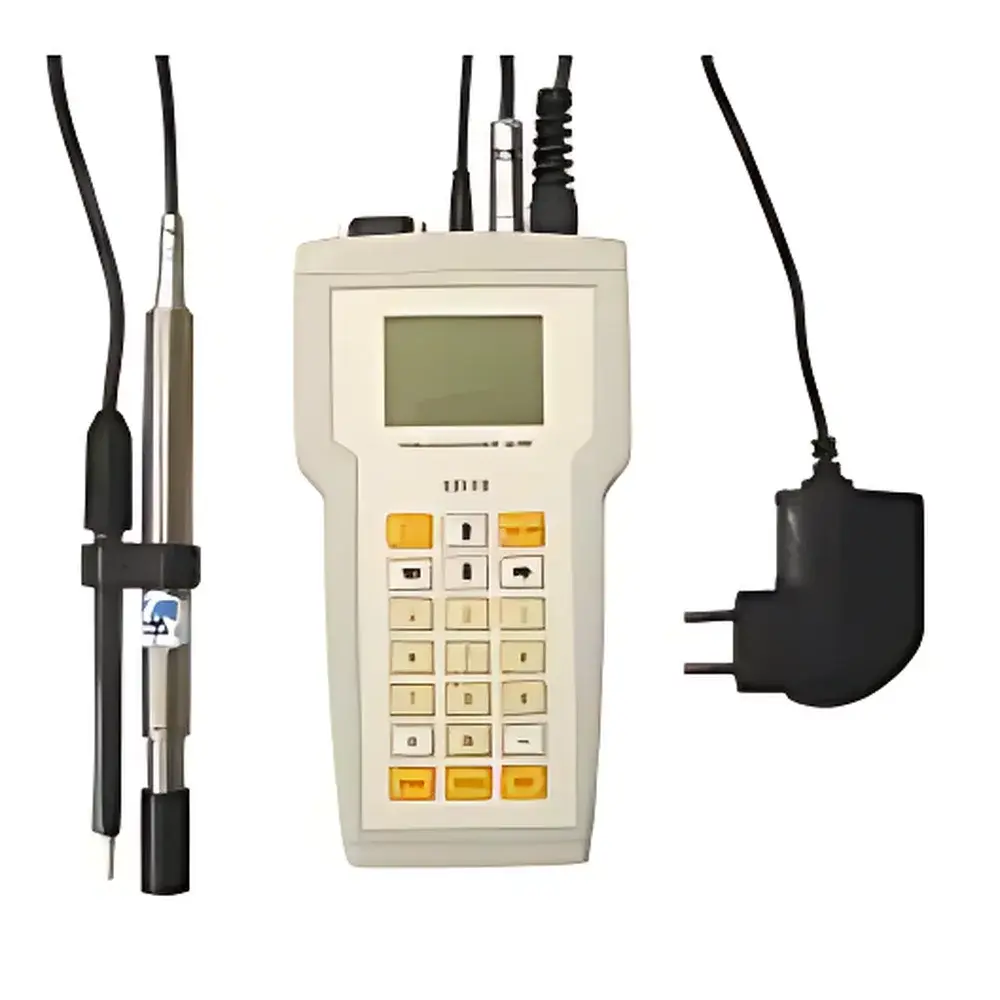
AMT Underwater Hydrogen Peroxide (H₂O₂) Sensor
| Brand | AMT |
|---|---|
| Origin | Germany |
| Model | AMT-H2O2 |
| Electrode Configuration | 3-electrode amperometric |
| Membrane Material | Silicone elastomer |
| Output Signal | 0–5 V DC proportional to partial pressure (0–400 Pa) |
| Measurement Range (Type I) | 0.02–10% w/w H₂O₂ |
| Accuracy | ±1% of full scale |
| Response Time (t₉₀) | 1–2 s |
| Operating Temperature | 0–30 °C |
| pH Range | 0–11 |
| Pressure Rating | >10 bar |
| Housing Material | Titanium |
| Typical Service Life | 5–9 months |
| Polarization Time | 5–15 min |
| Probe Replaceability | Yes |
Overview
The AMT-H2O2 is a submersible, electrochemical hydrogen peroxide sensor engineered for continuous, real-time monitoring of aqueous H₂O₂ concentrations in demanding aquatic environments—including freshwater systems, wastewater treatment processes, ballast water disinfection units, and marine research platforms. It operates on the principle of amperometric detection via a three-electrode system housed within a sealed, silicone-membrane-encapsulated sensing chamber. The silicone membrane selectively permits dissolved H₂O₂ molecules to diffuse into the electrolyte-filled detection cell while excluding water, particulates, and hydrostatic pressure fluctuations. This establishes a stable diffusion gradient directly proportional to the partial pressure of H₂O₂ in the surrounding medium. The resulting Faradaic current—generated by the electrochemical reduction of H₂O₂ at the working electrode—is linearly converted to a 0–5 V DC analog output, traceable to a calibrated partial pressure range of 0–400 Pa.
Key Features
- Submersible titanium housing rated for operation up to 100 m depth (system-dependent configuration), with corrosion-resistant integrity in saline, acidic, and alkaline media.
- Silicone membrane-based gas-permeable barrier ensures mechanical stability under variable hydrostatic pressure (>10 bar) and eliminates flow-rate dependency in low-turbulence deployments.
- Three-electrode amperometric architecture (working, counter, reference) enables stable polarization and minimizes drift during extended unattended operation.
- Rapid response kinetics: t₉₀ ≤ 2 seconds—critical for dynamic process control and transient event detection in oxidation-based treatment systems.
- Wide operational pH tolerance (0–11) and temperature range (0–30 °C) support deployment across diverse environmental matrices without external conditioning.
- Modular probe design allows field-replacement of the sensing element, reducing total cost of ownership and minimizing instrument downtime.
Sample Compatibility & Compliance
The AMT-H2O2 sensor is validated for direct immersion in natural waters, effluents, and process streams containing suspended solids, organic load, and variable ionic strength. Its silicone membrane exhibits low interference from common oxidants (e.g., Cl₂, O₃, NO₂⁻) and negligible cross-sensitivity to dissolved oxygen when operated within specified polarization voltage windows. The sensor complies with ISO 5814:2012 (Water quality — Determination of dissolved oxygen — Electrochemical probe method) for analogous amperometric principles, and its construction adheres to EN 61000-6-2/6-4 for electromagnetic compatibility in industrial settings. While not certified for regulatory compliance reporting per se, it is routinely deployed in GLP-aligned monitoring programs where traceable calibration and documented maintenance logs are maintained.
Software & Data Management
The AMT-H2O2 integrates seamlessly with standard data acquisition platforms via its 0–5 V analog output. For OEM or networked deployments, optional digital interfaces (RS-485 Modbus RTU or SDI-12) are available upon request. Lab-grade configurations include an integrated electronics module with built-in Pt100 temperature compensation and real-time linearization firmware. All variants support time-stamped output synchronized with auxiliary sensors (e.g., CTD, pH, conductivity). Data logging systems utilizing this sensor are commonly configured to meet FDA 21 CFR Part 11 requirements when paired with audit-trail-enabled software and user-access controls—particularly in pharmaceutical water system validation and sterilant residue verification workflows.
Applications
- Real-time monitoring of H₂O₂ residuals in advanced oxidation process (AOP) reactors and UV/H₂O₂ disinfection systems.
- Verification of peroxide-based biofouling control in seawater-cooled heat exchangers and membrane pre-treatment circuits.
- Environmental assessment of H₂O₂ release from sediment remediation zones or in situ chemical oxidation (ISCO) sites.
- Calibration transfer and field validation of laboratory spectrophotometric methods (e.g., titanium sulfate or potassium iodide assays).
- Integration into autonomous underwater vehicles (AUVs) and moored observatories for high-resolution spatial mapping of oxidative stress indicators in coastal ecosystems.
FAQ
What calibration standards are recommended for field verification?
Primary calibration is performed using gravimetrically prepared H₂O₂ standards in deionized water buffered to pH 7.0. Secondary field checks may employ certified reference materials traceable to NIST SRM 3112a.
Is temperature compensation automatic?
Yes—the integrated Pt100 sensor provides continuous thermal feedback, and the electronics module applies polynomial-based compensation per ISO/IEC 17025-compliant algorithms.
Can the sensor be used in aerated or turbulent water?
The silicone membrane design renders it insensitive to flow velocity; however, consistent exposure to air bubbles may cause transient signal noise—recommended installation includes downward-facing orientation or use of anti-fouling shrouds.
How often does the probe require recalibration?
Initial calibration is required before first use; subsequent recalibration intervals depend on application severity but typically range from 7–30 days under continuous operation in wastewater, or up to 90 days in clean-water research applications.
Does the sensor comply with explosion-proof or ATEX requirements?
No—the AMT-H2O2 is not intrinsically safe or ATEX-certified; it is intended for non-hazardous area deployment only.
Related Products







