
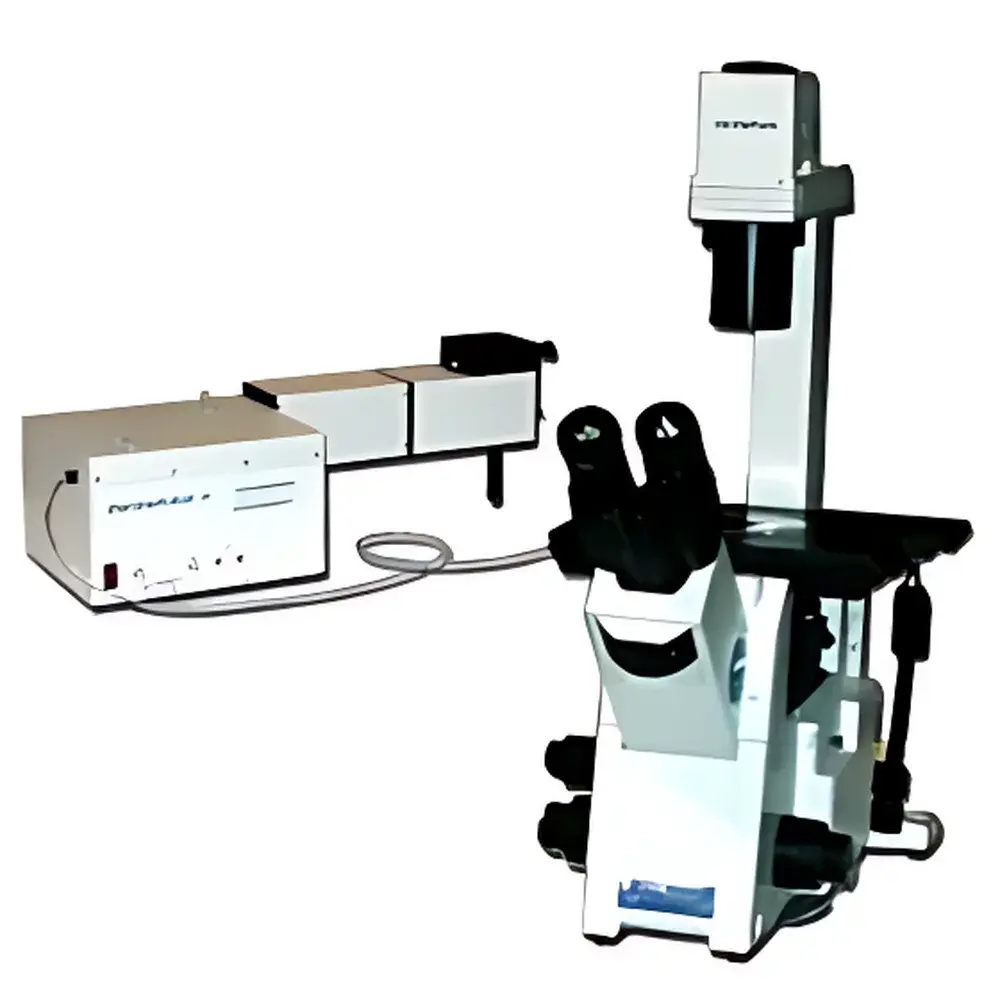
DeltaRAM™ X High-Speed Random-Access Monochromator Illuminator for Quantitative Fluorescence Microscopy
| Brand | HORIBA |
|---|---|
| Origin | USA |
| Manufacturer Type | Authorized Distributor |
| Origin Category | Imported |
| Model | DeltaRAM™ X |
| Light Source Type | High-Intensity Xenon Arc Lamp |
| Illumination Mode | Internal (Epi/Illuminator-Coupled) |
| Excitation Wavelength Range | 250–650 nm |
| Wavelength Switching Speed | < 2 ms |
| Beam Uniformity | < 5% |
| Stray-Light Rejection | 10⁻⁴ |
| Wavelength Accuracy | ±1 nm |
| Optical Output | 15 mW (in 10 nm bandwidth) |
| Bandwidth Adjustment | 0–24 nm (manually adjustable slit) |
| Coupling | 2 m Liquid Light Guide included |
Overview
The DeltaRAM™ X is a high-performance, self-contained monochromator-based illuminator engineered for quantitative ratiometric fluorescence microscopy—particularly in live-cell ion imaging and kinetic photometry applications. Unlike conventional filter-wheel or LED-based excitation systems, the DeltaRAM™ X employs a galvanometer-driven random-access scanning monochromator to deliver precise, millisecond-scale wavelength selection across a broad UV–visible range (250–650 nm). Its core architecture is rooted in the principles of dispersive spectroscopy: broadband light from a stabilized 75 W xenon arc lamp is collimated and focused onto a diffraction grating; the galvanometer-mounted mirror rapidly directs selected wavelengths through an adjustable exit slit onto the sample via a liquid light guide. This design enables true analog control of excitation position and bandwidth—critical for minimizing phototoxicity, avoiding spectral crosstalk in dual-excitation dyes (e.g., Fura-2, BCECF, SBFI), and supporting time-resolved FRET or spectral scanning protocols. Developed by Photon Technology International (PTI), now part of HORIBA Scientific, the DeltaRAM™ X has been validated in hundreds of peer-reviewed studies and serves as the illumination engine for PTI’s EasyRatioPro and RatioMaster™ platforms.
Key Features
- Sub-2-millisecond wavelength switching between any two excitation bands—enabling high-temporal-resolution ratio imaging without mechanical latency or vibration-induced image drift.
- Patented PowerArc™ xenon lamp housing with on-axis ellipsoidal reflector, achieving ~70% radiant energy collection efficiency—5–6× higher than standard Köhler-coupled illuminators—resulting in superior signal-to-noise for low-light applications.
- Continuously adjustable spectral bandwidth (0–24 nm, manual slit control), allowing empirical optimization of throughput versus photobleaching and channel separation fidelity in ratiometric experiments.
- Analog voltage-controlled wavelength positioning (−4.87 V to +4.87 V = 650 nm to 250 nm), linear and deterministic, compatible with real-time feedback loops in closed-loop acquisition systems.
- Integrated TTL-controlled solenoid shutter with BNC interface, synchronized to external triggers for precise exposure gating.
- Modular DAC interface support—including 16-bit PCI and USB options (NI- or Measurement Computing–based)—ensuring compatibility with LabVIEW, MetaMorph, Micro-Manager, Nikon Elements, and custom acquisition software.
Sample Compatibility & Compliance
The DeltaRAM™ X is designed for integration into standard epifluorescence and transmitted-light microscopes via optional port-specific adapters (e.g., Nikon C-mount, Zeiss AV, Olympus U-IL, Leica DMI series). Its high-brightness, low-stray-light output supports demanding applications including intracellular Ca²⁺, Na⁺, H⁺, Cl⁻, and Mg²⁺ imaging using ratiometric dyes, as well as lifetime-resolved FRET and action potential sensing with voltage-sensitive dyes. The system meets optical safety standards per IEC 62471 (Photobiological Safety of Lamps) and complies with electromagnetic compatibility requirements per FCC Part 15 Class B and CE directives. While not inherently 21 CFR Part 11–compliant, its deterministic analog control architecture and audit-ready DAC logging (when paired with validated LabVIEW or PTI software) facilitate GLP/GMP-aligned experimental documentation workflows.
Software & Data Management
The DeltaRAM™ X operates via external digital-to-analog control, requiring no embedded firmware or proprietary OS. All OBB-supplied DAC interfaces ship with LabVIEW drivers and a minimal Windows-compatible control utility (XP/2000+) for manual wavelength stepping and shutter actuation. For production environments, integration with commercial platforms—including Molecular Devices MetaFluor, Nikon Elements, and National Instruments LabVIEW—is achieved through documented BNC-level voltage and TTL signaling. Acquisition synchronization is supported via hardware trigger lines (TTL In/Out), enabling lock-step coordination with camera exposure, PMT sampling, or electrophysiology hardware. Raw wavelength-position data (V → nm mapping) and shutter state logs can be timestamped and exported in CSV or TDMS format—essential for retrospective analysis and regulatory traceability in preclinical assay development.
Applications
- Real-time quantification of cytosolic Ca²⁺ dynamics using Fura-2 (340/380 nm excitation) with Rmax/Rmin > 40—enabled by high-intensity, low-crosstalk excitation.
- pH mapping in organelles or subcellular compartments using BCECF (440/490 nm) under physiological perfusion conditions.
- Na⁺ flux assays with SBFI in neurons, cardiomyocytes, or epithelial monolayers requiring rapid dual-wavelength alternation.
- Förster resonance energy transfer (FRET) monitoring with CFP/YFP or mTurquoise2/sYFP2 pairs, where precise donor/acceptor excitation tuning minimizes bleed-through artifacts.
- Excitation spectral scanning for characterization of novel fluorophores or validation of multiplexed probe panels.
- Combined optogenetics–fluorescence experiments, where the DeltaRAM™ X provides spectrally defined excitation while leaving visible channels free for stimulation light delivery.
FAQ
What is the minimum dwell time required between wavelength switches?
The DeltaRAM™ X achieves full wavelength repositioning in less than 2 ms; however, stable intensity settling typically occurs within 3–5 ms depending on lamp stability and thermal equilibrium. For optimal ratiometric precision, ≥5 ms inter-frame intervals are recommended.
Can the DeltaRAM™ X be used with confocal or spinning-disk systems?
Yes—when coupled via the liquid light guide to a fiber-coupled port or side-port adapter, it functions as a flexible excitation source for point-scanning confocals and Nipkow disk systems, provided the system accepts external TTL-triggered illumination control.
Is cooling required for the PowerArc™ lamp housing?
No. The PowerArc™ housing is air-cooled and vent-free, eliminating acoustic noise and thermal drift associated with forced-air or water-cooled lamp systems.
How is wavelength calibration maintained over time?
The galvanometer-based monochromator exhibits long-term positional stability. A one-time factory calibration (±1 nm accuracy) is retained unless subjected to mechanical shock; users may verify alignment using a mercury-argon emission lamp or certified reference filters.
Does the DeltaRAM™ X support automated bandwidth sweeps?
While the bandwidth is manually set via micrometer-adjustable slits, sequential wavelength sweeps (e.g., 260–650 nm at 1 nm steps) are fully supported via software-controlled voltage ramping—enabling acquisition of excitation spectra without hardware modification.




